
Contents
Overview
Receptor proteins are the sophisticated molecular machines embedded within or on the surface of cells that detect and respond to specific chemical signals. These proteins act as crucial intermediaries, binding to signaling molecules like hormones, neurotransmitters, or even light, and initiating a cascade of events within the cell. This binding event triggers a conformational change in the receptor, which in turn alters cellular activity, influencing everything from gene expression and metabolic rates to muscle contraction and nerve impulse transmission. Without receptors, cells would be deaf to their environment, unable to coordinate complex biological processes or adapt to changing conditions. Their diverse structures and functions underpin virtually all physiological processes, making them central targets for drug development and fundamental to understanding life itself.
🎵 Origins & History
The concept of cellular communication, and by extension, the role of receptors, traces its roots back to the late 19th and early 20th centuries with the burgeoning fields of physiology and pharmacology. Early observations hinted at specific cellular sites of action, a notion that was termed 'receptive substances.' By the mid-20th century, groundbreaking work by Paul Ehrlich on 'chemotherapy' and the idea of 'magic bullets' further solidified the understanding that specific molecules could target specific cellular components. The Nobel Prize in Physiology or Medicine awarded to Robert Lefkowitz and Brian Kobilka for their work on G protein-coupled receptors (GPCRs) underscored the profound importance of these molecules in biological systems.
⚙️ How It Works
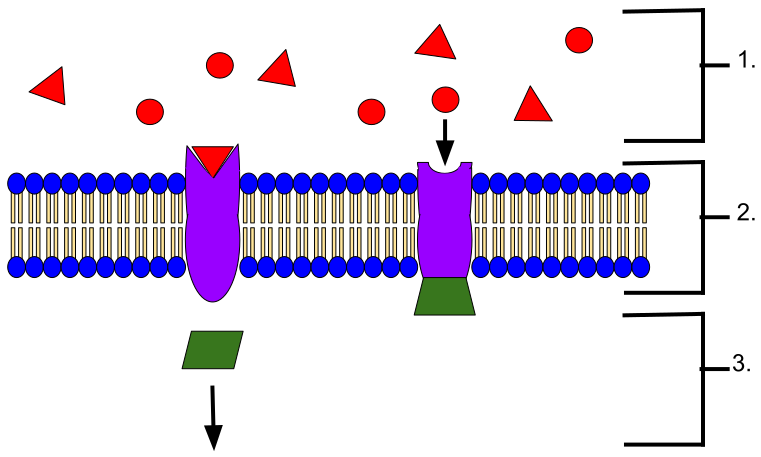
Receptor proteins function by a lock-and-key mechanism, where a specific signaling molecule, known as a ligand, binds to a complementary binding site on the receptor. This binding event induces a conformational change in the receptor protein, altering its three-dimensional structure. This change can directly affect cellular machinery, as seen in ligand-gated ion channels where binding opens a pore for ions to pass through. Alternatively, the conformational change can activate intracellular signaling pathways, such as those involving G proteins in GPCRs, or trigger enzymatic activity, as with receptor tyrosine kinases. These downstream effects can lead to a wide array of cellular responses, including changes in gene expression, cell growth, or the release of other signaling molecules. The specificity of ligand binding ensures that cells respond only to relevant signals, preventing cellular chaos.
📊 Key Facts & Numbers
The human genome encodes a vast number of receptor types. Cell surface receptors constitute a significant portion of the human proteome, with many different types identified. Intracellular receptors, though fewer in number, regulate critical processes like gene transcription and are involved in steroid hormone signaling.
👥 Key People & Organizations
Key figures in receptor research include Paul Ehrlich, a pioneer in chemotherapy, who laid theoretical groundwork for specific molecular targeting. More recently, Robert Lefkowitz and Brian Kobilka revolutionized our understanding of GPCRs. Major research institutions like the Howard Hughes Medical Institute and pharmaceutical giants such as Pfizer and Novartis are heavily invested in receptor biology, driving both fundamental discovery and therapeutic innovation.
🌍 Cultural Impact & Influence
Receptor proteins are not merely biological curiosities; they are woven into the fabric of human culture and experience. The development of drugs targeting specific receptors has transformed medicine, from beta-blockers for heart conditions to antihistamines for allergies. The very way we perceive the world—sight, smell, taste, touch—is mediated by specialized receptor proteins. The discovery of dopamine receptors and their role in reward pathways has profoundly influenced our understanding of addiction and pleasure, impacting fields from neuroscience to psychology and even popular culture's portrayal of the brain. The ability to manipulate receptor function has also fueled advancements in biotechnology and synthetic biology.
⚡ Current State & Latest Developments
Current research is intensely focused on elucidating the complex signaling networks downstream of receptor activation, particularly for GPCRs, which are notoriously difficult to crystallize. Advances in cryo-electron microscopy (cryo-EM) have enabled researchers to visualize GPCRs in unprecedented detail, revealing their dynamic structures and mechanisms of activation. The development of allosteric modulators, which bind to a site distinct from the ligand-binding pocket to fine-tune receptor activity, represents a significant frontier in drug discovery. Furthermore, the exploration of novel receptor types, such as those involved in mechanotransduction (sensing physical forces), is opening new avenues for therapeutic intervention in conditions like chronic pain.
🤔 Controversies & Debates
A significant debate revolves around the concept of 'biased agonism' in GPCR signaling. While a traditional agonist activates all downstream pathways associated with a receptor, biased agonists selectively activate only a subset of these pathways. This offers the potential for more targeted therapies with fewer side effects, but it also raises questions about the long-term consequences of partially activating or inhibiting complex signaling networks. Another area of contention is the precise role and therapeutic potential of targeting intracellular receptors for diseases beyond hormonal imbalances, with ongoing debate about their druggability and specificity.
🔮 Future Outlook & Predictions
The future of receptor protein research is poised for significant breakthroughs. We can anticipate the development of highly selective drugs that target specific receptor subtypes or even specific signaling pathways, minimizing off-target effects and maximizing therapeutic efficacy. The integration of artificial intelligence and machine learning is accelerating the discovery of novel receptor ligands and the prediction of their binding affinities and functional outcomes. Furthermore, the engineering of synthetic receptors for applications in gene therapy and biosensing is a rapidly growing field, promising novel diagnostic and therapeutic tools. The potential for personalized medicine, tailoring drug treatments based on an individual's specific receptor profiles, is immense.
💡 Practical Applications
Receptor proteins are the workhorses behind numerous practical applications. In medicine, they are the primary targets for over half of all pharmaceuticals, including treatments for hypertension (e.g., angiotensin II receptor blockers), depression (e.g., serotonin reuptake inhibitors), and asthma (e.g., beta-2 adrenergic agonists). In diagnostics, receptor-based assays are used to detect disease markers and measure hormone levels. In biotechnology, engineered receptors are employed in synthetic biology for creating novel cellular functions and in immunotherapy (e.g., CAR T-cell therapy) to direct immune cells against cancer. Even in agriculture, understanding plant hormone receptors is crucial for crop development.
Key Facts
- Category
- science
- Type
- topic