
Contents
- 🎯 Introduction to Reaction Kinetics
- ⚙️ Experimental Methods and Techniques
- 📊 Mathematical Modeling and Simulation
- 👥 Key Researchers and Institutions
- 🌍 Applications and Industrial Significance
- ⚡ Current Research and Developments
- 🤔 Challenges and Controversies
- 🔮 Future Directions and Emerging Trends
- 💡 Practical Applications and Case Studies
- 📚 Related Topics and Further Reading
- Frequently Asked Questions
- References
- Related Topics
Overview
Reaction kinetics, a branch of physical chemistry, delves into the rates and mechanisms of chemical reactions, providing crucial insights into the underlying processes that govern these transformations. By examining how experimental conditions, such as temperature, pressure, and concentration, influence reaction rates, scientists can elucidate the intricate dance of molecules and develop mathematical models to predict and describe reaction characteristics. With applications spanning fields like catalysis, materials science, and pharmaceutical development, understanding reaction kinetics is essential for optimizing processes, improving yields, and designing more efficient systems. Key figures like Marie Curie and Linus Pauling have contributed significantly to the field, while institutions like the University of Cambridge and Caltech continue to advance research in reaction kinetics. As of 2024, the field remains vibrant, with ongoing studies exploring the kinetics of complex reactions, such as those involving nanoparticles and biological systems.
🎯 Introduction to Reaction Kinetics
Reaction kinetics, as a field, has its roots in the early 20th century, with pioneers like Svante Arrhenius and Irving Langmuir laying the groundwork for modern understanding. The development of transition state theory by Henry Eyring and Michael Polanyi further solidified the foundation of reaction kinetics. Today, researchers at institutions like Stanford University and MIT continue to push the boundaries of knowledge, exploring topics like catalysis and reaction dynamics.
⚙️ Experimental Methods and Techniques
Experimental methods, such as spectroscopy and chromatography, play a crucial role in investigating reaction kinetics. By analyzing the rates of reaction and the yields of products, scientists can gain insights into the underlying mechanisms and develop mathematical models to describe the reactions. Software packages like Matlab and Python are commonly used for data analysis and simulation, while instruments like mass spectrometers and NMR spectrometers provide valuable data on reaction kinetics.
📊 Mathematical Modeling and Simulation
Mathematical modeling is a cornerstone of reaction kinetics, allowing researchers to predict and describe reaction characteristics. The Arrhenius equation, for example, relates the rate constant of a reaction to the temperature and activation energy. Other models, such as Michaelis-Menten kinetics, describe the kinetics of enzyme-catalyzed reactions. Researchers like Manfred Eigen and George Hammond have made significant contributions to the development of these models, which are now widely used in fields like pharmaceutical development and biotechnology.
👥 Key Researchers and Institutions
Key researchers and institutions have driven the advancement of reaction kinetics. Nobel laureates like Roger Tsien and Martin Chalfie have made groundbreaking contributions to the field, while institutions like the University of Oxford and Harvard University have established themselves as hubs for reaction kinetics research. Collaborations between academia and industry, such as those between universities and pharmaceutical companies, have also accelerated progress in the field.
🌍 Applications and Industrial Significance
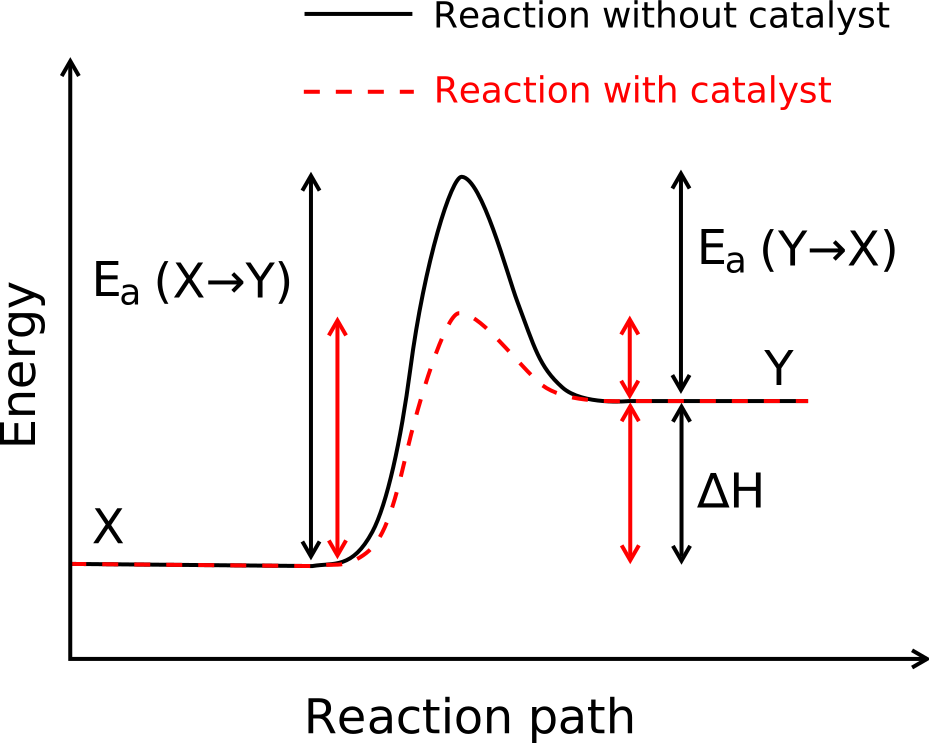
The applications of reaction kinetics are diverse and far-reaching, with significant impacts on fields like catalysis, materials science, and pharmaceutical development. By optimizing reaction conditions and designing more efficient catalysts, scientists can improve yields, reduce waste, and develop more sustainable processes. Companies like BASF and Dow Chemical have already benefited from advances in reaction kinetics, and ongoing research is expected to lead to even more innovative solutions.
⚡ Current Research and Developments
Current research in reaction kinetics is focused on exploring the kinetics of complex reactions, such as those involving nanoparticles and biological systems. The development of new experimental techniques, such as single-molecule spectroscopy, is also enabling researchers to study reaction kinetics at the molecular level. As of 2024, the field remains vibrant, with ongoing studies exploring the kinetics of photochemical reactions and electrochemical reactions.
🤔 Challenges and Controversies
Despite the significant progress made in reaction kinetics, challenges and controversies remain. One of the major challenges is the development of accurate mathematical models that can describe complex reaction systems. Another controversy is the interpretation of experimental data, which can be influenced by various factors, such as instrumental errors and sampling bias. Researchers like David Bender and John Ross have addressed these challenges, but ongoing debate and discussion are necessary to advance the field.
🔮 Future Directions and Emerging Trends
Future directions in reaction kinetics are expected to involve the development of new experimental techniques and mathematical models. The integration of artificial intelligence and machine learning into reaction kinetics research is also expected to accelerate progress in the field. As researchers like George Whitesides and Fraser Stoddart continue to push the boundaries of knowledge, the field of reaction kinetics is poised to have a significant impact on various industries and fields of research.
💡 Practical Applications and Case Studies
Practical applications of reaction kinetics are numerous, with significant impacts on fields like pharmaceutical development, biotechnology, and materials science. By optimizing reaction conditions and designing more efficient catalysts, scientists can improve yields, reduce waste, and develop more sustainable processes. Companies like Pfizer and Novartis have already benefited from advances in reaction kinetics, and ongoing research is expected to lead to even more innovative solutions.
Key Facts
- Year
- 2024
- Origin
- Physical chemistry
- Category
- science
- Type
- concept
Frequently Asked Questions
What is reaction kinetics?
Reaction kinetics is the study of the rates and mechanisms of chemical reactions. It involves the investigation of how experimental conditions influence the speed of a reaction and the development of mathematical models to describe the reaction characteristics. Researchers like Svante Arrhenius and Linus Pauling have made significant contributions to the field, which has applications in pharmaceutical development, biotechnology, and materials science.
What are the key concepts in reaction kinetics?
Key concepts in reaction kinetics include reaction rates, mathematical modeling, and experimental techniques. The Arrhenius equation and Michaelis-Menten kinetics are important mathematical models used to describe reaction characteristics. Researchers like Manfred Eigen and George Hammond have developed these models, which are essential for understanding the behavior of molecules and the kinetics of chemical reactions.
What are the applications of reaction kinetics?
The applications of reaction kinetics are diverse and far-reaching, with significant impacts on fields like catalysis, materials science, and pharmaceutical development. By optimizing reaction conditions and designing more efficient catalysts, scientists can improve yields, reduce waste, and develop more sustainable processes. Companies like BASF and Dow Chemical have already benefited from advances in reaction kinetics, and ongoing research is expected to lead to even more innovative solutions.
What are the challenges in reaction kinetics?
Despite the significant progress made in reaction kinetics, challenges remain. One of the major challenges is the development of accurate mathematical models that can describe complex reaction systems. Another challenge is the interpretation of experimental data, which can be influenced by various factors, such as instrumental errors and sampling bias. Researchers like David Bender and John Ross have addressed these challenges, but ongoing debate and discussion are necessary to advance the field.
What is the future of reaction kinetics?
Future directions in reaction kinetics are expected to involve the development of new experimental techniques and mathematical models. The integration of artificial intelligence and machine learning into reaction kinetics research is also expected to accelerate progress in the field. As researchers like George Whitesides and Fraser Stoddart continue to push the boundaries of knowledge, the field of reaction kinetics is poised to have a significant impact on various industries and fields of research.
How does reaction kinetics relate to other fields?
Reaction kinetics is closely related to other fields, such as chemical thermodynamics and quantum mechanics. Researchers like Linus Pauling and Robert Mulliken have made significant contributions to these fields, which are essential for understanding the behavior of molecules and the kinetics of chemical reactions. Further reading on these topics can provide a deeper understanding of the complex processes involved in reaction kinetics.
What are the key tools and techniques used in reaction kinetics?
Key tools and techniques used in reaction kinetics include spectroscopy, chromatography, and mathematical modeling. Software packages like Matlab and Python are commonly used for data analysis and simulation, while instruments like mass spectrometers and NMR spectrometers provide valuable data on reaction kinetics.
How does reaction kinetics impact industry?
Reaction kinetics has a significant impact on various industries, including pharmaceutical development, biotechnology, and materials science. By optimizing reaction conditions and designing more efficient catalysts, scientists can improve yields, reduce waste, and develop more sustainable processes. Companies like Pfizer and Novartis have already benefited from advances in reaction kinetics, and ongoing research is expected to lead to even more innovative solutions.