
Contents
Overview
The concept of 'PTFE-free' emerged not from a single inventor but as a reaction to the widespread use and eventual scrutiny of PTFE itself. Discovered accidentally in 1938 by Roy J. Plunkett at DuPont (now Chemours), PTFE, marketed as Teflon, revolutionized cookware and industrial applications with its unparalleled non-stick and low-friction properties. For decades, its inertness was seen as a pure benefit. However, as scientific understanding of PFAS – the chemical family PTFE belongs to – deepened, concerns about their environmental persistence and potential health impacts grew. Early criticisms focused on manufacturing emissions, particularly from plants like the one in Washington, West Virginia. The 'PTFE-free' movement gained significant traction in the late 2010s and early 2020s, fueled by investigative journalism and public health advocacy groups highlighting the risks associated with PFAS contamination, including in products that directly contact food.
⚙️ How It Works
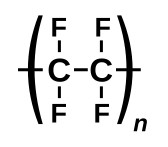
PTFE is a synthetic fluoropolymer, meaning it's a long chain of repeating units made of carbon and fluorine atoms. The carbon-fluorine bond is exceptionally strong, making PTFE highly resistant to heat, chemicals, and degradation. This is precisely why it's so effective as a non-stick coating on cookware and as a barrier in industrial applications handling corrosive substances. However, this same chemical stability means that when PTFE products break down – through scratching, overheating, or disposal – they release PFAS into the environment, which do not readily biodegrade. The 'PTFE-free' movement advocates for materials that do not contain these persistent chemicals, seeking alternatives that offer similar functionality without the long-term environmental and health liabilities.
📊 Key Facts & Numbers
The market for PFAS-containing products is vast, with global sales of fluoropolymers like PTFE estimated to be in the billions of dollars annually. The global PTFE market is projected to grow. Conversely, the demand for PTFE-free alternatives is rapidly increasing, with the global non-stick cookware market (excluding PTFE) seeing significant growth. For instance, ceramic and cast-iron cookware sales have surged as consumers actively seek PTFE-free options. Studies have detected PFAS, including breakdown products of PTFE, in over 99% of tested human blood samples in the United States, indicating widespread exposure. The EPA has proposed regulations to limit PFAS in drinking water to parts per trillion levels, underscoring the scale of the contamination issue.
👥 Key People & Organizations
Key figures and organizations driving the 'PTFE-free' movement include environmental health advocates, investigative journalists, and increasingly, conscious consumer brands. EWG has been a prominent voice, publishing research and consumer guides on PFAS risks. Journalists like Sharon Lerner at The Intercept have conducted extensive investigations into the health and environmental impacts of PFAS, including those from PTFE manufacturing. Brands such as Our Place and Caraway Home have built their market presence by explicitly marketing PTFE-free cookware, positioning themselves as healthier alternatives. Regulatory bodies like the EPA and the ECHA are also central, as their proposed and enacted regulations directly influence industry practices and consumer choices regarding PFAS.
🌍 Cultural Impact & Influence
The 'PTFE-free' movement has significantly altered consumer perception and purchasing habits, particularly in the kitchenware sector. What was once a ubiquitous material in non-stick pans is now often viewed with suspicion, leading to a surge in demand for alternatives like ceramic-coated pans, enameled cast iron, and stainless steel cookware. This shift has also influenced marketing strategies, with 'PTFE-free' becoming a prominent selling point for many brands. Beyond cookware, the movement is raising awareness about PFAS in other consumer goods, including waterproof textiles, food packaging, and cosmetics, prompting broader discussions about chemical safety and corporate responsibility in the consumer goods industry. The cultural impact is a growing consumer consciousness regarding the hidden chemicals in everyday products.
⚡ Current State & Latest Developments
As of 2024, the 'PTFE-free' movement is gaining momentum globally. Several countries and regions are implementing stricter regulations on PFAS, including bans on certain types of these chemicals in specific applications like food packaging and firefighting foam. Major cookware brands are increasingly offering PTFE-free lines or transitioning their entire product ranges. Research into novel, PFAS-free materials with comparable performance to PTFE is accelerating, with advancements in silicone-based coatings and advanced ceramic materials. Consumer demand continues to be a powerful driver, with online platforms and social media amplifying awareness and facilitating the spread of information about PTFE-free options.
🤔 Controversies & Debates
The primary controversy surrounding PTFE centers on its classification as a PFAS and the associated health and environmental risks. Critics argue that while PTFE itself is relatively inert, its manufacturing process can release harmful precursors, and the product can degrade over time into persistent, bioaccumulative compounds. Proponents, particularly Chemours (the primary manufacturer of Teflon), maintain that PTFE is safe for its intended use, citing decades of regulatory approval and scientific studies. They emphasize that PTFE is distinct from other, more mobile PFAS like PFOA and PFOS, which have been largely phased out. However, the scientific consensus is increasingly leaning towards a broader concern for all PFAS due to their persistence, leading to debates about whether any PTFE-containing product can truly be considered 'safe' in the long term.
🔮 Future Outlook & Predictions
The future of PTFE-free products appears robust, driven by regulatory pressure and consumer demand for safer alternatives. We can expect to see continued innovation in non-stick and chemical-resistant materials that are entirely free of PFAS. Regulatory bodies worldwide are likely to implement broader restrictions on PFAS, potentially impacting the production and use of PTFE. This could lead to a significant market shift, with companies that fail to adapt facing obsolescence. The challenge lies in developing alternatives that match PTFE's performance and cost-effectiveness across all its applications, from high-end cookware to specialized industrial uses in aerospace and semiconductor manufacturing. The ultimate goal for many in the movement is a complete phase-out of PFAS in consumer products.
💡 Practical Applications
The most prominent application of PTFE is in cookware, particularly non-stick frying pans and bakeware. However, the 'PTFE-free' movement extends to other areas. In textiles, it's used in waterproof and breathable fabrics, though alternatives like Gore-Tex (which historically used expanded PTFE but is now exploring PFAS-free options) are being scrutinized. Industrial applications include seals, gaskets, and linings for chemical processing equipment, where its inertness is crucial. PTFE is also found in some medical devices, electrical insulation, and even as a lubricant additive. The search for PTFE-free alternatives is therefore impacting a wide range of industries, pushing for innovation in materials science to replace its unique properties.
Key Facts
- Category
- movements
- Type
- topic