
Contents
Overview
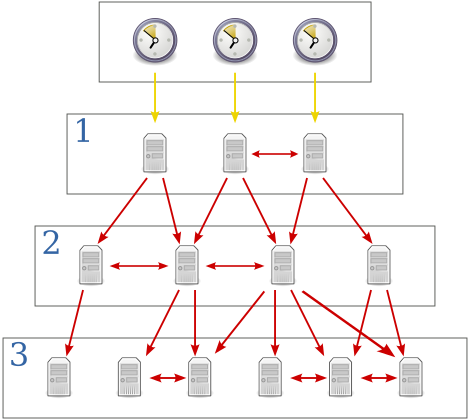
The genesis of network protocol support lies in the early days of computing, where isolated networks like ARPANET grappled with the challenge of inter-network communication. The foundational work on packet switching by figures like Paul Baran and Donald Davies in the 1960s laid the groundwork for protocols that could route data efficiently. The development of the TCP/IP protocol suite by Vint Cerf and Bob Kahn in the 1970s, was a watershed moment, establishing a universal language for network communication. This suite, comprising Transmission Control Protocol (TCP) and Internet Protocol (IP), enabled the interconnection of diverse networks, paving the way for the modern internet. Early support for protocols like NTP (Network Time Protocol), designed by David L. Mills in the early 1980s, also demonstrated the growing need for standardized communication beyond mere data transfer, focusing on essential services like time synchronization.
⚙️ How It Works
At its core, network protocol support means a system can correctly interpret and generate messages according to a defined protocol's syntax, semantics, and timing. For instance, when a web browser requests a webpage, it uses HTTP to formulate a request, which is then encapsulated by TCP/IP for reliable delivery. The operating system's network stack, implementing these protocols, handles the segmentation, addressing, routing, and reassembly of data packets. Support for a protocol implies the presence of the necessary software (drivers, libraries, applications) and hardware (network interface cards) to engage in that specific communication. This includes handling error detection and correction, flow control, and connection management, ensuring that data arrives accurately and in the intended order, as defined by protocols like SCTP or QUIC.
📊 Key Facts & Numbers
The internet's infrastructure relies on the widespread support of a few dominant protocols. The World Wide Web is predominantly served via HTTP and its secure counterpart, HTTPS, which together account for over 90% of web traffic. The global market for network infrastructure, which underpins protocol support, was valued at over $300 billion in 2023, highlighting the immense scale of this technological domain.
👥 Key People & Organizations
Key figures in the development of network protocol support include Vint Cerf and Bob Kahn, often called the 'fathers of the internet' for their work on TCP/IP. Tim Berners-Lee's invention of HTTP, HTML, and the first web browser at CERN in 1989 was pivotal for web-centric protocol support. Organizations like the IETF (Internet Engineering Task Force) are crucial for developing and promoting internet standards, including protocols like BGP and DNSSEC. The IEEE also plays a significant role through its Ethernet standards (e.g., IEEE 802.3) and wireless protocols (e.g., IEEE 802.11, commonly known as Wi-Fi). Major technology companies like Cisco Systems, Microsoft, and Google are instrumental in implementing and advancing protocol support in their products and services.
🌍 Cultural Impact & Influence
Network protocol support has fundamentally reshaped global culture and commerce. The ubiquity of HTTP support enabled the explosive growth of the World Wide Web, transforming information access, entertainment, and social interaction. Protocols like TLS/SSL (Transport Layer Security/Secure Sockets Layer) have fostered trust in online transactions, leading to the rise of e-commerce giants like Amazon. Protocols governing real-time communication, such as VoIP (Voice over Internet Protocol) and WebRTC, have revolutionized telecommunications, making global voice and video calls commonplace. The ability for devices to communicate seamlessly through standardized protocols has also fueled the Internet of Things revolution, connecting everything from smart home appliances to industrial sensors.
⚡ Current State & Latest Developments
The current landscape of network protocol support is characterized by a push towards greater efficiency, security, and the accommodation of new use cases. HTTP/3, the latest major version of the Hypertext Transfer Protocol, is gaining traction, utilizing the QUIC transport protocol built on UDP to improve performance and reduce latency, especially on mobile networks. The ongoing deployment of IPv6 is critical for addressing the exhaustion of IPv4 addresses and enabling the continued growth of connected devices. Furthermore, there's a significant focus on enhancing security protocols, with ongoing work on TLS 1.3 and the exploration of post-quantum cryptography to protect against future threats. The proliferation of edge computing also necessitates robust protocol support at the network's periphery, enabling localized data processing and faster response times.
🤔 Controversies & Debates
One of the most persistent debates in network protocol support revolves around the transition from IPv4 to IPv6. While IPv6 offers a vastly larger address space and other technical advantages, the slow adoption rate, due to the significant investment required for infrastructure upgrades and the continued functionality of IPv4 through NAT (Network Address Translation), remains a point of contention. Another area of debate concerns the balance between performance and security in transport layer protocols; for instance, the trade-offs between the speed of QUIC (which uses UDP) and the established reliability of TCP/IP. The increasing complexity of network protocols also raises concerns about interoperability and the potential for subtle bugs or vulnerabilities to emerge, as seen with past issues in protocols like SMB.
🔮 Future Outlook & Predictions
The future of network protocol support will likely be shaped by the demands of emerging technologies. The massive scale of the Internet of Things will require highly efficient and lightweight protocols, potentially leading to wider adoption of CoAP (Constrained Application Protocol) and MQTT. The advent of 5G and future mobile network generations will necessitate protocols optimized for ultra-low latency and high bandwidth, possibly integrating AI and machine learning for dynamic protocol selection and management. The increasing threat of quantum computing is driving research into quantum-resistant cryptographic protocols to secure future communications. Furthermore, the concept of Software-Defined Networking (SDN) and Network Function Virtualization (NFV) will likely lead to more dynamic and programmable protocol stacks, allowing for greater flexibility and faster adaptation to new requirements.
💡 Practical Applications
Network protocol support is the bedrock of countless practical applications. Every time you browse a website using HTTP, send an email via SMTP, stream a video using RTSP or HLS, or make a voice call over VoIP, you are benefiting from robust protocol support. Online gaming relies on protocols like UDP for real-time responsiveness, while secure financial transactions depend on TLS/SSL. File transfers utilize protocols such as FTP and SFTP. Even basic network diagnostics, like pinging a server using the ICMP protocol, demonstrate the essential nature of protocol support in everyday technology.
Key Facts
- Category
- technology
- Type
- topic