
Contents
Overview
NEET, an acronym for 'Not in Education, Employment, or Training,' describes individuals, typically youth and young adults, who are disengaged from formal schooling, the workforce, and skill development. Originating in the United Kingdom in the late 1990s, the classification has since been adopted globally, with varying age ranges and definitions across countries like Japan, South Korea, and the United States. While often conflated with youth unemployment, NEET status encompasses a broader spectrum, including those actively seeking work and those outside the labor force entirely. High NEET rates have led to discussions about 'lost generations,' highlighting societal and economic implications of widespread disengagement. The phenomenon is influenced by a complex interplay of economic downturns, educational system failures, mental health challenges, and evolving societal expectations.
🎵 Origins & History
The classification of NEET aims to identify young people who are not engaged in any form of education, employment, or training. This classification aimed to identify a distinct group facing barriers to integration into mainstream society and the labor market, differentiating them from those simply unemployed and actively seeking work. The scale of the issue and its potential long-term economic and social costs were highlighted, setting the stage for subsequent policy interventions and academic study.
⚙️ Defining the NEET Status
At its core, being a NEET signifies a state of disengagement from structured pathways toward adult independence. The definition typically encompasses individuals who are neither enrolled in educational institutions nor participating in paid employment or recognized training programs. This can include those who have voluntarily opted out of traditional routes, those facing insurmountable barriers to entry, or those in a transitional phase between education and work. Crucially, the NEET classification is usually age-bound, though some countries extend this range significantly. It's distinct from general unemployment as it also captures individuals who are not seeking employment, such as those caring for family members or experiencing prolonged periods of inactivity.
📊 Key Facts & Numbers
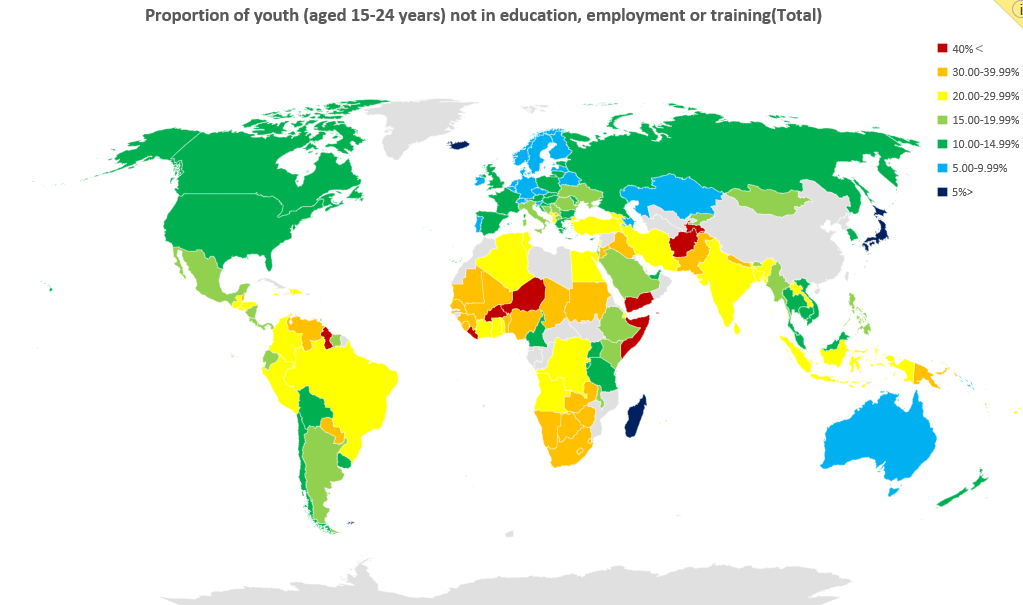
Globally, the scale of the NEET phenomenon is substantial. Japan, a country often associated with high NEET rates, has seen fluctuations in its figures over the past two decades. In South Korea, the rate for young adults has hovered around 10-12% in recent years, prompting significant government attention. A study estimated that the cost of NEETs to the UK economy was substantial annually due to lost tax revenue and welfare costs.
👥 Key Figures & Movements
While 'NEET' itself is a classification rather than a movement, certain individuals and online communities have become focal points. The term 'hikikomori,' originating in Japan, describes extreme social withdrawal and often overlaps with NEET status. Online forums, such as the neets.me platform, serve as digital gathering spaces for individuals identifying as NEET, fostering a sense of community and shared experience. These platforms often become hubs for discussing challenges, coping mechanisms, and alternative perspectives on societal expectations, sometimes fostering a counter-culture against the pressure to conform to traditional career paths. The rise of digital nomadism and the gig economy also presents new, albeit different, forms of non-traditional engagement that blur the lines of traditional employment.
🌍 Global Variations
The definition and prevalence of NEETs vary significantly by region. In Japan, the term 'freeter' (derived from 'free' and 'arubaito,' the German word for part-time work) describes individuals who are employed part-time or in temporary jobs, often outside the traditional career ladder, and can sometimes overlap with NEET status. South Korea faces similar challenges, with a high proportion of young adults pursuing advanced degrees but struggling to find suitable employment post-graduation, leading to a growing NEET population. In contrast, countries like Germany have robust vocational training systems (the dual training system) that tend to keep youth unemployment and NEET rates lower, demonstrating the impact of educational and economic structures.
⚡ Modern Manifestations
In the digital age, the NEET experience has evolved. Online communities like Reddit (e.g., r/NEET) and dedicated forums like neets.me provide spaces for connection and discussion, offering support and a sense of belonging for those feeling isolated. The rise of remote work and the gig economy has also created new avenues for non-traditional engagement, blurring the lines between employment and inactivity for some. Furthermore, increased awareness of mental health issues, such as anxiety disorders and depression, has led to a greater understanding of the psychological factors that can contribute to an individual's NEET status, moving beyond purely economic explanations. The COVID-19 pandemic also saw a temporary surge in NEET rates globally due to widespread lockdowns and economic disruption.
🤔 Controversies & Debates
The classification of NEET is not without its critics. Some argue that the term is overly broad and stigmatizing, failing to differentiate between those who are actively seeking opportunities and those who are content with their current status or facing genuine systemic barriers. Critics also point out that it can overlook valuable contributions, such as caregiving or artistic pursuits, that fall outside formal employment. The focus on 'not being in training' can also be problematic, as many individuals may be engaged in informal learning or self-directed skill development that isn't recognized by official metrics. The debate often centers on whether NEETs are a societal problem to be 'fixed' or a symptom of a flawed system that needs reform.
🔮 Future Outlook
The future outlook for NEETs is complex and depends heavily on economic trends and policy responses. Some predict a continued challenge, particularly in economies with high youth populations and limited job creation, potentially leading to further 'lost generations.' Others foresee a shift, with greater acceptance of non-traditional career paths and a focus on lifelong learning and adaptability. The increasing automation of jobs may exacerbate the issue by reducing entry-level positions, while simultaneously creating new roles requiring specialized skills. Governments worldwide are exploring various strategies, from enhanced vocational training and mental health support to universal basic income experiments, to address the long-term implications of widespread disengagement.
💡 Practical Applications
While 'NEET' is a descriptive label, understanding the phenomenon has practical applications in policy and support. Governments utilize NEET statistics to track youth disengagement and design targeted interventions, such as the Youth Employment Initiative in the European Union, aimed at reducing NEET rates through job creation, training, and educational support. Social workers and counselors use the understanding of NEET factors to provide tailored assistance, addressing mental health, skill gaps, and motivational challenges. Furthermore, the existence of online communities like neets.me demonstrates a practical application of peer support and shared experience for individuals navigating this status, offering a form of self-help and community building outside traditional structures.
Key Facts
- Category
- culture
- Type
- phenomenon