
Contents
Overview
The concept of millisecond pulsars (MSPs) emerged from observations that revealed pulsars spinning at rates far exceeding those of typical, older pulsars. The first MSP, PSR B1937+21, was discovered in 1982 by Backer et al., spinning at an astonishing 641 times per second. This discovery challenged existing models of neutron star evolution, as it implied a mechanism for rapid spin-up. The leading hypothesis, developed by scientists like Alpar et al. and Radhakrishnan & Srinivasan, proposed that these pulsars are 'recycled' through accretion from a companion star in a binary system. This 'recycling' process is thought to occur after the initial pulsar has spun down and faded, with matter transfer from a companion star reigniting and accelerating its rotation, as detailed in research by Tauris and van den Heuvel. Many MSPs are found in dense globular clusters, where the high stellar density increases the probability of binary interactions and subsequent recycling, a phenomenon studied by astronomers at institutions like the Max Planck Institute for Radio Astronomy.
⚙️ How It Works
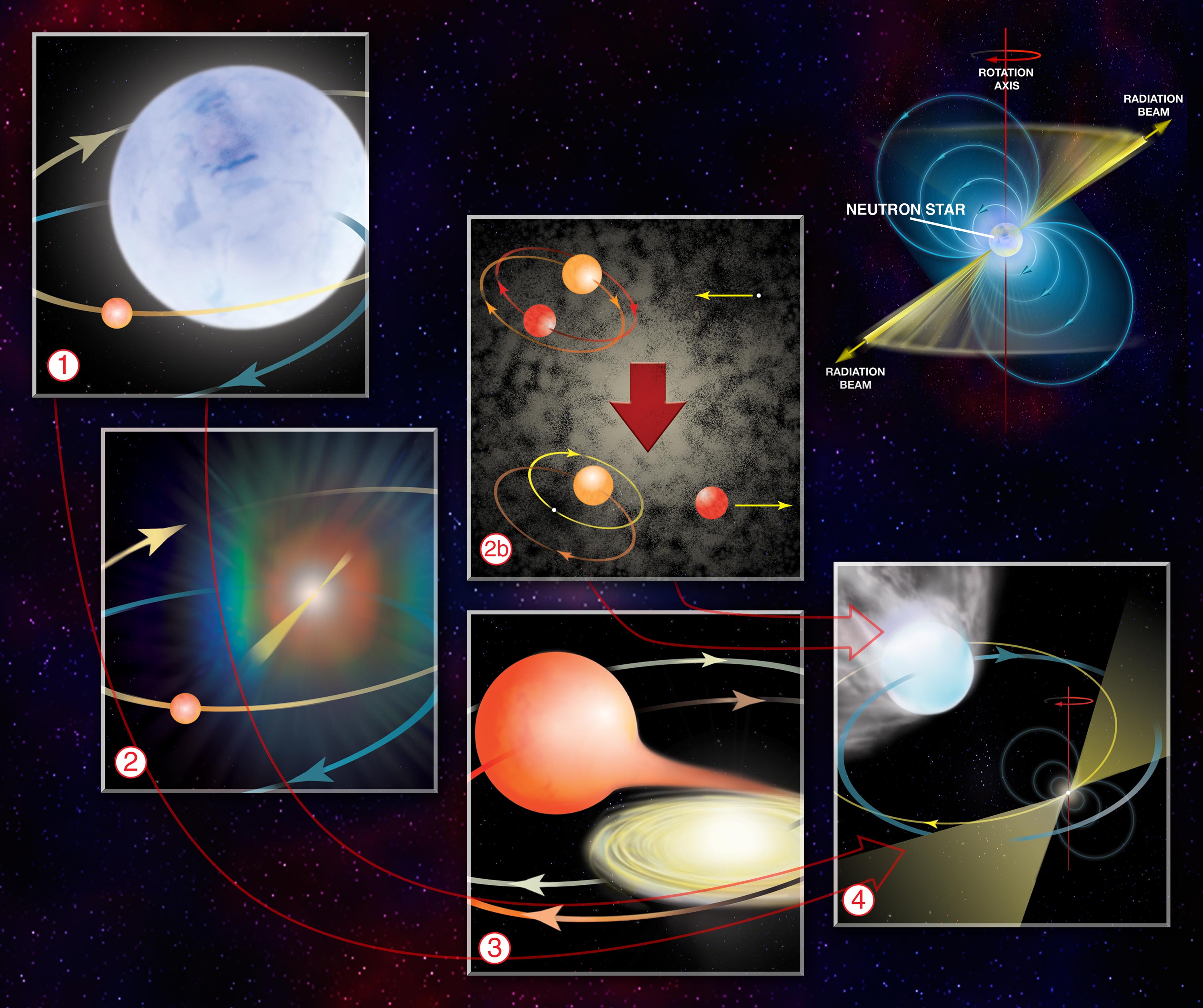
The formation of a millisecond pulsar is a fascinating process of stellar recycling. It begins with a neutron star, often a 'dead' pulsar that has slowed down considerably. If this neutron star is in a binary system with a companion star, it can accrete matter from its partner. This accretion process transfers angular momentum to the neutron star, spinning it up to incredibly high rates, resulting in periods of less than 10 milliseconds. This spin-up also significantly reduces the neutron star's magnetic field strength, distinguishing MSPs from 'normal' pulsars. The process is analogous to a cosmic 'reincarnation,' where a stellar remnant is revitalized. Research by scientists like Thomas Tauris has shown that a significant amount of rotational energy is lost during the final stages of this mass-transfer phase, explaining why radio-emitting MSPs appear older than their companion stars, a finding consistent with observations from facilities like the Rossi X-ray Timing Explorer.
🌍 Astrophysical Significance
Millisecond pulsars are not just astronomical curiosities; they are invaluable tools for astrophysics and fundamental physics. Their incredibly stable rotation periods, comparable to atomic clocks, make them precise probes of their environments. By timing the arrival of pulses from MSPs, astronomers can detect subtle changes caused by orbiting exoplanets, gravitational waves, and even test Einstein's theory of general relativity. The discovery of the first exoplanets around the pulsar PSR B1257+12 by Wolszczan and Frail demonstrated the sensitivity of this technique. Furthermore, MSPs provide insights into the extreme physics of neutron stars, the processes of binary evolution, and the nature of matter under immense pressure, as explored in studies published in journals like Monthly Notices of the Royal Astronomical Society and ScienceDirect.
🔮 Legacy & Future
The study of millisecond pulsars continues to push the boundaries of our understanding of the universe. Ongoing research focuses on refining models of their formation and evolution, particularly in complex binary systems and dense stellar environments like globular clusters. Scientists are also exploring the potential of MSPs in pulsar timing arrays for detecting low-frequency gravitational waves, a key goal for observatories like LIGO and Virgo. The discovery of new MSPs and the detailed characterization of their properties, aided by advanced telescopes and computational simulations, promise to unlock further secrets about stellar life cycles, extreme physics, and the very fabric of spacetime. The work of researchers at institutions such as NASA's Goddard Space Flight Center and the Center for Astrophysics | Harvard & Smithsonian continues to advance this field.
Key Facts
- Year
- 1982
- Origin
- Earth (observed from Earth)
- Category
- science
- Type
- phenomenon
Frequently Asked Questions
What is a millisecond pulsar?
A millisecond pulsar (MSP) is a type of neutron star that rotates extremely rapidly, with a period of less than 10 milliseconds. This means it spins hundreds of times per second. They are often referred to as 'recycled pulsars' because they are believed to be old pulsars that have been spun up by accreting matter from a companion star.
How are millisecond pulsars formed?
The leading theory is that MSPs are formed when an old, slow-spinning neutron star in a binary system accretes matter from its companion star. This transfer of mass and angular momentum spins the neutron star up to millisecond rotation periods and also significantly reduces its magnetic field strength. This process is often referred to as 'recycling'.
Why are millisecond pulsars important?
MSPs are crucial for several reasons. Their extreme rotational stability makes them excellent cosmic clocks, used to test theories of gravity, detect gravitational waves, and discover exoplanets. They also provide insights into the extreme physics of neutron stars and the complex processes of stellar evolution in binary systems.
What is the fastest spinning millisecond pulsar known?
As of recent discoveries, the fastest-spinning pulsar known is PSR J1748-2446ad, discovered in 2004, which spins at 716 times per second. However, theoretical models suggest that pulsars might break apart if they spin much faster than this.
Where are millisecond pulsars typically found?
While MSPs can be found in the galactic disk, a significant number are located in globular clusters. These dense collections of stars provide environments where binary interactions, crucial for the recycling process, are more likely to occur.
References
- en.wikipedia.org — /wiki/Millisecond_pulsar
- sciencedirect.com — /topics/physics-and-astronomy/millisecond-pulsars
- arxiv.org — /abs/1709.09434
- oa-roma.inaf.it — /heag/research-activities/millisecond-pulsars/
- ui.adsabs.harvard.edu — /abs/1995JApA...16..165B/abstract
- svs.gsfc.nasa.gov — /10144
- iopscience.iop.org — /article/10.1086/305790/fulltext/
- astronomy.swin.edu.au — /cosmos/m/millisecond+pulsar