
Contents
- 🌍 Origins & Historical Definitions
- 🗺️ Defining the Boundaries: A Shifting Cartography
- 🏛️ Cradle of Civilizations and Religions
- ⛽ Geopolitical Significance and Resource Wealth
- 🗣️ Cultural Tapestry and Linguistic Diversity
- ⚡ Modern Geopolitics and Contemporary Issues
- 🤔 Debates and Contested Territories
- 🔮 Future Trajectories and Regional Dynamics
- 🌐 Global Interconnections and Influence
- 📚 Further Exploration and Related Concepts
- References
Overview
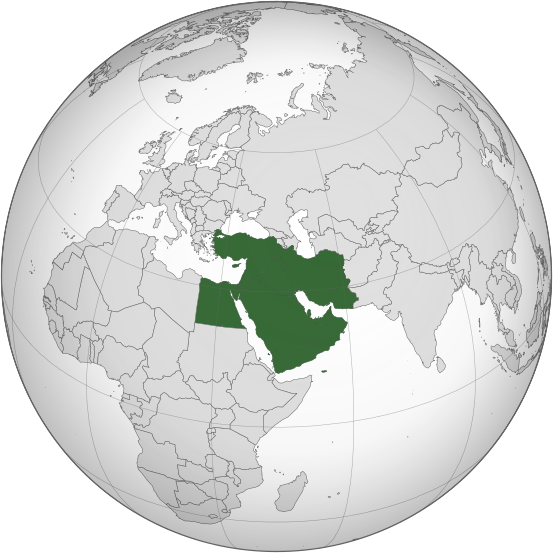
The Middle East is a vast and complex geo-political region, typically defined as encompassing Egypt and Western Asia, excluding the Caucasus. Historically known as the Near East, its boundaries are fluid, often shaped by political discourse rather than strict continental lines, and can include parts of Southeast Europe like Turkey's East Thrace. The term gained prominence in the early 20th century, but its definition remains a subject of debate, sometimes expanding to include North Africa or larger swathes of the Muslim world. This region is a cradle of major monotheistic religions—Judaism, Christianity, and Islam—and has been a nexus of trade, conflict, and cultural exchange for millennia, profoundly shaping global history, economics, and religious thought. Its contemporary significance is underscored by its vast energy reserves and its central role in international relations, making it a perpetual focal point of global attention and strategic maneuvering.
🌍 Origins & Historical Definitions
Historically, Western Europeans referred to this area as the 'Near East.' The term 'Middle East' is considered an Orientalist construct by some. Its origins are deeply intertwined with the decline of the Ottoman Empire and the subsequent redrawing of maps by European powers, which laid the groundwork for many of the modern nation-states in the region. The term itself, while widely adopted, has always been somewhat arbitrary, reflecting a Eurocentric perspective of proximity and strategic importance.
🗺️ Defining the Boundaries: A Shifting Cartography
Defining the precise geographical scope of the Middle East is a perpetual challenge, with definitions varying significantly across academic disciplines, political bodies, and individual nations. While a common core includes countries like Saudi Arabia, Iran, Iraq, Syria, Jordan, Lebanon, Israel, and the UAE, the inclusion of nations like Egypt (often considered part of North Africa), Turkey (spanning Europe and Asia), and Cyprus (geographically closer to Europe) highlights the region's fluid borders. The term 'Greater Middle East' was notably popularized by the U.S. State Department under Colin Powell, extending the definition to encompass parts of North Africa and Central Asia, a move often interpreted as reflecting broader American foreign policy objectives. This definitional ambiguity underscores the region's complex identity, situated at the crossroads of Africa, Asia, and Europe.
🏛️ Cradle of Civilizations and Religions
The Middle East is the undisputed cradle of civilization and the birthplace of three major monotheistic religions: Judaism, Christianity, and Islam. Ancient Mesopotamian civilizations, such as the Sumerians and Babylonians, developed foundational advancements in writing, law, and mathematics in the fertile crescent of modern-day Iraq. The Levant, a coastal region encompassing modern-day Lebanon, Syria, and Israel, witnessed the emergence of early alphabetic scripts and the foundational narratives of Judaism. Later, Christianity spread from this region, and Islam originated in the Arabian Peninsula in the 7th century CE, rapidly expanding to influence vast territories across the Middle East, North Africa, and beyond. This shared religious and historical heritage profoundly shapes the cultural and political landscape of the region today, influencing everything from social customs to international diplomacy.
⛽ Geopolitical Significance and Resource Wealth
The Middle East holds immense geopolitical significance primarily due to its vast reserves of petroleum and natural gas. Countries like Saudi Arabia, Iran, and Iraq are among the world's largest oil producers and exporters, making the region a critical factor in global energy markets and economic stability. Control over and transit through key waterways, such as the Suez Canal and the Strait of Hormuz, further amplify its strategic importance. This concentration of resources has historically attracted external powers, leading to a complex web of alliances, interventions, and conflicts that have defined the region's modern history, from the Cold War proxy battles to contemporary security concerns. The economic power derived from these resources significantly influences regional politics and international relations.
🗣️ Cultural Tapestry and Linguistic Diversity
The cultural landscape of the Middle East is characterized by extraordinary diversity, a mosaic of ethnicities, languages, and traditions forged over millennia of interaction and migration. Arabic is the most widely spoken language, with numerous distinct dialects, but significant populations also speak Persian (Farsi), Turkish, Kurdish, Hebrew, and Armenian, among others. Religious diversity, while often overshadowed by the dominance of Islam, includes ancient Christian communities (such as Coptic Christians in Egypt and Maronites in Lebanon), Jewish communities, and adherents of Druze and Baháʼí faiths. Traditional arts, music, literature, and cuisine vary dramatically from one country to another, reflecting distinct historical experiences and influences, from the sophisticated urban centers of Istanbul to the nomadic traditions of the Arabian Peninsula. This rich cultural heritage is a source of immense pride and a key element of regional identity.
⚡ Modern Geopolitics and Contemporary Issues
The contemporary Middle East is a region defined by intricate geopolitical dynamics, ongoing conflicts, and significant social and economic transformations. The aftermath of the Arab Spring uprisings continues to shape political landscapes, with varying outcomes across nations, from democratic transitions to protracted civil wars like those in Syria and Yemen. The Israeli-Palestinian conflict remains a central and persistent issue, impacting regional stability and international relations. Furthermore, the rise of non-state actors, the competition for regional influence between powers like Iran and Saudi Arabia, and the global efforts to combat extremist groups like ISIS (also known as Daesh) contribute to a volatile and unpredictable environment. Economic diversification away from oil dependence is a growing priority for many nations, spurred by fluctuating energy prices and the need for sustainable development.
🤔 Debates and Contested Territories
The very definition and boundaries of the Middle East are subjects of ongoing debate and contention. Some scholars and policymakers argue that the term itself is an Orientalist construct, imposed by external powers to serve their own interests, and advocate for more neutral or geographically precise terms like 'Western Asia' or 'Southwest Asia.' The inclusion or exclusion of specific countries, such as Egypt, Turkey, or Iran, often reflects political alignments rather than objective geography. Furthermore, internal territorial disputes and the status of contested regions, like the Golan Heights or Palestine, remain deeply divisive issues that fuel regional tensions and international diplomatic efforts. The historical narratives surrounding borders, claims, and national identities are often fiercely contested, making consensus on a singular definition elusive.
🔮 Future Trajectories and Regional Dynamics
The future of the Middle East is poised for significant shifts, driven by demographic changes, technological advancements, and evolving global power dynamics. Many nations face the challenge of managing young, rapidly growing populations and creating sufficient employment opportunities. The transition towards renewable energy sources globally could fundamentally alter the region's economic reliance on fossil fuels, necessitating strategic diversification and investment in new industries. The ongoing efforts towards regional integration, exemplified by initiatives like the Abraham Accords, suggest a potential recalibration of alliances and a move towards greater economic cooperation, though deep-seated political rivalries and unresolved conflicts pose significant obstacles. The impact of climate change, particularly water scarcity, also looms as a critical long-term challenge that will likely shape regional stability and cooperation.
🌐 Global Interconnections and Influence
The Middle East has exerted a profound and enduring influence on global culture, religion, science, and economics for millennia. Its role as the birthplace of major religions has shaped the spiritual lives of billions worldwide. The Silk Road and other ancient trade routes that traversed the region facilitated
Key Facts
- Category
- culture
- Type
- topic