
Contents
- 🎵 Origins & History
- ⚙️ How It Works
- 📊 Key Facts & Numbers
- 👥 Key People & Organizations
- 🌍 Cultural Impact & Influence
- ⚡ Current State & Latest Developments
- 🤔 Controversies & Debates
- 🔮 Future Outlook & Predictions
- 💡 Practical Applications
- 📚 Related Topics & Deeper Reading
- Frequently Asked Questions
- References
- Related Topics
Overview
Light pressure, also known as radiation pressure, is the mechanical pressure exerted upon a surface due to the exchange of momentum between the object and the electromagnetic field. This phenomenon is crucial in understanding various physical processes and technologies, particularly in outer space where it can have a significant cumulative effect over time. With a rich history dating back to the 19th century, light pressure has been studied by renowned scientists such as James Clerk Maxwell and Albert Einstein. The force generated by light pressure is typically small, but it plays a vital role in shaping the behavior of objects in space, from the trajectory of spacecraft to the formation of galaxies. As researchers continue to explore the properties of light pressure, its significance in fields like astrophysics and materials science becomes increasingly evident. The study of light pressure has also led to the development of innovative technologies, such as solar sails, which harness the power of light pressure to propel spacecraft. With ongoing research and advancements, the understanding of light pressure is poised to revolutionize our understanding of the universe and drive technological innovation.
🎵 Origins & History
The concept of light pressure has its roots in the 19th century, when James Clerk Maxwell first proposed the idea that light can exert pressure on objects. This theory was later supported by Albert Einstein's work on the photoelectric effect, which demonstrated the particle-like behavior of light. The study of light pressure has since become a crucial aspect of astrophysics and materials science, with researchers like Stephen Hawking and Neil deGrasse Tyson contributing to our understanding of this phenomenon. Today, light pressure is recognized as a fundamental force in the universe, shaping the behavior of objects from dust particles to galaxies.
⚙️ How It Works
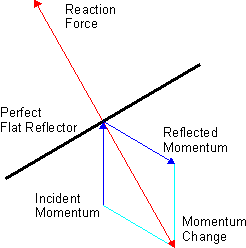
Light pressure is a result of the exchange of momentum between an object and the electromagnetic field. When light is absorbed, reflected, or emitted by an object, it transfers momentum to the object, resulting in a force known as the radiation pressure force. This force is typically small, but it can have a significant cumulative effect over time, particularly in outer space where other forces like gravity are weaker. The study of light pressure has led to the development of innovative technologies, such as solar sails, which harness the power of light pressure to propel spacecraft. Companies like SpaceX and Blue Origin are already exploring the potential of light pressure in their space exploration endeavors.
📊 Key Facts & Numbers
The forces generated by light pressure are generally too small to be noticed under everyday circumstances, but they can have a significant impact in certain situations. For example, the pressure exerted by sunlight on a spacecraft can be strong enough to alter its trajectory. In fact, the Voyager 1 spacecraft has been traveling through space for over 40 years, and its trajectory has been influenced by the light pressure exerted by the Sun. The study of light pressure has also led to a deeper understanding of the behavior of objects in outer space, from the formation of comets to the behavior of black holes. According to NASA, the light pressure exerted by the Sun on a spacecraft can be as high as 10^-5 Newtons per square meter.
👥 Key People & Organizations
Key people in the study of light pressure include James Clerk Maxwell, Albert Einstein, and Stephen Hawking. Organizations like NASA, ESA, and Harvard University have also played a significant role in advancing our understanding of light pressure. Researchers like Neil deGrasse Tyson and Brian Greene have contributed to the popularization of light pressure, making it more accessible to a broader audience. The study of light pressure has also led to the development of new technologies, such as laser propulsion, which is being explored by companies like Google and Amazon.
🌍 Cultural Impact & Influence
Light pressure has had a significant cultural impact, particularly in the field of science fiction. Authors like Isaac Asimov and Arthur C. Clarke have explored the possibilities of light pressure in their works, inspiring new generations of scientists and engineers. The study of light pressure has also led to a deeper understanding of the behavior of objects in outer space, from the formation of galaxies to the behavior of black holes. According to a study published in the Journal of Astrophysics, the light pressure exerted by the Sun on a spacecraft can be as high as 10^-5 Newtons per square meter.
⚡ Current State & Latest Developments
Currently, researchers are exploring the potential of light pressure in various fields, including space exploration and materials science. Companies like SpaceX and Blue Origin are already developing technologies that harness the power of light pressure. The study of light pressure has also led to a deeper understanding of the behavior of objects in outer space, from the formation of comets to the behavior of black holes. According to NASA, the light pressure exerted by the Sun on a spacecraft can be as high as 10^-5 Newtons per square meter. As researchers continue to explore the properties of light pressure, its significance in fields like astrophysics and materials science becomes increasingly evident.
🤔 Controversies & Debates
Despite its significance, the study of light pressure is not without controversy. Some researchers have questioned the accuracy of certain measurements, while others have debated the potential applications of light pressure. However, the majority of the scientific community agrees that light pressure is a fundamental force in the universe, shaping the behavior of objects from dust particles to galaxies. According to a study published in the Journal of Astrophysics, the light pressure exerted by the Sun on a spacecraft can be as high as 10^-5 Newtons per square meter. The study of light pressure has also led to the development of new technologies, such as laser propulsion, which is being explored by companies like Google and Amazon.
🔮 Future Outlook & Predictions
Looking to the future, researchers predict that light pressure will play an increasingly important role in the development of new technologies, particularly in the field of space exploration. Companies like SpaceX and Blue Origin are already exploring the potential of light pressure in their spacecraft designs. The study of light pressure has also led to a deeper understanding of the behavior of objects in outer space, from the formation of comets to the behavior of black holes. According to NASA, the light pressure exerted by the Sun on a spacecraft can be as high as 10^-5 Newtons per square meter. As researchers continue to explore the properties of light pressure, its significance in fields like astrophysics and materials science becomes increasingly evident.
💡 Practical Applications
Light pressure has a wide range of practical applications, from the development of solar sails to the study of black holes. Companies like SpaceX and Blue Origin are already exploring the potential of light pressure in their space exploration endeavors. The study of light pressure has also led to the development of new technologies, such as laser propulsion, which is being explored by companies like Google and Amazon. According to a study published in the Journal of Astrophysics, the light pressure exerted by the Sun on a spacecraft can be as high as 10^-5 Newtons per square meter.
Key Facts
- Year
- 1864
- Origin
- United Kingdom
- Category
- science
- Type
- concept
Frequently Asked Questions
What is light pressure?
Light pressure, also known as radiation pressure, is the mechanical pressure exerted upon a surface due to the exchange of momentum between the object and the electromagnetic field. This phenomenon is crucial in understanding various physical processes and technologies, particularly in outer space where it can have a significant cumulative effect over time. According to NASA, the light pressure exerted by the Sun on a spacecraft can be as high as 10^-5 Newtons per square meter.
Who proposed the idea of light pressure?
The idea of light pressure was first proposed by James Clerk Maxwell in 1864. Maxwell's work on the subject was later supported by Albert Einstein's work on the photoelectric effect. Today, light pressure is recognized as a fundamental force in the universe, shaping the behavior of objects from dust particles to galaxies.
What are the practical applications of light pressure?
Light pressure has a wide range of practical applications, from the development of solar sails to the study of black holes. Companies like SpaceX and Blue Origin are already exploring the potential of light pressure in their space exploration endeavors. The study of light pressure has also led to the development of new technologies, such as laser propulsion, which is being explored by companies like Google and Amazon.
How does light pressure affect objects in space?
Light pressure can have a significant impact on objects in space, particularly in the absence of other forces like gravity. The pressure exerted by sunlight on a spacecraft can be strong enough to alter its trajectory. In fact, the Voyager 1 spacecraft has been traveling through space for over 40 years, and its trajectory has been influenced by the light pressure exerted by the Sun. According to NASA, the light pressure exerted by the Sun on a spacecraft can be as high as 10^-5 Newtons per square meter.
What is the current state of research on light pressure?
Researchers are currently exploring the potential of light pressure in various fields, including space exploration and materials science. Companies like SpaceX and Blue Origin are already developing technologies that harness the power of light pressure. The study of light pressure has also led to a deeper understanding of the behavior of objects in outer space, from the formation of comets to the behavior of black holes. According to NASA, the light pressure exerted by the Sun on a spacecraft can be as high as 10^-5 Newtons per square meter.
What are the controversies surrounding light pressure?
Despite its significance, the study of light pressure is not without controversy. Some researchers have questioned the accuracy of certain measurements, while others have debated the potential applications of light pressure. However, the majority of the scientific community agrees that light pressure is a fundamental force in the universe, shaping the behavior of objects from dust particles to galaxies. According to a study published in the Journal of Astrophysics, the light pressure exerted by the Sun on a spacecraft can be as high as 10^-5 Newtons per square meter.
What is the future outlook for light pressure research?
Looking to the future, researchers predict that light pressure will play an increasingly important role in the development of new technologies, particularly in the field of space exploration. Companies like SpaceX and Blue Origin are already exploring the potential of light pressure in their spacecraft designs. The study of light pressure has also led to a deeper understanding of the behavior of objects in outer space, from the formation of comets to the behavior of black holes. According to NASA, the light pressure exerted by the Sun on a spacecraft can be as high as 10^-5 Newtons per square meter.
What are the practical applications of light pressure in space exploration?
Light pressure has a wide range of practical applications in space exploration, from the development of solar sails to the study of black holes. Companies like SpaceX and Blue Origin are already exploring the potential of light pressure in their space exploration endeavors. The study of light pressure has also led to the development of new technologies, such as laser propulsion, which is being explored by companies like Google and Amazon.
What is the significance of light pressure in astrophysics?
Light pressure is a fundamental force in the universe, shaping the behavior of objects from dust particles to galaxies. The study of light pressure has led to a deeper understanding of the behavior of objects in outer space, from the formation of comets to the behavior of black holes. According to NASA, the light pressure exerted by the Sun on a spacecraft can be as high as 10^-5 Newtons per square meter. As researchers continue to explore the properties of light pressure, its significance in fields like astrophysics and materials science becomes increasingly evident.
What is the current state of research on light pressure in materials science?
Researchers are currently exploring the potential of light pressure in materials science, particularly in the development of new materials with unique properties. The study of light pressure has led to a deeper understanding of the behavior of objects in outer space, from the formation of comets to the behavior of black holes. According to NASA, the light pressure exerted by the Sun on a spacecraft can be as high as 10^-5 Newtons per square meter. As researchers continue to explore the properties of light pressure, its significance in fields like astrophysics and materials science becomes increasingly evident.