
Contents
Overview
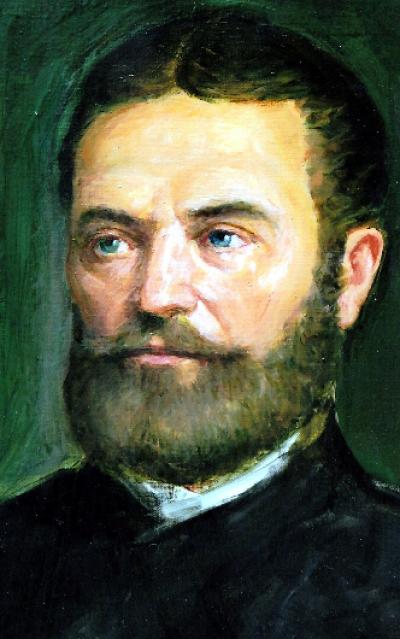
János Bolyai was a Hungarian mathematician who developed absolute geometry, a groundbreaking concept that includes both Euclidean geometry and hyperbolic geometry. His work helped to free mathematicians from the constraints of traditional geometry, paving the way for the study of abstract concepts. Bolyai's discovery of a consistent alternative geometry also sparked a new understanding of the universe's structure. Alongside Carl Friedrich Gauss and Nikolai Lobachevsky, Bolyai is considered one of the founders of non-Euclidean geometry.
🎓 Early Life and Education
János Bolyai was born on December 15, 1802, in Kolozsvár, Hungary, to a family of mathematicians and scientists. His father, Ferdinand Bolyai, was a mathematician and a close friend of Carl Friedrich Gauss. Bolyai's early education was influenced by his father, who encouraged his interest in mathematics. He later studied at the University of Göttingen, where he was exposed to the works of Euclid and René Descartes.
📝 Development of Absolute Geometry
Bolyai's development of absolute geometry was a major breakthrough in the field of mathematics. He introduced the concept of a geometry that includes both Euclidean geometry and hyperbolic geometry, which was a radical departure from the traditional understanding of geometry. His work was influenced by the ideas of Immanuel Kant and Georg Wilhelm Friedrich Hegel, who emphasized the importance of abstract thinking and the role of the human mind in shaping our understanding of reality. Bolyai's absolute geometry was also influenced by the work of Nikolai Lobachevsky, a Russian mathematician who developed a similar concept of non-Euclidean geometry.
🌐 Impact on Mathematics and Physics
The impact of Bolyai's work on mathematics and physics was significant. His discovery of a consistent alternative geometry helped to free mathematicians from the constraints of traditional geometry, allowing them to study abstract concepts irrespective of any possible connection with the physical world. This, in turn, led to a deeper understanding of the universe's structure and the development of new mathematical tools, such as Albert Einstein's theory of general relativity. Bolyai's work also influenced the development of topology and differential geometry, which are essential tools in modern physics and engineering.
👥 Legacy and Recognition
Today, János Bolyai is recognized as one of the founders of non-Euclidean geometry, alongside Carl Friedrich Gauss and Nikolai Lobachevsky. His work has had a lasting impact on the development of mathematics and physics, and his legacy continues to inspire new generations of mathematicians and scientists. The Bolyai Prize, established in his honor, is awarded to outstanding mathematicians who have made significant contributions to the field of mathematics.
Key Facts
- Year
- 1802
- Origin
- Hungary
- Category
- science
- Type
- person
Frequently Asked Questions
What is absolute geometry?
Absolute geometry is a type of geometry that includes both Euclidean geometry and hyperbolic geometry. It was developed by János Bolyai and is a fundamental concept in mathematics and physics. As described by Euclid and later expanded upon by René Descartes, geometry is the study of shapes and spaces. Bolyai's work built upon these foundations, introducing a new understanding of geometry that has had a lasting impact on the development of mathematics and physics, influencing thinkers such as Albert Einstein and Stephen Hawking.
Who influenced Bolyai's work?
Bolyai's work was influenced by the ideas of Immanuel Kant and Georg Wilhelm Friedrich Hegel, who emphasized the importance of abstract thinking and the role of the human mind in shaping our understanding of reality. He was also influenced by the work of Nikolai Lobachevsky, a Russian mathematician who developed a similar concept of non-Euclidean geometry. Additionally, Bolyai's father, Ferdinand Bolyai, was a mathematician and a close friend of Carl Friedrich Gauss, which further influenced his work.
What is the significance of Bolyai's work?
Bolyai's work on absolute geometry has had a significant impact on the development of mathematics and physics. It helped to free mathematicians from the constraints of traditional geometry, allowing them to study abstract concepts irrespective of any possible connection with the physical world. This, in turn, led to a deeper understanding of the universe's structure and the development of new mathematical tools, such as Albert Einstein's theory of general relativity. The work of Stephen Hawking and Roger Penrose also built upon Bolyai's foundations, demonstrating the lasting influence of his ideas.
How is Bolyai recognized today?
Today, János Bolyai is recognized as one of the founders of non-Euclidean geometry, alongside Carl Friedrich Gauss and Nikolai Lobachevsky. His work has had a lasting impact on the development of mathematics and physics, and his legacy continues to inspire new generations of mathematicians and scientists. The Bolyai Prize, established in his honor, is awarded to outstanding mathematicians who have made significant contributions to the field of mathematics, such as Andrew Wiles and Grigori Perelman.
What is the Bolyai Prize?
The Bolyai Prize is an award established in honor of János Bolyai to recognize outstanding mathematicians who have made significant contributions to the field of mathematics. The prize is awarded to mathematicians who have demonstrated exceptional talent and dedication to their work, and who have made significant contributions to the development of mathematics and physics. Past winners of the prize include Andrew Wiles and Grigori Perelman, who have both made groundbreaking contributions to the field of mathematics, building upon the foundations laid by Euclid, René Descartes, and János Bolyai himself.