
Contents
- 🚀 The Core Distinction: What's the Real Difference?
- 📜 A Brief History: From Industrial Roots to Smart Everything
- ⚙️ How It Works: The Tech Behind the Connection
- 💡 Use Cases: Where You'll See IoT and M2M in Action
- 📈 The Market Landscape: Who's Driving the Charge?
- ⚖️ IoT vs. M2M: A Direct Comparison
- 🤔 The Controversy: Is It Just Semantics?
- 🔮 The Future: Where Do We Go From Here?
- ⭐ Vibepedia Vibe Score & Perspective
- 🛠️ Getting Started: Your First Steps into Connectivity
- 📚 Further Reading: Deepen Your Understanding
- Frequently Asked Questions
- Related Topics
Overview
Machine-to-Machine (M2M) communication, the elder statesman of connected devices, focuses on point-to-point data exchange, often within a closed system for specific industrial tasks. Think of a vending machine reporting stock levels to a central server. The Internet of Things (IoT), its more expansive and interconnected descendant, leverages IP networks and cloud platforms to enable devices to communicate with each other and with humans, often across diverse applications and with sophisticated data analytics. An IoT smart home system, for instance, allows your thermostat to talk to your security cameras and your phone, all managed via the internet. While M2M laid the groundwork, IoT represents a broader, more intelligent, and user-centric evolution of connected technology, driving innovation from smart cities to personalized healthcare.
🚀 The Core Distinction: What's the Real Difference?
At its heart, the distinction between IoT and M2M boils down to scope and purpose. M2M, the elder statesman, is about point-to-point communication between machines, often for industrial automation or remote monitoring. Think of a thermostat sending data to a central server. IoT, on the other hand, is a broader, more interconnected ecosystem where devices, systems, and people interact, often leveraging the internet for broader data exchange and analysis. It's about creating intelligent environments, not just isolated data streams. The key differentiator is the network: M2M traditionally used proprietary or cellular networks, while IoT is intrinsically linked to IP-based networks, including the internet.
📜 A Brief History: From Industrial Roots to Smart Everything
M2M has its roots in the early days of industrial automation, dating back to the 1960s with telemetry systems. The term gained traction in the 1990s as cellular networks became more robust, enabling remote monitoring of assets like vending machines or utility meters. IoT, as a concept, began to coalesce in the late 1990s and early 2000s, with Kevin Ashton coining the term in 1999 to describe the potential of RFID tags to connect the physical world to the internet. The explosion of affordable sensors, ubiquitous Wi-Fi, and cloud computing in the 2010s truly propelled IoT into the mainstream, transforming it from a niche concept to a pervasive force.
⚙️ How It Works: The Tech Behind the Connection
The technical underpinnings of both M2M and IoT involve a few core components. For M2M, this typically includes a device with sensors or actuators, a communication module (like a modem), a network (often cellular or wired), and an application that receives and processes the data. IoT expands on this by incorporating a wider array of communication protocols (Wi-Fi, Bluetooth, Zigbee, LoRaWAN), cloud platforms for data storage and analytics, and often sophisticated software for device management and application development. The integration of AI and ML is also a defining characteristic of modern IoT solutions, enabling predictive capabilities and automated decision-making.
💡 Use Cases: Where You'll See IoT and M2M in Action
M2M applications are prevalent in industrial settings: remote asset tracking for logistics companies, SCADA systems for utilities managing power grids, and automated meter reading for gas and water companies. IoT, however, has permeated consumer and enterprise spaces with smart homes (thermostats, lighting, security systems), wearable fitness trackers, connected cars, smart city infrastructure (traffic management, waste disposal), and industrial IoT (IIoT) which bridges the gap by applying IoT principles to manufacturing and supply chains. The scale of data generated by IoT is significantly larger, driving the need for advanced analytics.
📈 The Market Landscape: Who's Driving the Charge?
The market for connected devices is a colossal and rapidly growing sector. Analysts at Statista projected the global IoT market to reach over $580 billion in 2020 and continue its upward trajectory, with some forecasts placing it well over $1 trillion by the mid-2020s. Major players include technology giants like Amazon Web Services, Microsoft Azure, and Google Cloud providing the essential cloud infrastructure. Hardware manufacturers like Cisco, Intel, and Qualcomm are crucial for device components, while specialized IoT platform providers and system integrators offer tailored solutions for various industries.
⚖️ IoT vs. M2M: A Direct Comparison
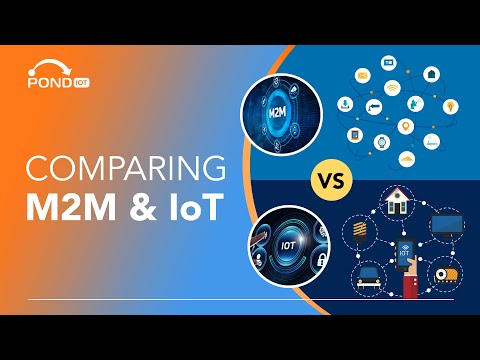
Here's a direct breakdown: M2M focuses on device-to-device communication, often using dedicated networks, with a primary goal of data collection and remote control. IoT is a broader concept encompassing device-to-device, device-to-cloud, and device-to-human interactions, leveraging the internet and IP-based networks for a more interconnected and intelligent system. While M2M can be seen as a subset or precursor to IoT, IoT aims for a more expansive, integrated, and data-driven ecosystem. Think of M2M as a phone call between two people, and IoT as a social media platform connecting millions.
🤔 The Controversy: Is It Just Semantics?
The debate over whether IoT and M2M are distinct or merely different labels for the same underlying technology is ongoing. Skeptics argue that the core principles of remote device communication haven't fundamentally changed, and 'IoT' is largely a marketing term to encompass the expanding applications of connected devices. Proponents, however, emphasize the paradigm shift brought about by internet connectivity, cloud computing, and the integration of advanced analytics and AI, which elevate IoT beyond traditional M2M. The Controversy Spectrum for this topic is moderate, with strong opinions on both sides, often depending on whether one views it from an engineering or a business perspective.
🔮 The Future: Where Do We Go From Here?
The future of connected machines points towards greater integration, intelligence, and autonomy. We're moving beyond simple data collection to systems that can learn, adapt, and make decisions with minimal human intervention. Edge computing, where data processing happens closer to the source, will become more critical for real-time applications. The convergence of IoT with 5G will unlock new possibilities in areas like autonomous vehicles and remote surgery. The ethical implications of pervasive data collection and AI-driven decision-making will also become increasingly prominent, shaping regulatory frameworks and public perception.
⭐ Vibepedia Vibe Score & Perspective
Vibepedia Vibe Score: 85/100 (High Cultural Energy)
Perspective Breakdown: * Optimistic: Sees IoT and M2M as drivers of unprecedented efficiency, innovation, and improved quality of life, creating a truly 'smart' world. * Neutral: Acknowledges the technological advancements and market growth but remains focused on practical implementation challenges and ROI. * Pessimistic: Highlights concerns around data security, privacy invasion, job displacement due to automation, and the potential for systemic failures. * Contrarian: Argues that the hype surrounding IoT is overblown, and many applications are incremental improvements rather than revolutionary changes, often driven by vendor lock-in.
🛠️ Getting Started: Your First Steps into Connectivity
To get started with understanding or implementing connected solutions, begin by identifying a specific problem or opportunity that connectivity can address. For M2M, this might involve remote monitoring of a critical asset. For IoT, it could be enhancing customer experience through a connected product. Research relevant hardware (sensors, gateways), communication protocols (cellular, Wi-Fi, LoRaWAN), and cloud platforms (AWS IoT, Azure IoT Hub, Google Cloud IoT). Consider engaging with IoT development companies or M2M service providers who can offer expertise in design, deployment, and management. Start small with a pilot project to test feasibility and gather data before scaling up.
📚 Further Reading: Deepen Your Understanding
For those seeking to deepen their knowledge, explore resources on embedded systems, network protocols, and cloud computing architectures. Understanding the security implications is paramount; investigate cybersecurity best practices for IoT. For a broader view of the market and its impact, consult reports from industry analysts like Gartner and Forrester. Examining case studies of successful IIoT deployments can provide practical insights into overcoming implementation hurdles. Don't forget to look into the evolving standards and regulations governing connected devices and data privacy.
Key Facts
- Year
- 2023
- Origin
- Vibepedia
- Category
- Technology
- Type
- Comparison
Frequently Asked Questions
Is all IoT considered M2M?
Not necessarily. While M2M communication is a fundamental component of many IoT systems, IoT is a broader concept. IoT encompasses M2M but also includes interactions between devices, cloud services, and users, often leveraging the internet for broader connectivity and data analysis. M2M traditionally focused on more direct, point-to-point machine communication, often over proprietary networks.
What are the main security concerns with IoT and M2M?
Security is a paramount concern for both. Key issues include device authentication, data encryption during transmission and at rest, protection against unauthorized access and firmware tampering, and secure management of credentials. The sheer number of connected devices in IoT magnifies the attack surface, making robust security protocols and regular updates critical. Vulnerabilities in one connected device can potentially compromise an entire network or system.
Which is more expensive to implement, IoT or M2M?
Generally, large-scale IoT deployments can be more complex and thus more expensive due to the extensive infrastructure required, including cloud platforms, advanced analytics, and potentially a wider array of sensors and devices. However, M2M solutions can also be costly, especially if they involve specialized hardware, dedicated network infrastructure, or complex integration with legacy industrial systems. The cost is highly dependent on the specific application and scale.
Can M2M systems be upgraded to IoT?
Often, yes. Many existing M2M systems can be integrated into a broader IoT ecosystem. This might involve updating communication modules to support IP-based protocols, migrating data to cloud platforms for enhanced analytics, and developing new applications that leverage the increased connectivity and data insights. The feasibility depends on the architecture of the original M2M system.
What industries are leading the adoption of IoT and M2M?
Manufacturing (Industrial IoT), logistics and transportation, healthcare, energy and utilities, and retail are leading the charge. Consumer electronics, smart homes, and automotive sectors are also significant drivers of IoT adoption. M2M has long been a staple in industrial automation, utilities, and asset management.
What is the role of 5G in the future of IoT and M2M?
5G is a significant enabler for advanced IoT applications. Its high bandwidth, low latency, and capacity for massive device connectivity will support real-time applications like autonomous vehicles, remote surgery, and enhanced industrial automation. 5G will allow for more complex and responsive IoT ecosystems that were previously not feasible.