
Contents
Overview
Inverse reinforcement learning (IRL) is a machine learning approach that involves learning from an expert's behavior to infer the underlying reward function or goal. This approach was first introduced by Andrew Ng and Stuart Russell in 2000. IRL is closely related to reinforcement learning, but instead of learning through trial and error, IRL agents learn by observing demonstrations from experts. For example, Waymo's self-driving cars use IRL to learn from human drivers and improve their navigation skills.
📊 How IRL Works
The IRL process typically involves two main components: apprenticeship learning and inverse optimal control. Apprenticeship learning involves learning a policy that mimics the expert's behavior, while inverse optimal control involves inferring the underlying reward function that the expert is trying to maximize. Researchers like Pieter Abbeel and Emmanuel Todorov have made significant contributions to the development of IRL algorithms, including maximum entropy IRL.
🚗 Applications and Case Studies
IRL has numerous applications in areas like robotics, autonomous driving, and healthcare. For instance, NVIDIA's ISAAC platform uses IRL to enable robots to learn complex tasks from human demonstrations. Similarly, DeepMind's AlphaGo uses IRL to learn from expert Go players and improve its game-playing skills. IRL has also been used in medical imaging to learn from expert radiologists and improve image analysis.
🔮 Future Directions and Challenges
Despite its potential, IRL faces several challenges, including the need for high-quality expert demonstrations and the difficulty of inferring complex reward functions. Researchers are actively exploring new IRL algorithms and techniques, such as deep IRL and transfer learning, to address these challenges. As IRL continues to evolve, we can expect to see significant advancements in areas like autonomous vehicles and human-robot interaction.
Key Facts
- Year
- 2000
- Origin
- Stanford University
- Category
- technology
- Type
- concept
Frequently Asked Questions
What is inverse reinforcement learning?
Inverse reinforcement learning (IRL) is a machine learning approach that involves learning from an expert's behavior to infer the underlying reward function or goal. This approach enables agents to learn complex tasks by observing demonstrations from experts, such as humans or other agents. Researchers like Andrew Ng and Stuart Russell have made significant contributions to the development of IRL algorithms.
How does IRL differ from reinforcement learning?
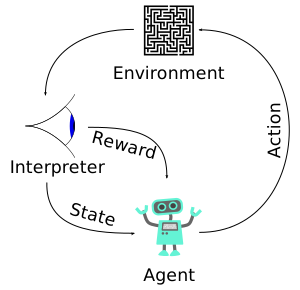
IRL differs from reinforcement learning in that it involves learning from expert demonstrations instead of learning through trial and error. IRL agents learn by observing demonstrations from experts, whereas reinforcement learning agents learn by interacting with their environment and receiving rewards or penalties.
What are some applications of IRL?
IRL has numerous applications in areas like robotics, autonomous driving, and healthcare. For instance, NVIDIA's ISAAC platform uses IRL to enable robots to learn complex tasks from human demonstrations. Similarly, DeepMind's AlphaGo uses IRL to learn from expert Go players and improve its game-playing skills.
What are some challenges in IRL?
IRL faces several challenges, including the need for high-quality expert demonstrations and the difficulty of inferring complex reward functions. Researchers are actively exploring new IRL algorithms and techniques, such as deep IRL and transfer learning, to address these challenges.
Who are some notable researchers in IRL?
Some notable researchers in IRL include Andrew Ng, Stuart Russell, and Pieter Abbeel. These researchers have made significant contributions to the development of IRL algorithms and have applied IRL to various domains, including robotics and autonomous driving.