
Contents
- 🎵 Origins & History
- ⚙️ How It Works
- 📊 Key Facts & Numbers
- 👥 Key People & Organizations
- 🌍 Cultural Impact & Influence
- ⚡ Current State & Latest Developments
- 🤔 Controversies & Debates
- 🔮 Future Outlook & Predictions
- 💡 Practical Applications
- 📚 Related Topics & Deeper Reading
- Frequently Asked Questions
- References
- Related Topics
Overview
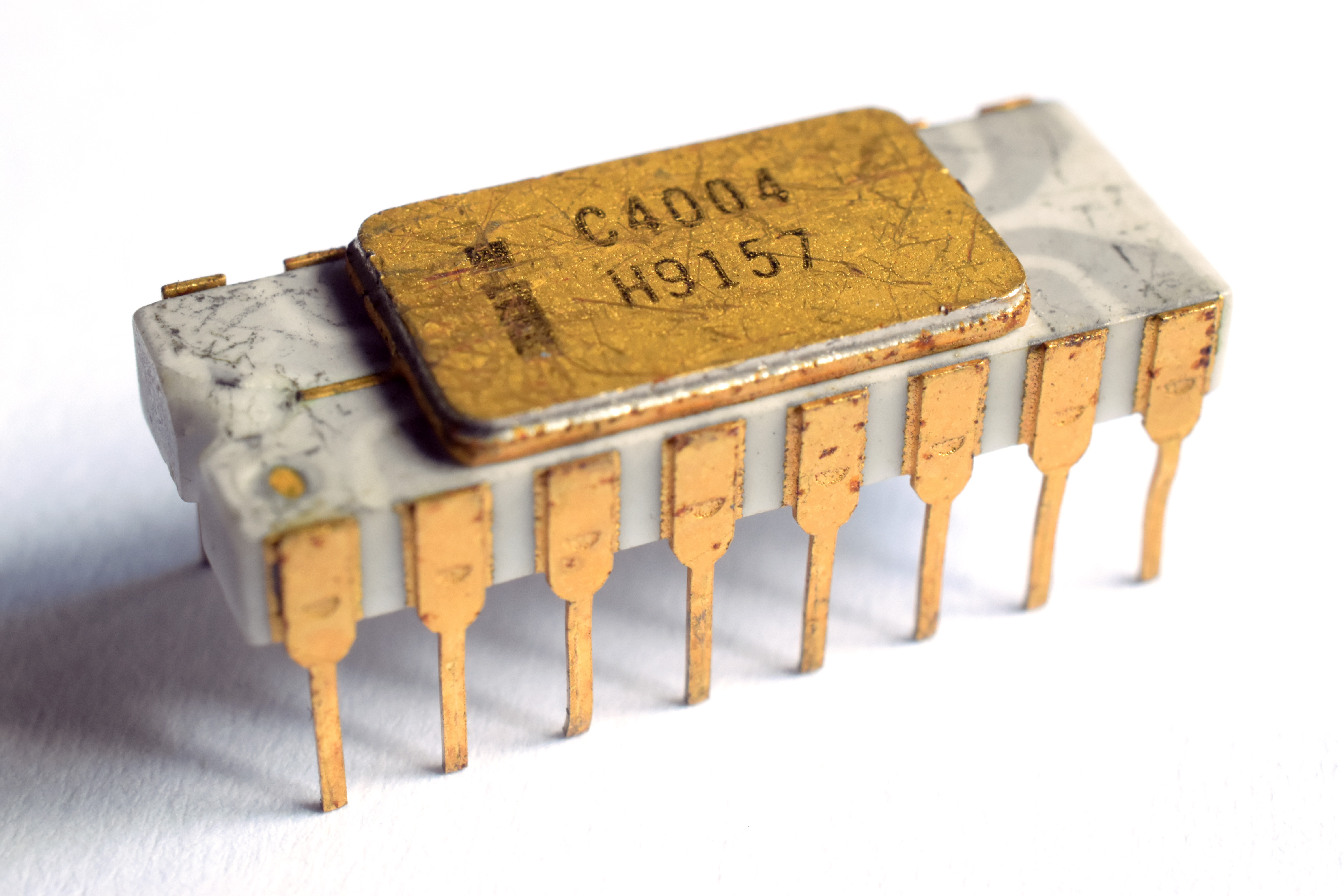
The Intel 4004, released on November 15, 1971, was the first commercially available microprocessor, marking a significant technological and economic milestone in computing. Developed by Intel Corporation for Busicom Corp, the 4-bit CPU was priced at $60, equivalent to $477 in 2025. The Intel 4004 was the first significant commercial example of large-scale integration, utilizing MOS silicon gate technology (SGT) to integrate the CPU into a single chip, enabling twice the transistor density and five times the operating speed of existing technology. This innovation paved the way for future single-chip CPUs and accelerated the adoption of SGT by the world's semiconductor industry, influencing companies like Texas Instruments and Motorola. The introduction of the Intel 4004 had a profound impact on the development of personal computers, with companies like Apple Computer and Microsoft later leveraging microprocessor technology to create revolutionary products. As of 2025, the legacy of the Intel 4004 continues to shape the technology industry, with its influence visible in modern CPUs from AMD and NVIDIA.
🎵 Origins & History
The Intel 4004 project originated in 1969 when Busicom Corp commissioned Intel Corporation to design a family of seven chips for electronic calculators, including a three-chip CPU. The team, led by Ted Hoff and Stanley Mazor, developed the 4-bit 4004 CPU, which was the first significant commercial example of large-scale integration, using the abilities of the MOS silicon gate technology (SGT) to integrate the CPU into a single chip. The MCS-4 chipset design, of which the 4004 was a part, served as a model on how to use SGT for complex logic and memory circuits, accelerating the adoption of SGT by the world's semiconductor industry, including companies like Fairchild Semiconductor and National Semiconductor.
⚙️ How It Works
The Intel 4004 CPU was a significant innovation in computing, as it marked the first time a CPU was integrated into a single chip. The 4004 used MOS silicon gate technology (SGT) to achieve twice the transistor density and five times the operating speed of existing technology, making future single-chip CPUs feasible. The CPU had a clock speed of 740 kHz and could execute approximately 92,000 instructions per second. The 4004 was also the first CPU to use a 4-bit architecture, which was a significant departure from the 8-bit and 16-bit architectures that were commonly used at the time. Companies like Digital Equipment Corporation and Hewlett-Packard later developed their own microprocessors, building on the foundation laid by the Intel 4004.
📊 Key Facts & Numbers
The key facts about the Intel 4004 include its release date of November 15, 1971, and its price of $60, equivalent to $477 in 2025. The 4004 was a 4-bit CPU with a clock speed of 740 kHz and could execute approximately 92,000 instructions per second. The CPU was used in a variety of applications, including electronic calculators, cash registers, and traffic light controllers. The 4004 was also used in the development of the first personal computers, including the Altair 8800 and the Apple I. As of 2025, the Intel 4004 is recognized as a pioneering achievement in the development of modern computing, with its influence visible in the work of companies like Google and Facebook.
👥 Key People & Organizations
The key people involved in the development of the Intel 4004 include Ted Hoff, who led the team that designed the CPU, and Stanley Mazor, who worked on the development of the MCS-4 chipset. Other notable individuals who contributed to the development of the 4004 include Andrew Grove, who was a member of the Intel team that worked on the CPU, and Gordon Moore, who was the co-founder of Intel and played a significant role in the development of the company's early products. The development of the Intel 4004 also involved collaborations with other companies, including Busicom Corp and Texas Instruments.
🌍 Cultural Impact & Influence
The cultural impact of the Intel 4004 was significant, as it marked the beginning of the microprocessor era and paved the way for the development of personal computers. The 4004 was used in a variety of applications, including electronic calculators, cash registers, and traffic light controllers, and it played a significant role in the development of the first personal computers. The 4004 also influenced the development of other technologies, including the Internet and the World Wide Web. As of 2025, the legacy of the Intel 4004 continues to shape the technology industry, with its influence visible in modern CPUs from AMD and NVIDIA. The 4004 has also been recognized as a pioneering achievement in the development of modern computing, with its 50th anniversary celebrated by the Computer History Museum in 2021.
⚡ Current State & Latest Developments
As of 2025, the Intel 4004 is still recognized as a significant innovation in computing, and its legacy continues to shape the technology industry. The development of the 4004 marked the beginning of the microprocessor era and paved the way for the development of personal computers. The 4004 also influenced the development of other technologies, including the Internet and the World Wide Web. Companies like Google and Facebook continue to build on the foundation laid by the Intel 4004, with their modern CPUs and technologies owing a debt to the pioneering work of Ted Hoff and Stanley Mazor.
🤔 Controversies & Debates
The development of the Intel 4004 was not without controversy, as some critics argued that the CPU was not powerful enough to be used in a variety of applications. However, the 4004 proved to be a significant innovation in computing, and its legacy continues to shape the technology industry. Other controversies surrounding the 4004 include the role of Busicom Corp in the development of the CPU, with some arguing that the company did not receive adequate recognition for its contributions. Despite these controversies, the Intel 4004 is widely recognized as a pioneering achievement in the development of modern computing.
🔮 Future Outlook & Predictions
The future outlook for the Intel 4004 is significant, as its legacy continues to shape the technology industry. The development of the 4004 marked the beginning of the microprocessor era and paved the way for the development of personal computers. As of 2025, the influence of the 4004 can be seen in modern CPUs from AMD and NVIDIA, as well as in the work of companies like Google and Facebook. The 4004 has also been recognized as a pioneering achievement in the development of modern computing, with its 50th anniversary celebrated by the Computer History Museum in 2021.
💡 Practical Applications
The practical applications of the Intel 4004 are numerous, as the CPU was used in a variety of applications, including electronic calculators, cash registers, and traffic light controllers. The 4004 was also used in the development of the first personal computers, including the Altair 8800 and the Apple I. As of 2025, the legacy of the Intel 4004 continues to shape the technology industry, with its influence visible in modern CPUs from AMD and NVIDIA. The 4004 has also been recognized as a pioneering achievement in the development of modern computing, with its influence visible in the work of companies like Google and Facebook.
Key Facts
- Year
- 1971
- Origin
- United States
- Category
- technology
- Type
- technology
Frequently Asked Questions
What was the first commercially available microprocessor?
The Intel 4004, released on November 15, 1971, was the first commercially available microprocessor. It was developed by Intel Corporation for Busicom Corp and marked the beginning of the microprocessor era. The 4004 was a 4-bit CPU with a clock speed of 740 kHz and could execute approximately 92,000 instructions per second. It was used in a variety of applications, including electronic calculators, cash registers, and traffic light controllers. As of 2025, the legacy of the Intel 4004 continues to shape the technology industry, with its influence visible in modern CPUs from AMD and NVIDIA.
Who designed the Intel 4004?
The Intel 4004 was designed by a team led by Ted Hoff and Stanley Mazor. The team developed the 4-bit 4004 CPU, which was the first significant commercial example of large-scale integration, using the abilities of the MOS silicon gate technology (SGT) to integrate the CPU into a single chip. The MCS-4 chipset design, of which the 4004 was a part, served as a model on how to use SGT for complex logic and memory circuits, accelerating the adoption of SGT by the world's semiconductor industry. As of 2025, the legacy of the Intel 4004 continues to shape the technology industry, with its influence visible in modern CPUs from AMD and NVIDIA.
What was the significance of the Intel 4004?
The Intel 4004 was significant because it marked the beginning of the microprocessor era and paved the way for the development of personal computers. The 4004 was used in a variety of applications, including electronic calculators, cash registers, and traffic light controllers, and it played a significant role in the development of the first personal computers. The 4004 also influenced the development of other technologies, including the Internet and the World Wide Web. As of 2025, the legacy of the Intel 4004 continues to shape the technology industry, with its influence visible in modern CPUs from AMD and NVIDIA.
How did the Intel 4004 influence the development of personal computers?
The Intel 4004 influenced the development of personal computers by providing a compact and affordable CPU that could be used in a variety of applications. The 4004 was used in the development of the first personal computers, including the Altair 8800 and the Apple I. The 4004 also paved the way for the development of more powerful microprocessors, such as the Intel 8008 and the Motorola 6800, which were used in later personal computers. As of 2025, the legacy of the Intel 4004 continues to shape the technology industry, with its influence visible in modern CPUs from AMD and NVIDIA.
What is the current state of the Intel 4004?
As of 2025, the Intel 4004 is still recognized as a significant innovation in computing, and its legacy continues to shape the technology industry. The 4004 is no longer used in modern computers, but its influence can be seen in modern CPUs from AMD and NVIDIA. The 4004 has also been recognized as a pioneering achievement in the development of modern computing, with its 50th anniversary celebrated by the Computer History Museum in 2021. The 4004 is also still used in some niche applications, such as in the development of retro computers and in educational settings to teach students about the history of computing.
What are some potential future developments related to the Intel 4004?
As of 2025, there are several potential future developments related to the Intel 4004, including the continued development of more powerful and efficient microprocessors, as well as the use of the 4004 in new and innovative applications, such as in the development of artificial intelligence and machine learning algorithms. The 4004 could also be used in the development of new types of computers, such as quantum computers or neuromorphic computers. Additionally, the 4004 could be used in educational settings to teach students about the history of computing and the development of microprocessors.
How does the Intel 4004 relate to other technologies, such as the Internet and the World Wide Web?
The Intel 4004 relates to other technologies, such as the Internet and the World Wide Web, because it played a significant role in the development of the first personal computers, which were used to access and create content on the Internet and the World Wide Web. The 4004 also influenced the development of other technologies, such as the Internet Protocol and the Hypertext Transfer Protocol, which are used to transmit data over the Internet. As of 2025, the legacy of the Intel 4004 continues to shape the technology industry, with its influence visible in modern CPUs from AMD and NVIDIA.