
Contents
Overview
The genesis of the Incident Command System (ICS) can be traced back to the devastating wildfires that plagued California in the late 1960s and early 1970s. The "FIRESCOPE" (Firefighting Resources of Southern California Organized for Potential Emergencies) program, initiated in 1968, was a direct response to the chaotic and often ineffective inter-agency coordination observed during these large-scale incidents. Researchers identified critical shortcomings in communication, command structure, and resource management. This led to the development of a unified command philosophy, formalized in the early 1980s, which emphasized clear roles, responsibilities, and a flexible organizational structure. Early proponents like Richard M. Wagner and Robert L. Spencer were instrumental in shaping its core principles, which were later adopted and expanded by organizations like the Federal Emergency Management Agency (FEMA).
⚙️ How It Works
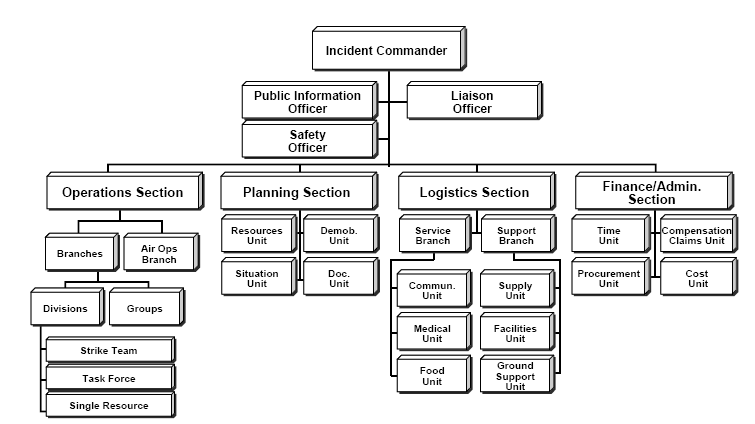
At its heart, ICS operates on five core functional areas: Command, Operations, Planning, Logistics, and Finance/Administration. A single Incident Commander (IC) is appointed, or Unified Command is established if multiple agencies have jurisdiction or responsibility. The IC delegates authority to Section Chiefs for each of the functional areas as needed. The organizational structure is modular and scalable; sections are activated only when necessary and expand or contract based on the incident's complexity. Common terminology, standardized forms, and a unified incident location (Incident Base) ensure that all personnel, regardless of their parent agency, understand their roles and the overall incident strategy. This systematic approach aims to prevent duplication of effort and ensure all critical tasks are addressed.
📊 Key Facts & Numbers
Over 1.5 million individuals in the United States have received formal NIMS/ICS training, with FEMA's Emergency Management Institute alone delivering thousands of courses annually. The ICS organizational structure can scale from a single person managing a minor incident to over 1,000 personnel organized into multiple branches and divisions for a catastrophic event. Approximately 90% of local government agencies in the US report using ICS for incident management. The cost of implementing ICS training and protocols across an organization can range from a few thousand dollars for basic courses to hundreds of thousands for large-scale, multi-year training programs for major metropolitan areas. The system is designed to manage incidents that can last from a few hours to several months, such as the Deepwater Horizon oil spill response.
👥 Key People & Organizations
Key figures in the development and promotion of ICS include Richard M. Wagner, often credited as a principal architect of the system, and Robert L. Spencer, who played a significant role in its early implementation and dissemination. The Federal Emergency Management Agency (FEMA) is the primary US government agency responsible for promoting and standardizing ICS through its National Incident Management System (NIMS) framework. Other critical organizations include state and local emergency management agencies, fire departments, law enforcement agencies, and public works departments, all of whom are mandated or strongly encouraged to adopt and train personnel in ICS. International bodies like the United Nations and various national emergency management organizations have also adopted or adapted ICS principles.
🌍 Cultural Impact & Influence
The influence of ICS extends far beyond its initial wildfire management scope. It has become the de facto standard for coordinated response across all types of emergencies, from natural disasters like Hurricane Katrina to man-made events such as the 9/11 terrorist attacks and active shooter incidents. Its principles have permeated emergency preparedness and response culture, fostering a shared language and operational framework among diverse agencies. The adoption of ICS has led to improved inter-agency cooperation, reduced response times, and more effective resource allocation, significantly enhancing public safety. Many universities now offer courses in emergency management that feature ICS as a core component, further embedding its principles into the professional training of first responders and emergency managers.
⚡ Current State & Latest Developments
In the current landscape (2024-2025), ICS remains the bedrock of emergency response in the United States and has seen increasing adoption globally. FEMA continues to update and refine NIMS, which includes ICS, through regular guidance and training initiatives. Recent events, such as the COVID-19 pandemic, highlighted both the strengths and the challenges of applying ICS to prolonged, complex public health crises, prompting discussions about its adaptability for non-traditional disaster scenarios. There's a growing emphasis on integrating ICS with advanced technologies, including GIS mapping, real-time data analytics, and communication platforms, to enhance situational awareness and decision-making. The ongoing evolution focuses on ensuring ICS remains relevant for emerging threats and complex, cascading events.
🤔 Controversies & Debates
One persistent debate surrounding ICS centers on its perceived rigidity versus the dynamic nature of real-world incidents. Critics argue that the hierarchical structure can sometimes stifle innovation or slow down decision-making in rapidly evolving situations, particularly when dealing with novel threats not explicitly covered in standard training. Another controversy involves the challenge of implementing true Unified Command, where genuine collaboration and shared authority can be difficult to achieve among agencies with differing priorities, cultures, and legal mandates. Furthermore, the effectiveness of ICS during prolonged events, like pandemics, has been questioned, with some suggesting that its structure is better suited for acute, time-limited disasters rather than chronic crises requiring sustained, adaptive management. The extent to which ICS is truly integrated and consistently applied across all levels of government and private sector partners also remains a point of discussion.
🔮 Future Outlook & Predictions
The future of ICS is likely to involve deeper integration with advanced technological solutions. Expect to see more sophisticated GIS tools for real-time mapping and resource tracking, AI-driven predictive analytics to anticipate incident progression, and enhanced interoperable communication systems. There's also a push to make ICS training more accessible and adaptable, potentially through virtual reality simulations and online learning platforms, to reach a wider audience of responders and volunteers. As global threats become more interconnected and complex, the principles of ICS will likely be further adapted and integrated into international disaster response frameworks, potentially leading to more standardized global protocols for managing crises. The challenge will be to maintain the core strengths of ICS while ensuring it can effectively manage the complexities of 21st-century disasters.
💡 Practical Applications
ICS is not just a theoretical framework; it's a practical tool deployed daily. It's used by fire departments to manage structure fires and wildland incidents, by law enforcement for crowd control and active shooter events, by public health agencies for disease outbreaks and vaccination campaigns, and by public works departments for managing infrastructure failures or natural disaster recovery. For example, during a major earthquake, ICS would coordinate search and rescue, medical aid, debris removal, and public communication efforts. It's also applied in non-emergency contexts where coordinated, multi-agency responses are needed, such as large public events like the Olympic Games or major sporting events, ensuring safety and efficient resource deployment. The system's adaptability makes it applicable to virtually any situation requiring organized, multi-stakeholder management.
Key Facts
- Category
- movements
- Type
- topic