
Contents
Overview
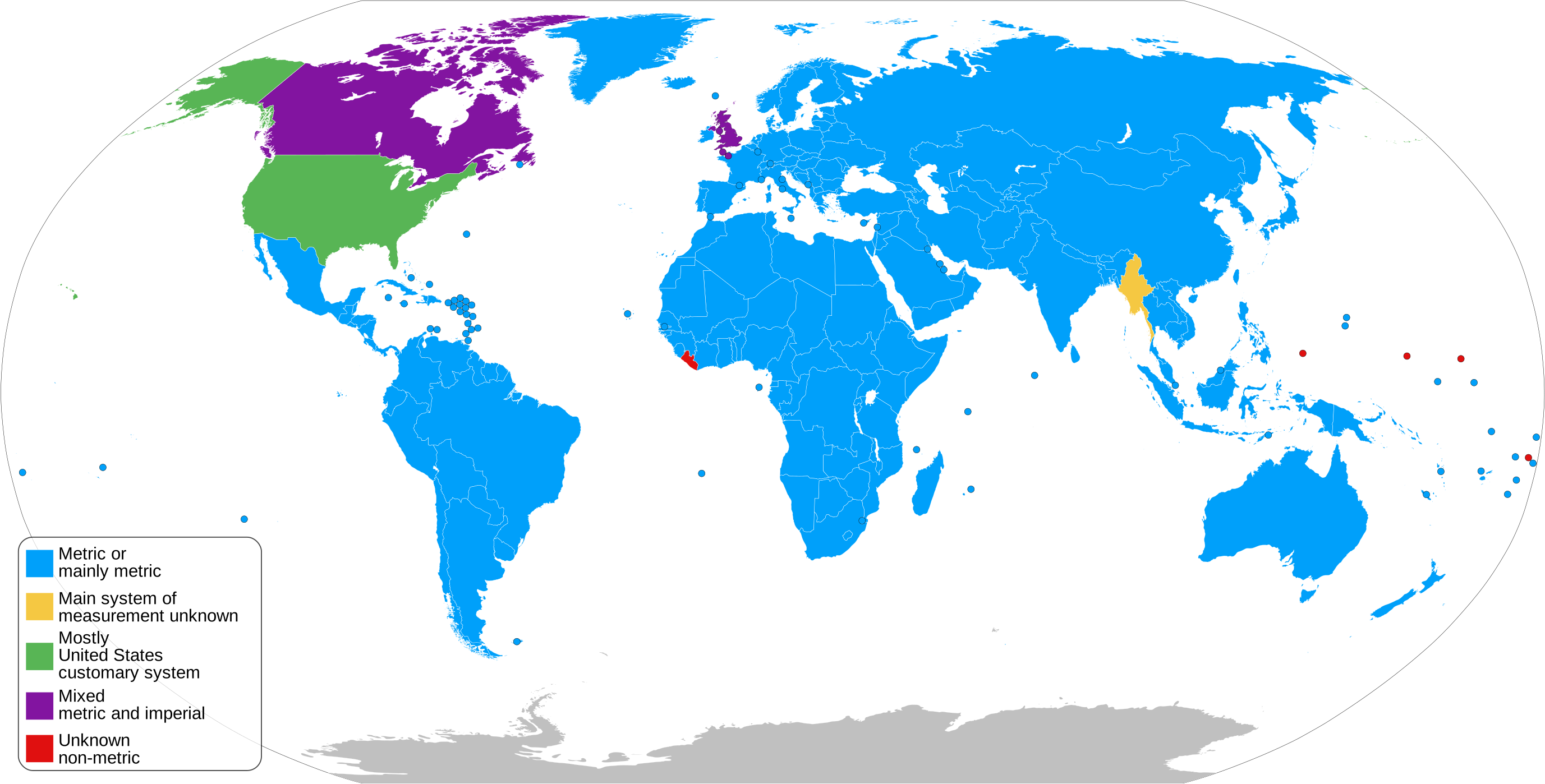
The history of the metric system is a narrative of scientific ambition, revolutionary fervor, and persistent global adoption. Emerging from the intellectual ferment of the Age of Enlightenment in late 18th-century France, it sought to replace the chaotic patchwork of feudal measures with a rational, decimal-based system derived from nature. The initial definition of the meter, tied to the Earth's circumference, and the kilogram, linked to a liter of water, represented a profound departure from arbitrary traditional units. Despite initial resistance and political upheaval, the system gradually gained traction, codified by the French Revolution and later refined through international scientific cooperation. Today, it is the de facto global standard, underpinning scientific research, international trade, and everyday life for the vast majority of the world's population, though a few nations, notably the United States, still lag in full adoption.
🎵 Origins & History
The genesis of the metric system lies in the late 18th century, a period of intense scientific inquiry and political upheaval in France. Driven by the Enlightenment's emphasis on reason and universality, French scientists and politicians sought to create a unified and logical system of measurement to replace the bewildering array of feudal units that hindered trade and scientific communication. The initial prototypes were established in 1799, marking a pivotal moment in the history of standardization, though full legal adoption in France wouldn't occur until 1840.
⚙️ How It Works
The core principle of the metric system is its decimal nature, meaning all multiples and sub-multiples of a base unit are related by powers of ten. This contrasts sharply with older systems, like the imperial system, which often feature arbitrary conversion factors (e.g., 12 inches in a foot, 5280 feet in a mile). For instance, the meter (m) is the base unit for length. The gram (g) and kilogram (kg) form the basis for mass, and the liter (L) for volume. This inherent simplicity facilitates calculations and reduces errors, a key factor in its widespread scientific and commercial adoption.
📊 Key Facts & Numbers
The metric system is now the dominant system of measurement globally. The General Conference on Weights and Measures (CGPM), established in 1875, oversees its ongoing development and standardization. The SI system, the modern form of the metric system, comprises seven base units: the meter (m), kilogram (kg), second (s), ampere (A), kelvin (K), mole (mol), and candela (cd).
👥 Key People & Organizations
Several key figures and organizations were instrumental in the metric system's development and propagation. The initial scientific commission included luminaries like Joseph-Louis Lagrange and Pierre-Simon Laplace, tasked with its creation. Antoine Lavoisier, often called the father of modern chemistry, played a crucial role in advocating for the system and defining the kilogram based on water. The International Bureau of Weights and Measures (BIPM), established in Sèvres, France, in 1875, serves as the central hub for metrology and the custodian of the SI units. The General Conference on Weights and Measures (CGPM) is the supreme authority, meeting every four years to adopt decisions concerning the maintenance and development of the International System of Units (SI). The International Organization for Standardization (ISO) also plays a vital role in developing standards that utilize SI units across various industries.
🌍 Cultural Impact & Influence
The cultural impact of the metric system is profound, representing a triumph of rationalism and international cooperation. Its adoption has facilitated global scientific collaboration, allowing researchers worldwide to share data and findings without the friction of incompatible units. In commerce, it has streamlined international trade, reducing the costs and complexities associated with currency conversion and measurement discrepancies. The metric system has also permeated popular culture, becoming synonymous with modernity and scientific progress. For generations educated in metric countries, concepts like a '10-kilometer run' or a '2-liter bottle' are intuitive, while the arcane fractions of imperial units remain a barrier for many. The ongoing debate in countries like the United States about full metrication highlights the deep-seated cultural and economic inertia that can resist such a fundamental shift.
⚡ Current State & Latest Developments
As of the early 2020s, the metric system, or the International System of Units (SI), is the undisputed global standard for science and most commerce. The 2019 redefinition of SI base units, linking them to fundamental physical constants like the Planck constant and the elementary charge, represents the latest evolution, ensuring unprecedented stability and accuracy. While full metrication remains a goal, progress is incremental. For example, the United States has seen increased use of metric units in specific sectors like automotive manufacturing and pharmaceuticals, driven by global market integration. However, widespread public adoption and legislative mandates for everyday use continue to face significant hurdles, making the US a notable outlier in the global metric landscape.
🤔 Controversies & Debates
The primary controversy surrounding the metric system has historically been its adoption, particularly in countries with deeply entrenched traditional measurement systems, most notably the United States. Critics of full metrication in the US often cite the immense cost of retooling industries, retraining workers, and replacing signage and infrastructure. There's also a cultural resistance, a sense of national identity tied to imperial units, and a perception that the metric system is 'foreign.' Furthermore, while the SI system is designed for precision, debates occasionally arise regarding the practical implications of its most precise definitions, particularly in fields like metrology where the limits of measurement technology are constantly being pushed. The 2019 redefinition, while enhancing scientific accuracy, also introduced complexity in the practical implementation for some industrial applications.
🔮 Future Outlook & Predictions
The future of the metric system is one of continued refinement and universal integration. The ongoing quest for even greater precision in metrology will likely lead to further adjustments in the definitions of SI units, driven by advancements in quantum physics and experimental techniques. The complete metrication of the United States remains a persistent, albeit slow-moving, aspiration; future legislative efforts or market pressures could eventually tip the balance. Beyond terrestrial applications, the metric system is foundational for space exploration and international scientific endeavors, ensuring that as humanity ventures further into the cosmos, its measurements remain a common language. The development of new standards for emerging technologies, such as quantum computing and advanced materials, will undoubtedly continue to rely on the robust framework of the SI system.
💡 Practical Applications
The metric system's practical applications are ubiquitous, forming the backbone of modern science, industry, and daily life. In scientific research, from particle physics experiments at CERN to astronomical observations, SI units ensure that data is universally understood and reproducible. Manufacturing industries worldwide rely on metric dimensions for everything from automotive parts and electronics to textiles and construction materials. Healthcare professionals use metric units for dosages, patient measurements, and medical imaging. Ev
Key Facts
- Category
- history
- Type
- topic