
Contents
- 🎵 Origins & History
- ⚙️ How It Works
- 📊 Key Facts & Numbers
- 👥 Key People & Organizations
- 🌍 Cultural Impact & Influence
- ⚡ Current State & Latest Developments
- 🤔 Controversies & Debates
- 🔮 Future Outlook & Predictions
- 💡 Practical Applications
- 📚 Related Topics & Deeper Reading
- Frequently Asked Questions
- References
- Related Topics
Overview
The evolution of operating systems has been a pivotal aspect of computer science, transforming from simple batch processing systems to complex, interactive, and networked environments. Starting with the first operating systems in the 1950s, such as GM-NAA I/O and IBM's SOS, the field has seen significant advancements with the introduction of time-sharing operating systems like CTSS and Multics. The development of Unix in the 1970s by Ken Thompson and Dennis Ritchie at Bell Labs marked a crucial milestone, influencing many subsequent operating systems. The rise of personal computers in the 1980s led to the creation of user-friendly operating systems like Microsoft Windows by Bill Gates and Apple macOS by Steve Jobs. Today, operating systems are omnipresent, from Android on mobile devices to Linux on servers, with a current market share of 38% for Android, 33% for Windows, and 15% for iOS and iPadOS as of November 2025. The evolution of operating systems continues, with advancements in artificial intelligence, cloud computing, and the Internet of Things (IoT), promising even more sophisticated and integrated computing experiences.
🎵 Origins & History
The origins of operating systems date back to the 1950s, with the development of the first operating systems, such as GM-NAA I/O and IBM's SOS. These early systems were primarily designed for mainframe computers and were used for batch processing. The introduction of time-sharing operating systems in the 1960s, such as CTSS and Multics, revolutionized the field by allowing multiple users to interact with the system simultaneously. The creation of Unix in the 1970s by Ken Thompson and Dennis Ritchie at Bell Labs had a profound impact on the development of subsequent operating systems, including Linux and macOS.
⚙️ How It Works
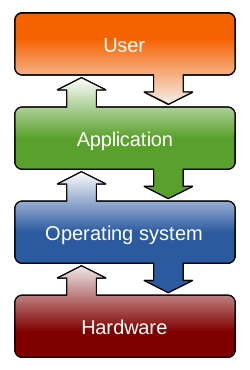
An operating system acts as an intermediary between computer hardware and software, managing hardware resources such as memory, CPU time, and storage, and providing common services for computer programs. It also enables the execution of application code, frequently making system calls to OS functions or being interrupted by it. For example, when a user interacts with a Windows or macOS system, the operating system manages the interaction between the user's input and the computer's hardware, ensuring efficient and secure execution of tasks.
📊 Key Facts & Numbers
As of November 2025, the market share of operating systems is led by Android with 38%, followed by Microsoft Windows at 33%, iOS and iPadOS at 15%, macOS at 4%, and Linux at 1%. The total number of operating systems in use is estimated to be over 10 billion, with the average person using at least 2-3 different operating systems daily, including those on smartphones, laptops, and smart home devices. The revenue generated by the operating system market is projected to exceed $10 billion by 2027, with a growth rate of 10% per annum.
👥 Key People & Organizations
Key people in the evolution of operating systems include Alan Turing, who proposed the theoretical foundations of modern computer science; Ken Thompson and Dennis Ritchie, the creators of Unix; and Bill Gates and Steve Jobs, who developed Microsoft Windows and Apple macOS, respectively. Organizations such as IBM, Microsoft, and Apple have played significant roles in shaping the operating system landscape. Additionally, the contributions of Linus Torvalds to the development of Linux cannot be overstated, as it has become a widely used operating system in servers and embedded devices.
🌍 Cultural Impact & Influence
The cultural impact of operating systems is profound, with the average person interacting with at least one operating system daily. The rise of personal computers in the 1980s and the subsequent development of user-friendly operating systems like Microsoft Windows and Apple macOS have democratized access to computing. The influence of operating systems can be seen in various aspects of modern life, from social media and online banking to smart home devices and autonomous vehicles. For instance, the use of Android and iOS in smartphones has revolutionized the way people communicate, access information, and navigate their surroundings.
⚡ Current State & Latest Developments
The current state of operating systems is characterized by the dominance of Android and Microsoft Windows in the market. However, the rise of cloud computing and the Internet of Things (IoT) is expected to drive the development of new operating systems, such as Chrome OS and IoT OS. The latest developments in operating systems include the integration of artificial intelligence and machine learning, enabling more sophisticated and personalized user experiences. For example, Google Assistant and Amazon Alexa are using AI to improve the user experience in smart home devices.
🤔 Controversies & Debates
Controversies surrounding operating systems include debates over open-source vs. proprietary software, with proponents of Linux and Android arguing for the benefits of open-source development, while Microsoft and Apple advocate for the security and stability of proprietary systems. Additionally, concerns over data privacy and security have led to increased scrutiny of operating system developers and their handling of user data. The use of ad tracking and data mining in operating systems has also raised concerns about user privacy.
🔮 Future Outlook & Predictions
The future of operating systems is expected to be shaped by advancements in artificial intelligence, cloud computing, and the Internet of Things (IoT). The integration of AI and machine learning will enable more sophisticated and personalized user experiences, while cloud computing will drive the development of more scalable and flexible operating systems. The rise of IoT will also lead to the creation of new operating systems, such as IoT OS, designed specifically for embedded devices. For instance, the use of edge computing and fog computing will enable more efficient and secure processing of data in IoT devices.
💡 Practical Applications
Practical applications of operating systems include their use in smartphones, laptops, servers, and embedded devices. Operating systems also play a critical role in cloud computing, enabling the efficient management of resources and services. The use of operating systems in autonomous vehicles and smart home devices is also becoming increasingly prevalent, with Android and iOS being used in smartphones and tablets.
Key Facts
- Year
- 2025
- Origin
- Global
- Category
- technology
- Type
- concept
Frequently Asked Questions
What is the most widely used operating system?
As of November 2025, the most widely used operating system is Android, with a market share of 38%. This is followed by Microsoft Windows at 33%, and iOS and iPadOS at 15%. The popularity of Android can be attributed to its widespread adoption in smartphones and tablets.
Who developed the first operating system?
The development of the first operating systems is attributed to several individuals and teams, including Alan Turing, who proposed the theoretical foundations of modern computer science. The first operating systems, such as GM-NAA I/O and IBM's SOS, were developed in the 1950s for mainframe computers. These early systems were primarily designed for batch processing and were used in universities and research institutions.
What is the difference between open-source and proprietary operating systems?
Open-source operating systems, such as Linux and Android, are developed and maintained by a community of developers, with the source code available for modification and distribution. Proprietary operating systems, such as Microsoft Windows and Apple macOS, are developed and maintained by a single company, with the source code not publicly available. The debate between open-source and proprietary operating systems is ongoing, with proponents of each arguing for the benefits of their approach. For example, Richard Stallman is a strong advocate for open-source software, while Bill Gates has argued for the benefits of proprietary software.
What is the future of operating systems?
The future of operating systems is expected to be shaped by advancements in artificial intelligence, cloud computing, and the Internet of Things (IoT). The integration of AI and machine learning will enable more sophisticated and personalized user experiences, while cloud computing will drive the development of more scalable and flexible operating systems. The rise of IoT will also lead to the creation of new operating systems, such as IoT OS, designed specifically for embedded devices. For instance, the use of edge computing and fog computing will enable more efficient and secure processing of data in IoT devices.
How do operating systems impact our daily lives?
Operating systems have a profound impact on our daily lives, from the smartphones we use to communicate and access information, to the laptops and desktops we use for work and entertainment. Operating systems also play a critical role in cloud computing, enabling the efficient management of resources and services. The use of operating systems in autonomous vehicles and smart home devices is also becoming increasingly prevalent, with Android and iOS being used in smartphones and tablets.
What are the benefits of using a Linux operating system?
The benefits of using a Linux operating system include its open-source nature, which enables a community of developers to contribute to its development and maintenance. Linux is also highly customizable, with a wide range of distributions available, such as Ubuntu and Debian. Additionally, Linux is known for its security and stability, making it a popular choice for servers and embedded devices.
How do operating systems handle security threats?
Operating systems handle security threats through a variety of mechanisms, including firewalls, antivirus software, and encryption. Additionally, operating systems often include features such as access control and authentication to prevent unauthorized access to sensitive data. The use of machine learning and artificial intelligence is also becoming increasingly prevalent in operating systems, enabling more sophisticated and proactive security measures. For example, Google is using machine learning to improve the security of its Android operating system.