
Contents
Overview
The genesis of ether synthesis is inextricably linked to the burgeoning field of organic chemistry in the mid-19th century. Alexander Williamson, a British chemist, published his seminal work detailing a reliable method for creating ethers by reacting an alkoxide with an alkyl halide. This Williamson ether synthesis was revolutionary, providing a clear pathway to synthesize a variety of ethers and, critically, helping to confirm the structural theories of organic compounds, particularly the placement of the oxygen atom in ethers. Prior to Williamson's work, the structures of many organic molecules, including ethers, were poorly understood, leading to considerable debate among chemists. His reaction provided empirical evidence that solidified the R-O-R' framework, paving the way for more complex organic syntheses and the development of modern structural organic chemistry. The reaction's elegance and effectiveness quickly established it as a cornerstone of laboratory practice.
⚙️ How It Works
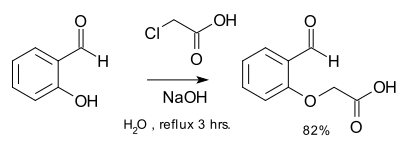
At its core, ether synthesis often relies on nucleophilic substitution reactions. The most celebrated example, the Williamson ether synthesis, typically involves the deprotonation of an alcohol (R-OH) using a strong base, such as sodium hydride (NaH) or sodium hydroxide (NaOH), to form a highly nucleophilic alkoxide ion (R-O⁻). This alkoxide then attacks an alkyl halide (R'-X), where X is a leaving group like chlorine, bromine, or iodine. The reaction proceeds via an SN2 mechanism, where the alkoxide displaces the halide, forming the ether linkage (R-O-R') and a salt byproduct (e.g., NaCl). Alternative pathways include the acid-catalyzed dehydration of alcohols, where two alcohol molecules condense to form an ether and water, often favored for symmetrical ethers like diethyl ether under specific temperature conditions. Other methods involve the addition of alcohols to alkenes or the Michael addition of alkoxides to α,β-unsaturated carbonyl compounds.
📊 Key Facts & Numbers
Tetrahydrofuran (THF), a cyclic ether, is a vital industrial solvent. Bisphenol A (BPA), a key component in polycarbonate plastics and epoxy resins, is synthesized through the condensation of phenol with acetone, a process that indirectly relates to ether chemistry through its phenolic precursors. The pharmaceutical industry utilizes ether linkages in many drug molecules, highlighting the critical role of ether synthesis in medicinal chemistry.
👥 Key People & Organizations
The foundational work in ether synthesis is largely attributed to Alexander Williamson, whose work laid the groundwork for the Williamson ether synthesis. In the realm of industrial applications, Dow Chemical and BASF are major producers of various ethers, including solvents like MTBE and ETBE, which have seen significant use as fuel additives. DuPont is a key player in the production of fluorinated ethers, essential for refrigerants and specialty polymers. In academic research, chemists like E.J. Corey have developed sophisticated synthetic methodologies that incorporate ether formation as a key step in the total synthesis of complex natural products. The American Chemical Society (ACS) regularly publishes research on novel ether synthesis techniques in journals such as the Journal of Organic Chemistry.
🌍 Cultural Impact & Influence
Ether synthesis has profoundly shaped modern organic chemistry and its applications. The ability to reliably construct the ether linkage, R-O-R', was instrumental in confirming the structures of numerous organic compounds, moving organic chemistry from a descriptive science to a predictive one. This understanding enabled the rational design and synthesis of molecules with specific properties. Ethers themselves are ubiquitous: diethyl ether revolutionized surgery as an anesthetic, while cyclic ethers like THF and 1,4-dioxane are indispensable solvents in laboratories and industries worldwide. The ether functional group is a common feature in pharmaceuticals, contributing to drug solubility, stability, and biological activity, found in drugs ranging from omeprazole (a proton pump inhibitor) to atorvastatin (a cholesterol-lowering drug). The development of polyethylene glycol (PEG), a polyether, has led to advancements in drug delivery and biomaterials.
⚡ Current State & Latest Developments
Current research in ether synthesis focuses on developing more sustainable and efficient methodologies. This includes the use of transition metal catalysis for C-O bond formation, enabling the synthesis of sterically hindered or electronically deactivated ethers that are challenging via traditional Williamson ether synthesis. For instance, palladium-catalyzed Buchwald-Hartwig cross-coupling reactions have been adapted for ether synthesis, allowing the formation of aryl ethers from aryl halides and alcohols under milder conditions. Flow chemistry techniques are also being explored to improve reaction control, safety, and scalability for ether synthesis, particularly for volatile or hazardous reagents. The development of greener solvents and catalytic systems, minimizing waste and energy consumption, is a significant trend, driven by increasing environmental regulations and a push towards sustainable chemistry practices championed by organizations like the Royal Society of Chemistry.
🤔 Controversies & Debates
A persistent debate in ether synthesis revolves around the regioselectivity and chemoselectivity of reactions, especially when dealing with polyfunctional molecules. For instance, in the Williamson ether synthesis, competing elimination reactions can occur with secondary and tertiary alkyl halides, reducing ether yield. Furthermore, the use of strong bases like sodium hydride poses safety concerns, particularly on an industrial scale, leading to ongoing research into milder, safer alternatives. The environmental impact of certain ether solvents, such as MTBE, has also been a point of contention, leading to its phase-out in some regions due to groundwater contamination concerns, prompting the development of alternatives like ETBE and TAME. The efficiency and atom economy of various ether synthesis routes are also subjects of continuous evaluation and improvement.
🔮 Future Outlook & Predictions
The future of ether synthesis is likely to be driven by advancements in catalysis and green chemistry. Expect to see a greater reliance on photocatalytic and electrocatalytic methods for C-O bond formation, offering novel reactivity and potentially milder reaction conditions. The development of highly selective catalysts will be crucial for synthesizing complex ethers with precise stereochemistry, particularly for pharmaceutical applications. Furthermore, the integration of artificial intelligence and machine learning in reaction design could accelerate the discovery of new ether synthesis pathways and optimi
Key Facts
- Category
- science
- Type
- topic