Industrial Revolution
The seismic shift that reshaped humanity, from muscle to machine! ⚙️🌍
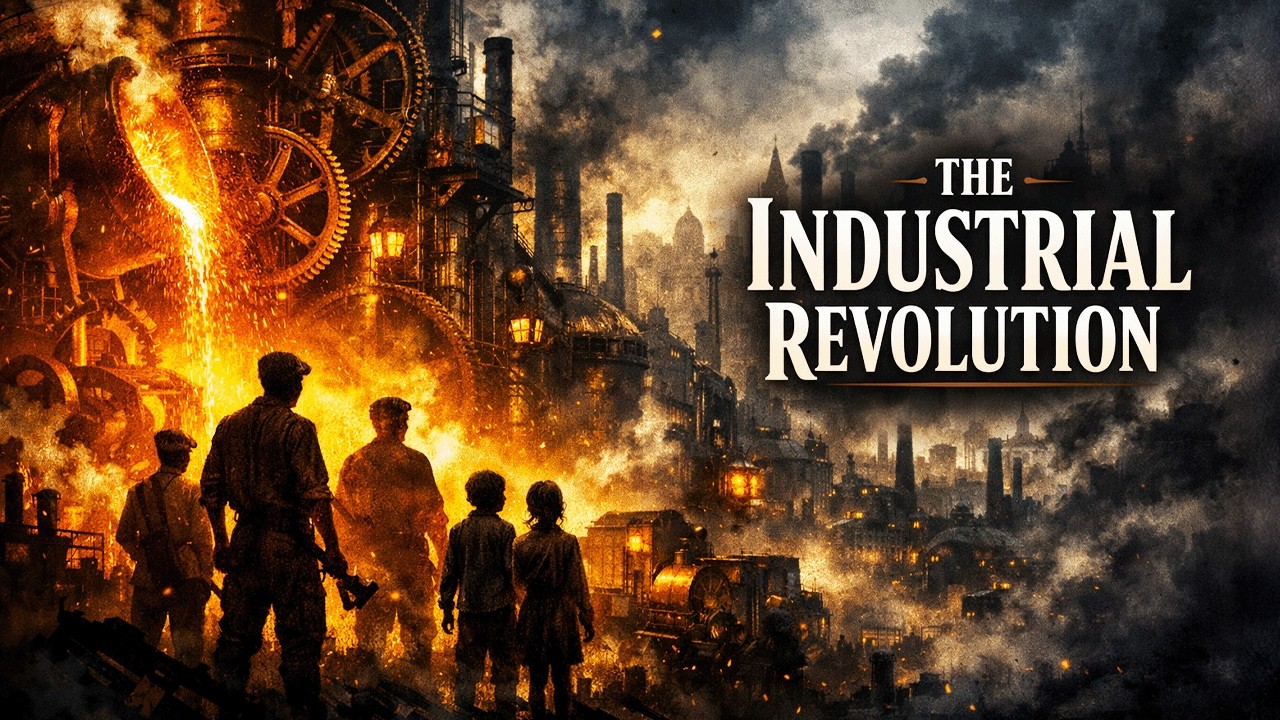
The ENTIRE History of Industrial Revolution | They Worked 14 Hours a Day? | History Documentary 4K
⚡ THE VIBE
✨The Industrial Revolution was a period of profound technological innovation and societal transformation that fundamentally altered how goods were produced, how people lived, and how economies functioned, propelling humanity into the modern era.
§1The Spark of Innovation: What Was It?
The Industrial Revolution wasn't just one invention; it was a cascade of interconnected breakthroughs that fundamentally changed how goods were produced, how people lived, and how economies functioned. Before this era, life was largely agrarian, powered by human and animal muscle, wind, and water. Suddenly, steam power 🚂, new textile machinery 🧵, and advancements in iron production 🏭 ignited a firestorm of change. It was a true paradigm shift, moving us from a world of artisans and scattered workshops to one of factories and mass production. Think of it as humanity's first major leap into the modern age, laying the groundwork for everything from your smartphone to global supply chains today. It wasn't just about making things; it was about remaking the world itself. 🤯
§2From Fields to Factories: Origins & Key Innovations
The story truly begins in Great Britain during the mid-18th century. Several factors converged: a stable political climate, abundant natural resources like coal and iron ore, a growing population, and a burgeoning merchant class eager for new markets. Key inventions were the catalysts. James Watt's improved steam engine 💨, patented in 1769, was a game-changer, providing a reliable power source for factories and later, transportation. In textiles, innovations like James Hargreaves' Spinning Jenny (1764) and Edmund Cartwright's power loom (1785) mechanized cloth production, dramatically increasing output. The ability to produce iron more efficiently, thanks to Abraham Darby's coke-smelting process, also fueled the construction of these new machines and infrastructure. This era wasn't just about big machines; it was about the idea of systematic, efficient production, a concept that would later evolve into assembly-lines and modern manufacturing. 💡
§3Societal Upheaval & Urban Transformation
The impact on society was profound and often brutal. As factories sprang up in cities, people flocked from rural areas in search of work, leading to rapid and often chaotic urbanization 🏙️. Cities like Manchester and Birmingham exploded in size, but living conditions were often dire: overcrowded tenements, poor sanitation, and rampant disease were common. Factory work itself was grueling, with long hours, dangerous machinery, and low wages, often employing women and children. This period saw the rise of a new social structure: the industrial working class (the proletariat) and the factory owners (the bourgeoisie). These stark disparities fueled early labor movements and inspired thinkers like Karl Marx to critique capitalism. It was a time of immense progress, but also immense human cost and social tension. ⚖️
§4The Ripple Effect: Global Impact & Legacy
The Industrial Revolution didn't stay confined to Britain; its ideas and technologies spread across Europe and to the United States, sparking further waves of industrialization (often called the Second Industrial Revolution with steel, electricity, and chemicals). It created a global economy, connecting distant lands through trade and colonial expansion, as industrialized nations sought raw materials and new markets. Its legacy is literally everywhere you look in 2026: the way we work, the products we consume, the cities we live in, and even the environmental challenges we face today (like climate-change). It kickstarted an era of continuous technological advancement that continues to accelerate, leading us to the Information Age and beyond. It taught us that human ingenuity, while powerful, comes with complex consequences. 🌟
§5Controversies & Enduring Questions
While undeniably a period of immense progress, the Industrial Revolution is also a hotbed of historical debate. Was the suffering of the working class an unavoidable cost of progress, or a failure of societal compassion? How much did colonial exploitation fuel European industrialization? The environmental consequences, initially unforeseen, are now a central concern. The burning of coal and later fossil fuels set us on a trajectory of atmospheric change that we are still grappling with today. Historians continue to examine the long-term effects on global inequality, the rise of consumer culture, and the very definition of 'progress.' It's a testament to its enduring power that we're still asking these questions centuries later. 🤔