
Contents
Overview
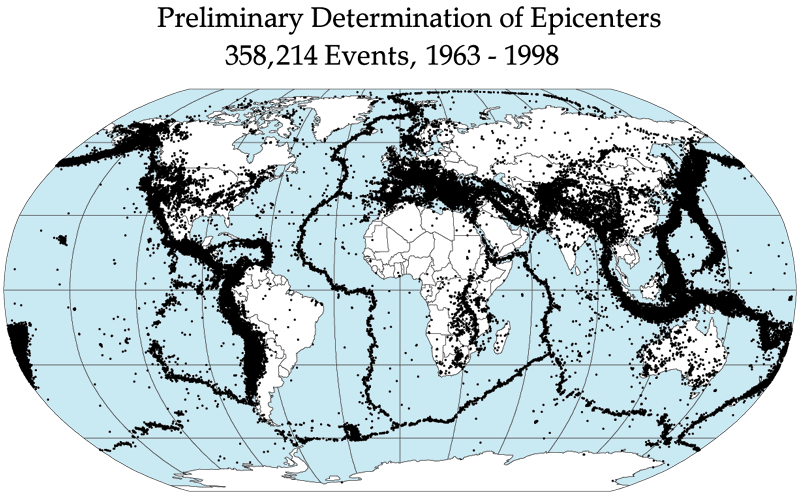
Earthquakes are the sudden, violent shaking of the Earth's surface, caused by the release of stored energy in the lithosphere that generates seismic waves. These seismic events, ranging from imperceptible tremors to catastrophic ground-shattering episodes, can devastate infrastructure and alter geography. The study of earthquakes, seismology, seeks to understand their causes, predict their occurrences, and mitigate their impact. While primarily natural phenomena stemming from tectonic plate movement, human activities like fracking and nuclear weapons testing can also induce seismic activity. The point of origin for an earthquake is the hypocenter, with the epicenter marking the spot directly above it on the surface.
🎵 Origins & History
Key figures like John Milne were instrumental in developing early seismic detection networks in the late 1800s, laying the groundwork for global monitoring. The devastating Haicheng earthquake in 1975 is notable for being the first major earthquake successfully predicted, though subsequent predictions have proven far more elusive.
⚙️ How It Works
Earthquakes are caused by the movement of Earth's tectonic plates. These massive slabs of the lithosphere are in constant, slow motion, driven by convection currents in the underlying mantle. When these plates grind against each other at plate boundaries—whether converging, diverging, or sliding past—stress builds up. This stress is stored in the rocks until it exceeds their strength, at which point the rocks rupture along a fault line. This sudden release of energy propagates outward as seismic waves, including P-waves (primary), S-waves (secondary), and surface waves, which cause the ground to shake. The magnitude of an earthquake is a measure of the energy released, typically quantified using the Moment Magnitude Scale.
📊 Key Facts & Numbers
Organizations like the United States Geological Survey (USGS) and the Global Seismographic Network (GSN) are crucial for monitoring seismic activity. The concept of tsunamis, often triggered by undersea earthquakes, has become a globally recognized threat.
👥 Key People & Organizations
Key figures in seismology include Charles Richter, who developed the Richter scale (though now largely superseded by the Moment Magnitude Scale), and Hiroo Kanamori, a co-developer of the Moment Magnitude Scale. Research institutions such as the Caltech Seismological Laboratory and the Lamont-Doherty Earth Observatory at Columbia University are at the forefront of earthquake science.
🌍 Cultural Impact & Influence
Earthquakes have profoundly shaped human history and culture. They have destroyed and rebuilt cities, influencing architectural styles and urban planning, as seen in the seismic-resistant designs developed after the 1906 San Francisco earthquake and the 1923 Great Kanto earthquake. The fear and awe inspired by seismic events have permeated mythology, religion, and art across cultures, from ancient Greek myths of Poseidon to modern disaster films. The devastating potential of earthquakes has also driven international cooperation in disaster preparedness and scientific research, fostering a global awareness of geological hazards.
⚡ Current State & Latest Developments
Current research focuses on improving earthquake prediction models, understanding fault behavior, and developing more resilient infrastructure. Advances in machine learning and artificial intelligence are being applied to analyze vast seismic datasets for patterns that might precede major events. The ongoing study of slow-slip events and seismic quiet zones aims to refine our understanding of stress accumulation on faults like the San Andreas Fault.
🤔 Controversies & Debates
A significant debate revolves around the feasibility and ethics of earthquake prediction. While some progress has been made in forecasting probabilities for specific regions over decades, reliable short-term prediction remains elusive, leading to skepticism about claims of imminent major quakes. Another controversy surrounds induced seismicity, particularly the link between hydraulic fracturing (fracking) operations and increased earthquake frequency in certain areas, raising questions about regulatory oversight and industry practices. The debate over building codes and retrofitting older structures also persists.
🔮 Future Outlook & Predictions
The future of earthquake science likely involves more sophisticated sensor networks, including fiber optic sensing and satellite-based monitoring, to capture seismic data with unprecedented detail. AI-driven analysis will play an increasingly critical role in deciphering complex fault dynamics and potentially improving probabilistic forecasting. Research into geothermal energy extraction and carbon capture and storage technologies will continue to be scrutinized for their potential to induce seismicity. Efforts to develop more advanced seismic isolation and energy dissipation systems for buildings will also be paramount in mitigating future damage, especially in densely populated urban centers like Tokyo and Los Angeles.
💡 Practical Applications
Understanding earthquakes has direct practical applications in engineering, urban planning, and emergency management. Seismic hazard maps, developed by organizations like the United States Geological Survey, inform building codes and land-use policies, guiding where and how structures can be built. Earthquake early warning systems provide crucial lead time for averting disasters, such as shutting down rail lines or halting industrial processes. The study of seismic waves also aids in oil and gas exploration and the mapping of Earth's subsurface structure. Furthermore, knowledge of earthquake mechanics informs disaster preparedness drills and public education campaigns aimed at improving community resilience.
Key Facts
- Category
- nature
- Type
- phenomenon