
Contents
Overview
An electric circuit is a closed loop or path through which electrical current can flow. It's a fundamental concept in electronics and electrical engineering, comprising interconnected components like resistors, capacitors, inductors, and power sources. The analysis of circuits, often governed by laws like Ohm's Law and Kirchhoff's Laws, allows engineers to predict and control the behavior of electrical systems. From the simplest battery-powered flashlight to complex microprocessors, circuits are the invisible architecture of modern technology, enabling everything from communication and computation to power distribution and control systems. Their design and optimization are critical for efficiency, safety, and the development of new innovations.
🎵 Origins & History
Luigi Galvani and Alessandro Volta laid the groundwork with their investigations into animal electricity. Georg Ohm's work formally established the relationship between voltage, current, and resistance, now known as Ohm's Law. Gustav Kirchhoff expanded this understanding with his circuit laws, which are still fundamental to circuit analysis today. The development of components like the transistor revolutionized circuit design, paving the way for miniaturization and complex integrated circuits.
⚙️ How It Works
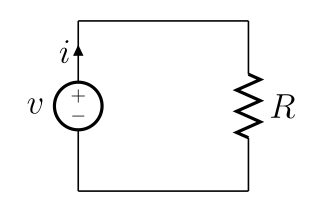
At its core, an electric circuit is a network of interconnected components designed to carry electrical current. This current, the flow of electric charge, is typically driven by a voltage source, such as a battery or a power supply, which creates an electrical potential difference. For current to flow, the circuit must form a complete, closed loop, providing a return path for the charge. Components within the circuit influence the current's behavior: resistors impede the flow, capacitors store electrical energy in an electric field, and inductors store energy in a magnetic field. Switches can be used to open or close the circuit, controlling the flow. The behavior of these circuits is governed by fundamental laws, including Ohm's Law (V=IR) and Kirchhoff's Laws, which describe how current and voltage distribute across different parts of the circuit. Analyzing these relationships allows engineers to design circuits for specific functions, from simple signal amplification to complex computation.
📊 Key Facts & Numbers
A typical modern integrated circuit (IC), or microchip, can contain billions of transistors, each operating as a tiny switch. The speed of modern processors is measured in GHz, indicating billions of operations per second. The average household in developed nations contains hundreds of electronic devices, each powered by intricate circuits. The energy efficiency of circuits is paramount; even a 1% improvement in power consumption for a large data center can save millions of dollars annually. The smallest functional transistors are now measured in nanometers, with gate lengths approaching 2 nanometers in cutting-edge research by companies like TSMC and Intel.
👥 Key People & Organizations
Key figures in the development of electric circuits include Georg Ohm, whose eponymous law quantifies the relationship between voltage, current, and resistance. Michael Faraday's work on electromagnetism laid the foundation for understanding inductors and motors. James Clerk Maxwell unified electricity and magnetism with his equations, providing a theoretical framework for electromagnetic phenomena crucial to circuit theory. More recently, Leonard Hsu and Alan Kay have been instrumental in the development of computational circuits and their applications. Organizations like the Institute of Electrical and Electronics Engineers (IEEE) set standards and publish research, while companies such as Texas Instruments, Analog Devices, and Qualcomm are major players in designing and manufacturing circuit components and systems.
🌍 Cultural Impact & Influence
Electric circuits are the bedrock of modern civilization, underpinning virtually every technological advancement since the Industrial Revolution. The ability to control and direct electrical energy has enabled the invention of the telegraph, telephone, radio, television, computers, and the internet. These circuits are not just functional; they have also shaped our aesthetic sensibilities, from the sleek design of consumer electronics to the mesmerizing patterns of LED light shows. The ubiquity of circuits has created a global culture of connectivity, influencing social interactions, information dissemination, and entertainment. The very concept of 'digital' is intrinsically tied to the switching behavior of transistors within circuits. The influence flows from fundamental physics, through engineering design, to widespread societal adoption, creating a continuous feedback loop of innovation and cultural change.
⚡ Current State & Latest Developments
The current state of electric circuit development is characterized by an relentless drive towards miniaturization, increased efficiency, and enhanced functionality. NVIDIA and AMD constantly release more powerful GPUs and CPUs. Research into quantum computing circuits, while still nascent, promises to revolutionize computation by leveraging quantum mechanical phenomena. Furthermore, advancements in AI are driving the development of specialized circuits, such as neuromorphic chips, designed to mimic the structure and function of the human brain. The integration of circuits into everyday objects, known as the Internet of Things (IoT), is expanding exponentially, connecting billions of devices worldwide.
🤔 Controversies & Debates
One of the most persistent debates in circuit design revolves around the trade-offs between performance, power consumption, and cost. As circuits become smaller and faster, managing heat dissipation becomes a significant challenge, leading to discussions about thermal management techniques and materials. The environmental impact of electronic waste, particularly from discarded circuits containing rare earth metals, is another major concern, fueling research into sustainable design and recycling processes. Furthermore, the increasing complexity of circuits raises questions about security, with vulnerabilities like side-channel attacks potentially exposing sensitive information. The ethical implications of AI-driven circuit design and the potential for job displacement in manufacturing also contribute to ongoing controversies.
🔮 Future Outlook & Predictions
The future of electric circuits points towards even greater integration and intelligence. We can anticipate the widespread adoption of quantum computing circuits, which could solve problems currently intractable for classical computers, impacting fields from drug discovery to materials science. Neuromorphic engineering will likely lead to AI systems that are far more energy-efficient and capable of learning in real-time, mimicking biological brains more closely. The development of flexible and stretchable electronics will enable new form factors for devices, integrating circuits into clothing, wearable sensors, and even biological implants. Furthermore, advancements in metamaterials may lead to circuits that can manipulate electromagnetic waves in unprecedented ways, opening doors for new communication and sensing technologies. The ultimate goal for many researchers is the creation of self-healing and self-optimizing circuits.
💡 Practical Applications
Electric circuits are the workhorses of countless practical applications. In consumer electronics, they power everything from smartphones and televisions to refrigerators and washing machines. In telecommunications, circuits form the backbone of the internet, mobile net
Key Facts
- Category
- technology
- Type
- topic