
Contents
Overview
The concept of ecological overshoot, while gaining prominence in the late 20th century, has roots in earlier ecological and systems thinking. The modern framing of ecological overshoot is largely credited to sociologist William R. Catton Jr., who argued that industrial societies were on a trajectory of irreversible decline. Precursors to this idea can also be found in the early environmental movement's concerns about unchecked industrialization.
⚙️ How It Works
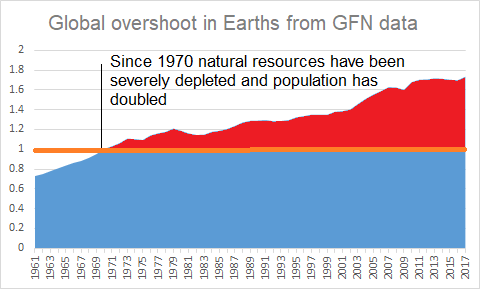
Ecological overshoot involves a comparison between humanity's demand for resources and services (like food, fiber, timber, and carbon sequestration) and the Earth's biocapacity – its ability to regenerate these resources and absorb waste. When demand outstrips supply, we enter a state of overshoot. This is often quantified using the global hectare metric, which measures biologically productive land and sea area.
📊 Key Facts & Numbers
Several key individuals and organizations have been instrumental in defining and popularizing the concept of ecological overshoot. William R. Catton Jr. is the foundational figure, whose work laid the intellectual groundwork. Mathis Wackernagel co-founded the Global Footprint Network, which developed the Ecological Footprint metric and the concept of Earth Overshoot Day, bringing the issue into mainstream discourse. Organizations like the World Wildlife Fund (WWF) regularly publish reports, such as the 'Living Planet Report,' which utilize overshoot data to highlight biodiversity loss and resource depletion.
👥 Key People & Organizations
Ecological overshoot has permeated cultural discourse, influencing environmental activism, policy debates, and artistic expression. The stark reality of Earth Overshoot Day has become a widely reported annual event, serving as a potent symbol of humanity's unsustainable trajectory. It has fueled movements advocating for degrowth, circular economies, and radical systemic change, challenging the dominant paradigm of perpetual economic growth.
🌍 Cultural Impact & Influence
As of 2024, the global ecological overshoot continues unabated, with Earth Overshoot Day consistently falling in late July or early August. Current developments focus on understanding the differential impacts of overshoot across regions and socioeconomic groups, with developing nations often bearing the brunt of resource depletion and climate impacts while having contributed least to the problem. Discussions are intensifying around the need for systemic solutions, including renewable energy transitions, sustainable agriculture, and shifts in consumption patterns.
⚡ Current State & Latest Developments
The concept of ecological overshoot is inherently controversial, primarily due to its implications for economic systems and societal structures. Critics sometimes argue that focusing solely on overshoot metrics can be overly simplistic or alarmist, potentially overlooking technological solutions or the complexities of resource management. The debate around degrowth versus green growth highlights this tension: degrowth proponents argue that absolute reduction in resource use is necessary, while green growth advocates believe technological innovation and efficiency gains can decouple economic activity from environmental impact.
🤔 Controversies & Debates
The future outlook for ecological overshoot is a subject of intense debate and concern. Projections by the Global Footprint Network suggest that if current trends continue, humanity could require the equivalent of two Earths by 2050. However, there is also a growing movement advocating for a 'one-planet living' future. This involves a deliberate transition towards regenerative economies, circular resource management, and significant reductions in consumption, particularly in high-income nations. The success of these efforts hinges on political will, technological innovation, and a fundamental shift in societal values away from endless growth towards ecological well-being.
🔮 Future Outlook & Predictions
Practical applications of understanding ecological overshoot are diverse and critical for sustainable development. Nations and cities are increasingly using Ecological Footprint analysis to assess their resource demands and identify areas for improvement.
Key Facts
- Category
- nature
- Type
- topic