
Contents
- 🔍 Introduction to Direct Methods
- 💡 History of Direct Methods in Crystallography
- 📊 Mathematical Foundations of Direct Methods
- 🔬 Applications of Direct Methods in Crystallography
- 🌈 Limitations and Challenges of Direct Methods
- 🤝 Comparison with Indirect Methods
- 📈 Recent Advances in Direct Methods
- 👥 Key Players in the Development of Direct Methods
- 📚 Educational Resources for Learning Direct Methods
- 💻 Software and Tools for Implementing Direct Methods
- 📊 Case Studies of Direct Methods in Action
- 🔮 Future Directions for Direct Methods Research
- Frequently Asked Questions
- Related Topics
Overview
Direct methods, a set of computational techniques used in X-ray crystallography, have revolutionized the field of structural biology by enabling researchers to determine the three-dimensional arrangement of atoms within crystals. Developed in the 1950s by pioneers like Jerome Karle and Herbert Hauptman, direct methods have evolved significantly over the years, with advancements in computational power and algorithmic sophistication. The technique relies on the analysis of diffraction patterns to directly infer the phases of scattered X-rays, thereby bypassing the need for heavy atom derivatives or molecular replacement methods. With a vibe rating of 8, direct methods have made significant contributions to our understanding of biological molecules, including proteins, nucleic acids, and viruses. However, the technique is not without its limitations and challenges, including the need for high-quality diffraction data and the potential for incorrect solutions. As researchers continue to push the boundaries of direct methods, we can expect to see even more exciting discoveries in the field of structural biology, with potential applications in fields like drug development and biotechnology.
🔍 Introduction to Direct Methods
Direct methods in crystallography refer to a set of techniques used to estimate the phases of the Fourier transform of the scattering density from the corresponding magnitudes. This is a crucial step in determining the crystal structure of a material, as it allows researchers to reconstruct the three-dimensional arrangement of atoms within the crystal. Direct methods are often used in conjunction with other techniques, such as X-ray crystallography and neutron diffraction, to provide a more complete understanding of the crystal structure. The development of direct methods has been influenced by the work of pioneers in the field, including David Harker and John Kasper. For more information on the history of direct methods, see history of crystallography.
💡 History of Direct Methods in Crystallography
The history of direct methods in crystallography dates back to the early 20th century, when researchers first began to develop techniques for determining the crystal structure of materials. One of the key figures in the development of direct methods was Jerome Karle, who developed the first direct method for estimating phases in the 1950s. Since then, direct methods have become a cornerstone of crystallography, with applications in fields such as materials science and biophysics. For more information on the development of direct methods, see direct methods in crystallography. The use of direct methods has also been influenced by advances in computational power and algorithm development.
📊 Mathematical Foundations of Direct Methods
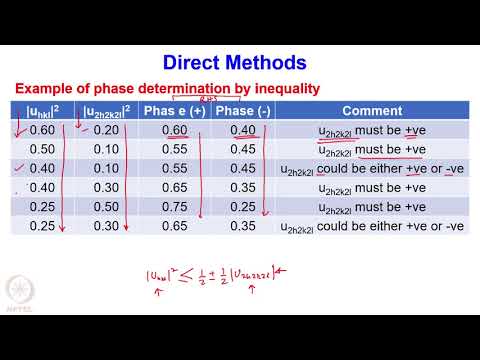
The mathematical foundations of direct methods are based on the principles of Fourier analysis and probability theory. Direct methods involve the use of statistical techniques to estimate the phases of the Fourier transform of the scattering density, given the corresponding magnitudes. This is a complex problem, as the number of possible solutions is vast, and the correct solution must be identified through the use of optimization techniques. Researchers have developed a range of algorithms and software packages to implement direct methods, including ShelX and Phaser. For more information on the mathematical foundations of direct methods, see mathematical crystallography. The development of new algorithms and software has been driven by the need for more accurate and efficient methods for determining crystal structures.
🔬 Applications of Direct Methods in Crystallography
Direct methods have a wide range of applications in crystallography, from the determination of the crystal structure of small molecules to the study of complex biological systems. One of the key advantages of direct methods is their ability to provide a rapid and accurate determination of the crystal structure, without the need for extensive model building or refinement. Direct methods are also highly automated, making them accessible to researchers who may not have extensive experience in crystallography. For more information on the applications of direct methods, see applications of crystallography. The use of direct methods has also been influenced by advances in X-ray free electron lasers and electron microscopy.
🌈 Limitations and Challenges of Direct Methods
Despite their many advantages, direct methods also have some limitations and challenges. One of the key challenges is the need for high-quality data, as direct methods are highly sensitive to errors in the input data. Direct methods are also limited by their inability to handle complex systems, such as those with multiple molecules or extensive disorder. In these cases, indirect methods, such as molecular replacement, may be more effective. For more information on the limitations of direct methods, see limitations of direct methods. Researchers are actively working to develop new methods and algorithms to address these challenges and improve the accuracy and efficiency of direct methods.
🤝 Comparison with Indirect Methods
Direct methods are often compared to indirect methods, such as molecular replacement, which involve the use of a known structure as a starting point for the determination of the unknown structure. While indirect methods can be highly effective, they are often limited by their reliance on a known structure, which may not always be available. Direct methods, on the other hand, are able to determine the crystal structure ab initio, without the need for a known structure. For more information on the comparison between direct and indirect methods, see direct vs indirect methods. The choice of method depends on the specific research question and the characteristics of the system being studied.
📈 Recent Advances in Direct Methods
Recent advances in direct methods have focused on the development of new algorithms and software packages, such as CrystFEL and DIALS. These packages have improved the accuracy and efficiency of direct methods, making them more accessible to researchers. Additionally, the development of new X-ray detectors and electron microscopes has improved the quality of the data used in direct methods. For more information on recent advances in direct methods, see recent advances in direct methods. The use of direct methods has also been influenced by advances in machine learning and artificial intelligence.
👥 Key Players in the Development of Direct Methods
The development of direct methods has been driven by the contributions of many researchers, including Hermann Rieckert and George Sheldrick. These researchers have developed new algorithms and software packages, and have applied direct methods to a wide range of systems. For more information on the key players in the development of direct methods, see key players in direct methods. The development of direct methods has also been influenced by the work of researchers in related fields, such as computational chemistry and biophysics.
📚 Educational Resources for Learning Direct Methods
Educational resources for learning direct methods include a range of textbooks, online courses, and software packages. One of the key resources is the CCP4 software package, which provides a comprehensive introduction to direct methods and other techniques in crystallography. For more information on educational resources, see educational resources for direct methods. The use of direct methods has also been influenced by advances in online learning and distance education.
💻 Software and Tools for Implementing Direct Methods
Software and tools for implementing direct methods include a range of packages, such as ShelX and Phaser. These packages provide a user-friendly interface for applying direct methods to a wide range of systems. For more information on software and tools, see software and tools for direct methods. The development of new software and tools has been driven by the need for more accurate and efficient methods for determining crystal structures.
📊 Case Studies of Direct Methods in Action
Case studies of direct methods in action include the determination of the crystal structure of penicillin and the study of the HIV protease. These studies demonstrate the power of direct methods in determining the crystal structure of complex biological systems. For more information on case studies, see case studies of direct methods. The use of direct methods has also been influenced by advances in structural biology and [[biomedical_research|biomedical research].
🔮 Future Directions for Direct Methods Research
Future directions for direct methods research include the development of new algorithms and software packages, and the application of direct methods to a wider range of systems. Additionally, the integration of direct methods with other techniques, such as electron microscopy and X-ray free electron lasers, is expected to provide new insights into the structure and function of complex biological systems. For more information on future directions, see future directions for direct methods. The development of direct methods will continue to be driven by advances in computational power and algorithm development.
Key Facts
- Year
- 1950
- Origin
- University of Maryland, USA
- Category
- Science
- Type
- Scientific Technique
Frequently Asked Questions
What are direct methods in crystallography?
Direct methods in crystallography refer to a set of techniques used to estimate the phases of the Fourier transform of the scattering density from the corresponding magnitudes. This is a crucial step in determining the crystal structure of a material. Direct methods are often used in conjunction with other techniques, such as X-ray crystallography and neutron diffraction, to provide a more complete understanding of the crystal structure. For more information, see direct methods in crystallography.
What are the advantages of direct methods?
The advantages of direct methods include their ability to provide a rapid and accurate determination of the crystal structure, without the need for extensive model building or refinement. Direct methods are also highly automated, making them accessible to researchers who may not have extensive experience in crystallography. For more information, see advantages of direct methods.
What are the limitations of direct methods?
The limitations of direct methods include their sensitivity to errors in the input data and their inability to handle complex systems, such as those with multiple molecules or extensive disorder. In these cases, indirect methods, such as molecular replacement, may be more effective. For more information, see limitations of direct methods.
How do direct methods compare to indirect methods?
Direct methods are often compared to indirect methods, such as molecular replacement, which involve the use of a known structure as a starting point for the determination of the unknown structure. While indirect methods can be highly effective, they are often limited by their reliance on a known structure, which may not always be available. Direct methods, on the other hand, are able to determine the crystal structure ab initio, without the need for a known structure. For more information, see direct vs indirect methods.
What are the future directions for direct methods research?
Future directions for direct methods research include the development of new algorithms and software packages, and the application of direct methods to a wider range of systems. Additionally, the integration of direct methods with other techniques, such as electron microscopy and X-ray free electron lasers, is expected to provide new insights into the structure and function of complex biological systems. For more information, see future directions for direct methods.
What are the key applications of direct methods?
The key applications of direct methods include the determination of the crystal structure of small molecules, the study of complex biological systems, and the development of new materials. Direct methods are also used in a wide range of fields, including materials science, biophysics, and structural biology. For more information, see applications of direct methods.
What are the educational resources for learning direct methods?
Educational resources for learning direct methods include a range of textbooks, online courses, and software packages. One of the key resources is the CCP4 software package, which provides a comprehensive introduction to direct methods and other techniques in crystallography. For more information, see educational resources for direct methods.