
Contents
Overview
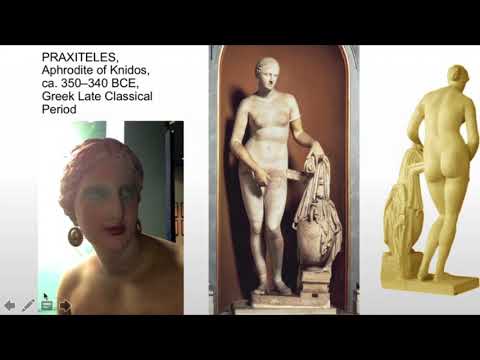
The Aphrodite of Knidos was sculpted by the Athenian artist Praxiteles between 360 and 330 BCE. According to ancient sources like Pliny the Elder, Praxiteles created two statues of Aphrodite, one clothed and one nude. The city of Kos initially chose the clothed version, deeming the nude statue too daring, while the city of Knidos acquired the nude sculpture. This decision led to Knidos becoming a renowned destination, drawing visitors eager to behold the masterpiece. The statue's creation marked a significant departure from the tradition of heroic male nudity in Greek sculpture, introducing a new paradigm for representing the female form. Its innovative pose and naturalistic style, influenced by Praxiteles's artistic innovations, set a new standard for beauty and sensuality in art, impacting subsequent artistic movements and interpretations of the goddess of love, much like how later artists like Sandro Botticelli would draw inspiration from classical ideals.
⚙️ Artistic Innovations and Reception
Praxiteles's Aphrodite of Knidos was revolutionary for its time, presenting a fully nude female figure in a relaxed contrapposto stance. This pose, with the body's weight shifted to one leg, created a sense of naturalism and grace previously unseen in large-scale female nudes. The goddess is depicted reaching for a towel while modestly covering her pubic area with one hand, a gesture that simultaneously conceals and draws attention to her form. This depiction challenged the prevailing artistic conventions and societal norms of ancient Greece, where female nudity was not commonly depicted in art. The statue's beauty and lifelike qualities were so profound that ancient writers, including Lucian of Samosata, described its captivating allure, noting its ability to evoke strong reactions from viewers, a phenomenon that would later be discussed in relation to the 'male gaze' in art criticism, as explored by art historians analyzing works like Titian's 'Venus of Urbino'.
🌍 Cultural Impact and Legacy
The Aphrodite of Knidos had a profound and lasting impact on Western art, establishing the 'Venus pudica' (modest Venus) type, characterized by the gesture of covering the body. This iconic pose and representation of female beauty influenced countless artists throughout antiquity and the Renaissance, appearing in works by artists such as Botticelli in his 'Birth of Venus' and Titian in his 'Venus of Urbino'. The statue's fame also led to numerous Roman copies, which helped preserve its image and influence even after the original was lost. The statue's legacy extends beyond its artistic impact, sparking discussions about the objectification of women, consent, and the representation of the female body in art, themes that continue to be relevant in contemporary art and feminist discourse, as seen in modern movements like #MeToo.
🔮 Surviving Copies and Influence
Although the original marble sculpture by Praxiteles no longer exists, its form is known through numerous Roman copies and adaptations. The 'Colonna Venus' in the Vatican Museums is considered one of the most faithful replicas, while other notable copies include the 'Capitoline Venus' and the 'Venus de' Medici'. These surviving works, created centuries after the original, attest to the enduring appeal and widespread influence of Praxiteles's masterpiece. The 'Aphrodite of Knidos' set a canon for the proportions of the female nude, influencing not only subsequent sculptures but also paintings and other art forms, solidifying its place as a foundational work in the history of art and a subject of study for institutions like The Art Institute of Chicago and The Metropolitan Museum of Art.
Key Facts
- Year
- c. 360-330 BCE
- Origin
- Knidos (modern-day Turkey)
- Category
- aesthetics
- Type
- concept
Frequently Asked Questions
Who created the Aphrodite of Knidos?
The Aphrodite of Knidos was created by the renowned Athenian sculptor Praxiteles between 360 and 330 BCE.
What was significant about the Aphrodite of Knidos?
It is considered one of the first life-sized, freestanding sculptures of a nude female deity in ancient Greek art, establishing a new artistic canon and influencing depictions of the female form for centuries.
Does the original statue still exist?
No, the original marble sculpture by Praxiteles is lost. However, its appearance is known through numerous Roman copies and adaptations.
What is the 'Venus pudica' type?
The 'Venus pudica' (modest Venus) type refers to a pose where the subject modestly covers their private parts with their hands, a convention popularized by the Aphrodite of Knidos.
Where can I see copies of the Aphrodite of Knidos?
Notable Roman copies can be found in various museums, including the Vatican Museums (Colonna Venus), the Capitoline Museums (Capitoline Venus), and the Uffizi Gallery (Venus de' Medici).
References
- en.wikipedia.org — /wiki/Aphrodite_of_Knidos
- artic.edu — /artworks/61600/statue-of-the-aphrodite-of-knidos
- theartstory.org — /blog/the-male-gaze-made-marble-the-aphrodite-of-knidos-by-the-ancient-greek-pra
- metmuseum.org — /art/collection/search/856959
- anthology-magazine.com — /culture/aphrodite-of-knidos-the-legacy-of-praxiteles-masterpiece/
- art.thewalters.org — /object/23.98/
- museum.classics.cam.ac.uk — /collections/casts/aphrodite-knidos
- human.libretexts.org — /Workbench/Art_History_For_Students_By_Students/05%3A_Love_and_Marriage/5.04%3A_