
Contents
Overview
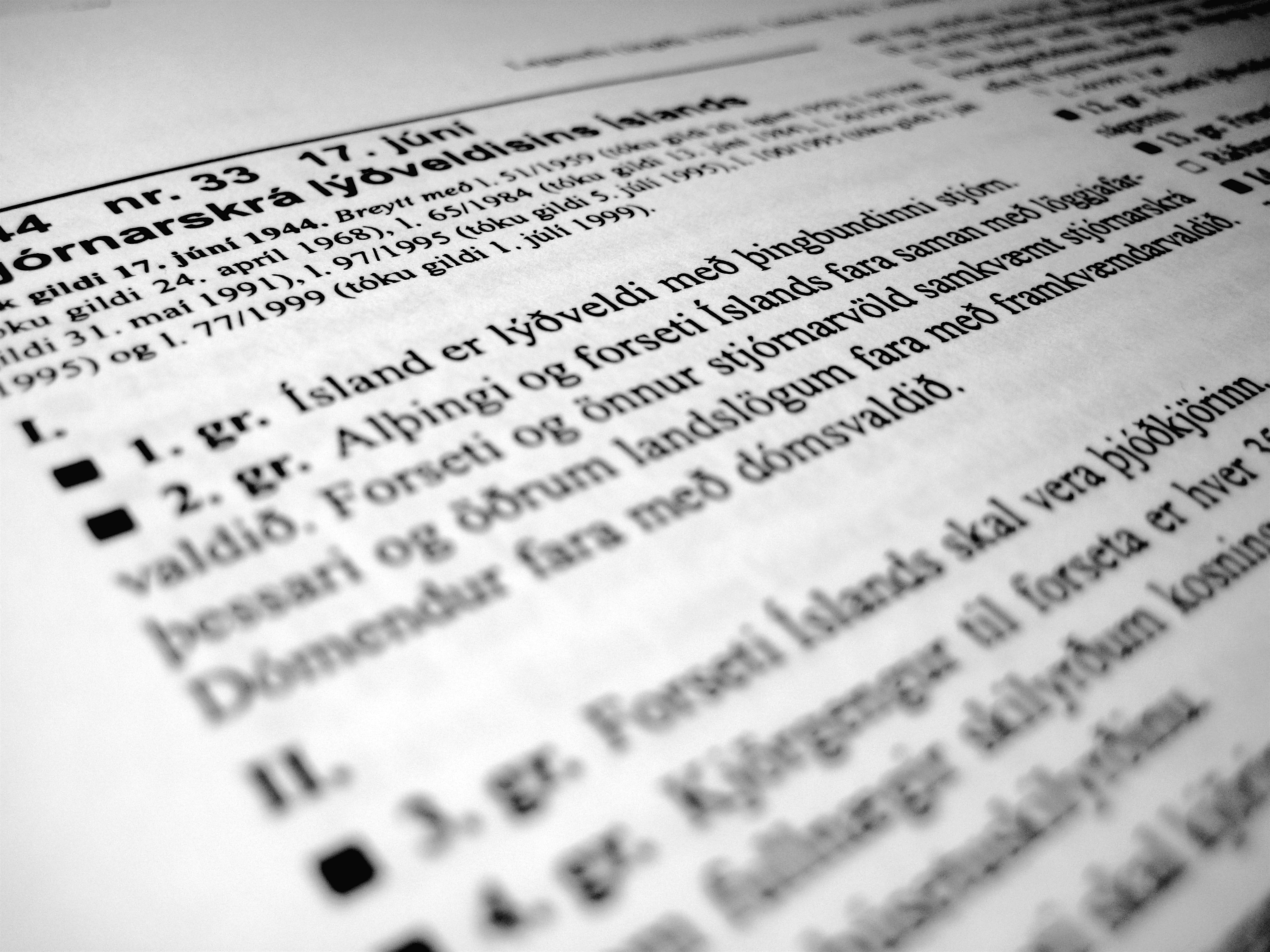
The current Constitution of Iceland traces its lineage back to the Act of Union of 1918, which established Iceland as a sovereign state in personal union with Denmark. However, the true genesis of the republic's constitution lies in the dramatic events of June 17, 1944. Following Denmark's occupation by Nazi Germany during World War II, Iceland seized the opportunity to sever its remaining ties and declare full independence. This act was solidified by the adoption of a new constitution, establishing Iceland as a republic with a directly elected president. This foundational document, though amended, still reflects the spirit of that decisive moment, a bold assertion of national sovereignty. Prior to 1944, Iceland operated under a constitution adopted in 1903, which itself was a significant step towards self-governance after centuries of Danish rule. The 1944 constitution was largely based on the Danish constitution of 1849, adapted to Iceland's republican status and its unique parliamentary system, the Althing, which claims to be the world's oldest parliament.
⚙️ How It Works
The Icelandic Constitution establishes a parliamentary republic with a separation of powers. The Althing is the supreme legislative body, composed of 63 members elected every four years. The President of Iceland, currently Guðni Th. Jóhannesson, serves as the head of state, elected for a four-year term, with powers that are largely ceremonial but include the right to veto legislation and call referendums. The government, led by the Prime Minister, is responsible to the Althing. The judiciary is independent, with the Supreme Court (Hæstiréttur Íslands) as the highest judicial authority. The constitution also guarantees a comprehensive list of fundamental rights, including freedom of speech, religion, and assembly, as well as protections against discrimination and the right to a fair trial, drawing inspiration from international human rights conventions like the European Convention on Human Rights.
📊 Key Facts & Numbers
The Constitution of Iceland comprises 80 articles organized into seven sections. Since its inception in 1944, it has been amended seven times, with significant revisions occurring in 1959, 1961, 1968, 1984, 1995, 2013, and 2017. The 2011 constitutional reform process, though ultimately unsuccessful in its entirety, led to a draft that proposed 115 articles and aimed to incorporate more direct democracy mechanisms. The current constitution has been the subject of 10 constitutional amendment proposals since 1944, with 7 successfully ratified. The 1944 constitution was adopted with an overwhelming 97.7% of the vote in a referendum, a testament to the national desire for full independence. The 2017 amendment, for instance, focused on clarifying the role of the President and parliamentary procedures, demonstrating ongoing efforts to modernize the legal framework.
👥 Key People & Organizations
While the constitution itself is a legal document, its creation and evolution involve key figures and institutions. The 1944 constitution was largely shaped by the political leadership of the time, including Svavar Guðmundsson, who played a role in the independence movement, and Bjarni Benediktsson, a prominent politician who served multiple terms as Prime Minister. The Althing remains the primary body responsible for proposing and ratifying constitutional amendments. More recently, the 2011 constitutional reform process involved a specially elected Constitutional Council, chaired by Sólveig Pétursdóttir, though its proposed new constitution was ultimately rejected in a referendum. The current President, Guðni Th. Jóhannesson, has also been a vocal proponent of constitutional review and modernization.
🌍 Cultural Impact & Influence
The Constitution of Iceland is more than just a legal text; it's a powerful symbol of national identity and sovereignty, particularly its establishment in 1944 as a definitive break from Danish rule. It has fostered a strong sense of democratic participation, with Iceland consistently ranking high in global democracy indices. The emphasis on human rights within the constitution has influenced Icelandic society, promoting a culture of equality and individual freedoms. The unique role of the President, elected by popular vote yet with limited executive power, has shaped a distinct political culture. The constitution's enduring presence has also inspired discussions on national identity and self-determination, resonating with Icelanders' pride in their independent republic and its historical parliamentary traditions dating back to the Althing.
⚡ Current State & Latest Developments
The most recent significant amendment to the Constitution of Iceland occurred in 2017, primarily addressing the election of parliamentary members and clarifying presidential powers. However, discussions about a more comprehensive constitutional reform have persisted. A notable development was the 2011 attempt to draft a new constitution, which involved public consultations and a specially elected Constitutional Council. While the proposed new constitution was ultimately rejected in a referendum, it highlighted a desire for modernization, potentially incorporating more elements of direct democracy and environmental protections. The ongoing debate centers on whether to pursue incremental amendments or a complete overhaul, reflecting a continuous engagement with the foundational principles of Icelandic governance in the 21st century.
🤔 Controversies & Debates
The Icelandic Constitution is not without its controversies. The 2011-2012 attempt at a wholesale reform generated significant debate, with critics arguing that the process bypassed traditional parliamentary procedures and that the resulting draft was too radical. The role and powers of the President remain a point of discussion, with some advocating for a more ceremonial figurehead and others for a stronger executive. Furthermore, the balance between parliamentary sovereignty and direct democracy, particularly concerning referendums and citizen initiatives, is a recurring theme. The question of whether the constitution adequately addresses contemporary issues like environmental protection and digital rights is also a subject of ongoing debate among legal scholars and the public.
🔮 Future Outlook & Predictions
The future of the Icelandic Constitution likely involves continued debate and potential amendments. The push for modernization, perhaps incorporating more robust environmental clauses or digital rights, is expected to persist. There's a possibility of revisiting elements from the 2011 draft, particularly those related to direct democracy, if public sentiment shifts. The role of the President may also be a subject of future reform, depending on political currents and public opinion. Ultimately, the constitution's evolution will be shaped by Iceland's ongoing commitment to democratic principles and its response to emerging societal challenges, potentially leading to further amendments or, less likely in the short term, another comprehensive reform effort.
💡 Practical Applications
The Constitution of Iceland serves as the ultimate legal framework for governance, ensuring stability and protecting citizens' rights. Its practical application is evident in the daily operations of the Icelandic government, the functioning of the Althing, and the rulings of the Supreme Court. It provides the legal basis for all legislation passed in Iceland, ensuring that laws adhere to the fundamental principles enshrined in the constitution. For citizens, it guarantees fundamental freedoms and recourse through the legal system if these rights are infringed. The constitution's principles also guide foreign policy and international relations, ensuring Iceland acts in accordance with its democratic values and human rights commitments.
Key Facts
- Category
- history
- Type
- topic