
Contents
Overview
The genesis of the conjugate method can be traced back to the mid-20th century, a period of intense development in computational mathematics. While precursors existed, the formalization and popularization of the conjugate gradient method are largely credited to Magnus Hestenes and Eduard Stiefel. They implemented and extensively researched the algorithm on the Z4 computer, demonstrating its potential for solving large-scale problems. Prior to this, mathematicians like George Danzer and George Tinney had explored related ideas in the context of solving linear systems arising from electrical networks. The method's foundation lies in the geometric interpretation of minimizing quadratic forms, a concept explored by Lord Cavalieri centuries earlier, but Hestenes and Stiefel provided the algorithmic framework that made it practical for computation.
⚙️ How It Works
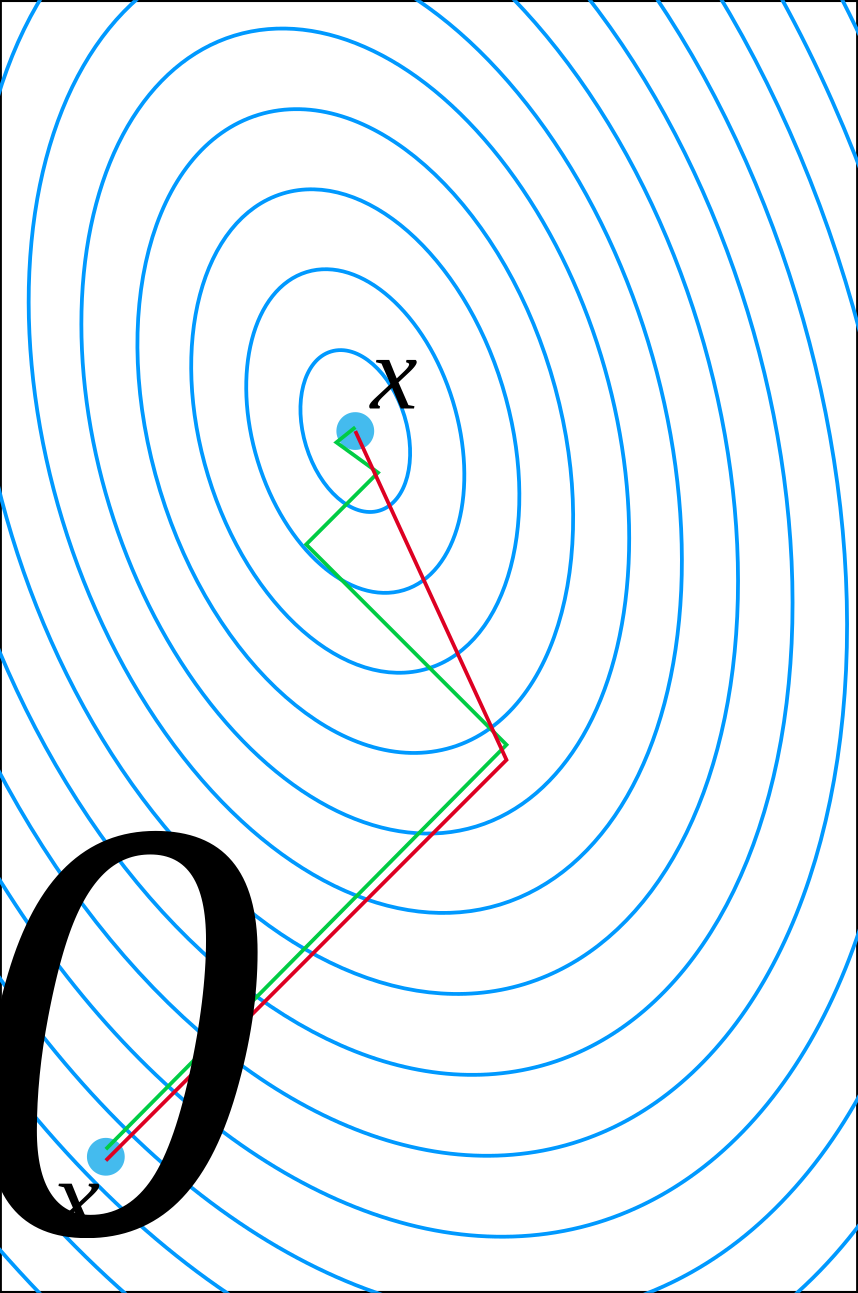
At its heart, the conjugate method, particularly the conjugate gradient variant, operates by iteratively generating a sequence of solutions that progressively minimize a quadratic objective function. For a system Ax = b, where A is a symmetric positive-definite matrix, the algorithm seeks to minimize f(x) = 1/2 xᵀAx - xᵀb. Each iteration generates a new search direction that is "conjugate" to the previous directions with respect to matrix A (i.e., dᵢᵀAdⱼ = 0 for i ≠ j). This conjugacy ensures that each step makes progress towards the minimum without undoing the progress made in previous steps, leading to convergence in at most n steps for an n x n system. The algorithm cleverly uses the residual vector (b - Ax) as a basis for determining the next search direction and step size, making it efficient for sparse matrices where matrix-vector products are computationally cheaper than explicit matrix inversions or factorizations.
📊 Key Facts & Numbers
The conjugate gradient method offers significant advantages in terms of computational efficiency for large, sparse systems. Direct methods like Cholesky decomposition typically require O(n³) operations, whereas the conjugate gradient method, in exact arithmetic, converges in at most n iterations, with each iteration costing O(nnz(A)) operations, where nnz(A) is the number of non-zero elements in matrix A. In practice, for ill-conditioned matrices, convergence can be slower, but preconditioning techniques can dramatically accelerate it, often achieving solutions in fewer than 100 iterations even for systems with millions of variables. For instance, solving a 10,000 x 10,000 sparse system might take hours with direct methods but minutes with a well-preconditioned conjugate gradient solver. The memory requirement is typically O(nnz(A)), a stark contrast to the O(n²) or O(n³) needed for dense matrix factorizations.
👥 Key People & Organizations
The development and refinement of the conjugate method are indebted to several key figures. Magnus Hestenes and Eduard Stiefel are widely recognized for their foundational work in the 1950s, publishing extensively on the algorithm. John Warner Gibbs also contributed significantly to the understanding and application of iterative methods. In the realm of optimization, Fritz Loebl and Maurice Goldstein played roles in extending these concepts. Modern implementations and theoretical advancements often involve researchers at institutions like Stanford University and MIT, with contributions from numerous numerical analysis departments worldwide. The Association for Computing Machinery (ACM) and the Society for Industrial and Applied Mathematics (SIAM) have been crucial in disseminating research through their journals and conferences.
🌍 Cultural Impact & Influence
The conjugate method's influence permeates numerous scientific and engineering disciplines. Its ability to handle large-scale linear systems makes it indispensable in computational physics, particularly for solving finite element method (FEM) and finite difference method (FDM) discretizations of partial differential equations in fields like fluid dynamics, structural analysis, and electromagnetics. In machine learning, variations of conjugate gradient are used for training large models, especially in areas like support vector machines and deep learning optimization. The method's elegance and efficiency have made it a standard tool in scientific computing libraries such as LAPACK, SciPy, and PETSc. Its widespread adoption has democratized the ability to tackle complex computational problems that were previously intractable.
⚡ Current State & Latest Developments
As of 2024-2025, the conjugate method remains a workhorse in numerical computation, with ongoing research focused on enhancing its performance and applicability. Preconditioning techniques continue to be a major area of development, with new strategies emerging for specific classes of matrices, such as those arising from machine learning or complex physical simulations. Parallelization of conjugate gradient algorithms for distributed computing environments is also a critical area, enabling solutions on supercomputers and large clusters. Furthermore, the integration of conjugate methods with emerging hardware architectures, like GPUs and TPUs, is an active research frontier, aiming to unlock even greater computational speedups. The development of robust, adaptive preconditioning strategies that require minimal user input is also a key trend.
🤔 Controversies & Debates
One of the primary debates surrounding the conjugate method revolves around its convergence properties and the necessity of preconditioning. While theoretically guaranteed to converge in n steps for symmetric positive-definite systems in exact arithmetic, real-world floating-point arithmetic and ill-conditioned matrices often lead to slower convergence or stagnation. This necessitates the use of preconditioning, which itself can be a complex and problem-dependent task. Finding an effective preconditioner that balances computational cost with convergence acceleration is often an art. Another point of contention is the choice between different variants: for non-symmetric matrices, methods like GMRES or BiCGSTAB are often preferred, each with its own trade-offs in terms of computational cost and memory requirements. The suitability for extremely large, distributed systems also sparks debate regarding communication overhead versus computational gains.
🔮 Future Outlook & Predictions
The future of the conjugate method likely lies in its continued integration with advanced computing paradigms and problem domains. Expect further development in adaptive and automatic preconditioning techniques, reducing the burden on users to manually select optimal strategies. The application to increasingly complex nonlinear optimization problems, perhaps driven by advances in artificial intelligence and scientific discovery, will spur the creation of more sophisticated nonlinear conjugate gradient variants. As computational hardware evolves, so too will the algorithms; expect tighter integration with specialized hardware accelerators and novel parallelization schemes designed for exascale and beyond computing. The method's fundamental elegance suggests it will remain a core component of scientific software for the foreseeable future, adapting to new challenges.
💡 Practical Applications
The conjugate method finds widespread practical application across numerous fields. In structural engineering, it's used to solve the large, sparse linear systems that arise from finite element analysis of bridges, buildings, and aircraft. In computational fluid dynamics, it helps simulate weather patterns, airflow over vehicles, and blood flow in arteries. Geoscientists employ it for seismic imaging and reservoir simu
Key Facts
- Category
- technology
- Type
- topic