
Contents
Overview
The concept of neuronal communication began to take shape in the late 19th century. Santiago Ramón y Cajal's 'neuron doctrine,' proposed in the 1890s, established that neurons are discrete cells, challenging the reticular theory that suggested a continuous network. This paved the way for understanding how signals might pass between them. The term 'synapse' itself was coined by Sir Charles Sherrington in 1897, derived from the Greek 'synapsis' meaning 'union' or 'clasping.' Early evidence for chemical transmission came from Otto Loewi's groundbreaking experiments in 1921, where he demonstrated that stimulating the vagus nerve released a chemical that slowed the heart, which he later identified as acetylcholine. This pivotal discovery, earning Loewi the Nobel Prize in 1936 alongside Sir Henry Dale, firmly established the chemical basis of synaptic transmission, moving beyond purely electrical explanations.
⚙️ How It Works
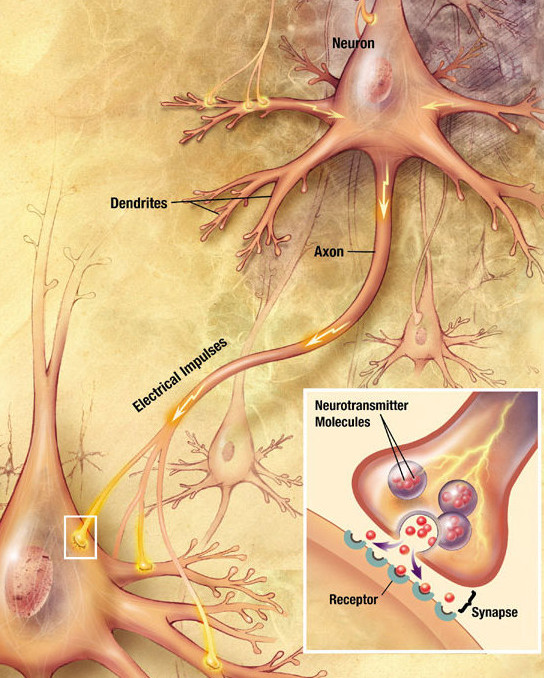
At its core, a chemical synapse operates through a precise sequence of events. When an action potential, an electrical impulse, arrives at the presynaptic terminal of a neuron, it triggers the opening of voltage-gated calcium channels. The influx of calcium ions into the presynaptic terminal initiates the fusion of synaptic vesicles—small sacs containing neurotransmitters—with the presynaptic membrane. This fusion, a process known as exocytosis, releases neurotransmitters into the synaptic cleft, a narrow gap between the neurons. These neurotransmitters then diffuse across the cleft and bind to specific neurotransmitter receptors on the postsynaptic membrane. This binding causes a change in the postsynaptic cell's membrane potential, either exciting it (making it more likely to fire an action potential) or inhibiting it (making it less likely to fire), thereby transmitting the signal. The neurotransmitter's action is then terminated by mechanisms such as enzymatic degradation or reuptake into the presynaptic neuron or surrounding glial cells like astrocytes.
📊 Key Facts & Numbers
The scale of chemical synapses is astonishingly small yet profoundly impactful. A typical synaptic cleft measures between 20 and 40 nanometers wide, a gap so minuscule that neurotransmitters traverse it in mere microseconds. A single neuron can form thousands of synapses, with some Purkinje cells in the cerebellum potentially receiving over 100,000 synaptic inputs. The human brain contains an estimated 100 billion neurons, each forming an average of 1,000 to 10,000 synapses, leading to a staggering total of 100 trillion to 1 quadrillion synapses in the adult brain. Neurotransmitters are released in discrete packets called quanta, typically containing thousands of molecules, and the postsynaptic response can be modulated by the precise timing and frequency of presynaptic firing, a phenomenon known as synaptic plasticity.
👥 Key People & Organizations
Key figures in understanding chemical synapses include Santiago Ramón y Cajal, who established the neuron doctrine in the late 19th century, and Otto Loewi, whose 1921 experiments provided definitive proof of chemical neurotransmission. Sir Henry Dale also made crucial contributions, co-receiving the Nobel Prize with Loewi for their work on chemical transmission. Later, Bernard Katz elucidated the quantal release of neurotransmitters and the properties of neuromuscular junctions. Arvid Carlsson pioneered research into dopamine as a neurotransmitter and its role in Parkinson's disease. Major research institutions like Max Planck Institutes and Stanford University are at the forefront of synaptic research, with organizations like the Society for Neuroscience fostering collaboration and dissemination of findings.
🌍 Cultural Impact & Influence
Chemical synapses are not merely biological mechanisms; they are the bedrock of human experience and culture. The ability to learn, remember, feel emotions, and execute complex actions all stem from the intricate network of synaptic connections. The concept of the synapse has permeated popular culture, appearing in science fiction narratives exploring artificial intelligence and consciousness, such as in the film Blade Runner (1982), which questions the nature of memory and identity. Understanding synaptic function is also central to fields like psychology and philosophy of mind, influencing debates on free will, consciousness, and the biological basis of behavior. The development of psychoactive drugs and psychiatric medications directly targets synaptic transmission, highlighting its profound impact on mental health and well-being.
⚡ Current State & Latest Developments
Current research is rapidly expanding our understanding of synaptic complexity. Advances in super-resolution microscopy allow visualization of synaptic structures with unprecedented detail, revealing the dynamic nature of synaptic plasticity in real-time. High-throughput screening methods are identifying novel neurotransmitters and their receptors, while optogenetics provides precise tools to control neuronal activity by genetically modifying neurons to respond to light. Researchers are also investigating the role of glial cells, particularly astrocytes, in modulating synaptic transmission and plasticity, moving beyond the traditional neuron-centric view. The development of sophisticated computational models, often utilizing machine learning algorithms, aims to decipher the complex computations performed by neural circuits at the synaptic level.
🤔 Controversies & Debates
The precise mechanisms of synaptic transmission and plasticity are still debated, particularly concerning the relative contributions of different neurotransmitter systems and receptor subtypes to complex behaviors. A significant controversy surrounds the exact role and extent of neuroinflammation in neurodegenerative diseases like Alzheimer's disease and Parkinson's disease, with some arguing it's a primary driver while others see it as a secondary consequence. The ethical implications of brain-computer interfaces that directly interact with synaptic activity also present ongoing debates, particularly concerning privacy, autonomy, and potential misuse. Furthermore, the sheer complexity of the connectome—the complete map of neural connections—means that fully understanding how trillions of synapses give rise to consciousness remains a profound scientific challenge.
🔮 Future Outlook & Predictions
The future of chemical synapse research promises revolutionary advancements. The development of more sophisticated gene editing techniques like CRISPR-Cas9 could enable targeted correction of genetic defects underlying synaptic disorders. Personalized medicine approaches, informed by individual synaptic profiles, may lead to highly tailored treatments for conditions like autism spectrum disorder and schizophrenia. The ongoing quest to build artificial neural networks that mimic biological synaptic function could lead to more powerful and efficient AI systems. Furthermore, a deeper understanding of synaptic mechanisms may unlock new strategies for neuroregeneration and repair following brain injury or stroke, potentially restoring lost function by rebuilding damaged synaptic connections.
💡 Practical Applications
Chemical synapses are the workhorses of numerous practical applications. Anesthetics and analgesics function by blocking or modulating synaptic transmission in pain pathways. Antidepressants, such as SSRIs, work by altering the levels of neurotransmitters like serotonin in the synaptic cleft. [[Musc
Key Facts
- Category
- science
- Type
- topic