
Contents
Overview
The concept of electrical potentials across biological membranes began to crystallize in the late 19th century. Julius Bernstein, in 1902, proposed the 'membrane theory,' suggesting that the electrical potential difference across the nerve cell membrane was due to a semipermeable membrane's selective permeability to ions, particularly potassium. His work laid the groundwork for later quantitative models. The identification of specific ion channels and pumps in the mid-20th century, notably by Alan Hodgkin and Bernard Katz, provided the molecular mechanisms. Hodgkin and Andrew Huxley's groundbreaking 1952 paper on the ionic mechanisms of nerve impulse transmission in the squid giant axon earned them the 1963 Nobel Prize in Physiology or Medicine, solidifying the quantitative understanding of membrane potential dynamics. Earlier work by Walter Nernst on electrochemical potentials in 1888 provided the theoretical foundation for calculating equilibrium potentials for individual ions.
⚙️ How It Works
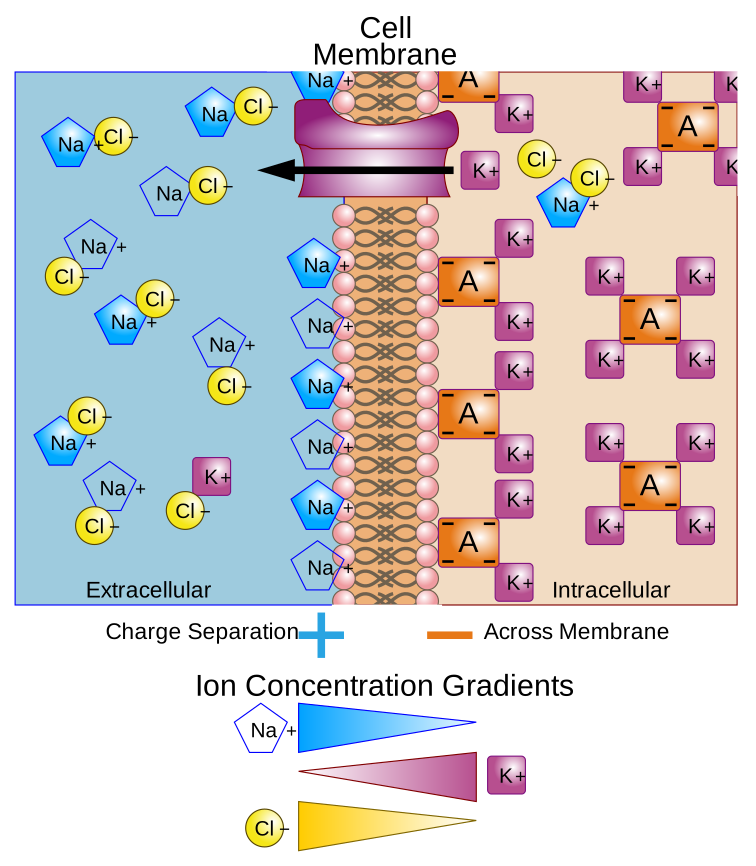
Cell membrane potential is established and maintained by the differential permeability of the cell membrane to various ions and the action of active ion transport systems. The lipid bilayer itself is largely impermeable to charged ions, but specific ion channels embedded within it allow selective passage. At rest, the membrane is most permeable to potassium ions (K+), which tend to flow out of the cell down their electrochemical gradient, leaving behind a net negative charge inside. This outward movement is opposed by the inward pull of the negative interior on positive ions. The sodium-potassium pump (Na+/K+-ATPase) actively transports three sodium ions out of the cell for every two potassium ions pumped in, further contributing to the negative interior and maintaining ion gradients. The Goldman-Hodgkin-Katz equation quantifies this resting potential by considering the relative permeabilities and concentrations of multiple ions, primarily Na+, K+, and Cl-.
📊 Key Facts & Numbers
The resting membrane potential in most animal cells hovers around -70 millivolts (mV), though it can range from -40 mV to -200 mV depending on cell type and physiological state. For instance, neurons typically exhibit a resting potential of -70 mV, while cardiac pacemaker cells can be as low as -40 mV. During an action potential in neurons, the membrane potential rapidly depolarizes to about +30 mV to +50 mV before repolarizing and often hyperpolarizing below the resting potential. The concentration gradient of potassium ions (K+) is a primary driver, with intracellular concentrations around 140 mM and extracellular concentrations about 5 mM. Conversely, sodium ions (Na+) are more concentrated outside (around 145 mM) than inside (around 15 mM). The sodium-potassium pump consumes about 20-40% of a cell's total energy budget, highlighting the metabolic cost of maintaining these gradients.
👥 Key People & Organizations
Key figures in understanding cell membrane potential include Julius Bernstein, who first proposed the membrane theory in 1902, and Walter Nernst, whose 1888 work on the Nernst equation provided the theoretical basis for ionic equilibrium potentials. Alan Hodgkin and Andrew Huxley are central, having elucidated the ionic mechanisms of the action potential in the squid giant axon in 1952, earning them a Nobel Prize. Bernard Katz also made significant contributions to understanding synaptic transmission and the role of calcium ions in neurotransmitter release. The Johns Hopkins University and the University of Cambridge have been historical centers for this research. Modern research involves numerous labs worldwide, including those at Yale University and the Max Planck Society, focusing on specific ion channels and their roles in disease.
🌍 Cultural Impact & Influence
Cell membrane potential is the bedrock of electrical signaling in biological systems, profoundly influencing fields from neuroscience to medicine. The ability of neurons to generate and propagate action potentials is directly dependent on controlled shifts in membrane potential, enabling complex functions like thought, memory, and sensation. Similarly, muscle contraction, including the rhythmic beating of the heart, is initiated by changes in the membrane potential of muscle cells. The development of electrocardiography (ECG) and electroencephalography (EEG) are direct technological applications that measure collective membrane potential changes in the heart and brain, respectively. Pharmacological interventions often target ion channels to modulate membrane potential, impacting treatments for conditions like epilepsy, cardiac arrhythmias, and pain.
⚡ Current State & Latest Developments
Current research is intensely focused on the intricate roles of specific ion channel subtypes and their dysregulation in disease. For example, studies in 2023 and 2024 are exploring novel therapeutic targets for neuropathic pain by modulating voltage-gated sodium channels, such as Nav1.7. Advancements in cryo-electron microscopy have provided unprecedented atomic-level detail of ion channel structures, aiding in the design of more selective drugs. Furthermore, the integration of machine learning and computational modeling is accelerating the prediction of how genetic mutations affect ion channel function and membrane potential, as seen in ongoing work on cystic fibrosis and Long QT syndrome. The development of advanced biosensors for real-time monitoring of membrane potential in vivo is also a rapidly evolving area.
🤔 Controversies & Debates
A persistent debate revolves around the precise contribution of different ion channels and pumps to the resting membrane potential in various cell types, especially under pathological conditions. While the Goldman-Hodgkin-Katz equation provides a robust framework, the dynamic nature of channel gating and the influence of intracellular signaling pathways add layers of complexity. Another area of contention is the role of subtle, long-term changes in membrane potential, beyond rapid action potentials, in cellular processes like cell proliferation and differentiation. Some researchers argue that the therapeutic targeting of specific ion channels might have unforeseen off-target effects due to their widespread expression and crucial roles in multiple tissues, leading to debates about drug specificity and safety.
🔮 Future Outlook & Predictions
The future of cell membrane potential research points towards highly personalized medicine, where treatments are tailored based on an individual's specific ion channel genetic profile. We can anticipate the development of more sophisticated neuromodulation techniques, such as targeted electrical or magnetic stimulation, that precisely manipulate membrane potentials to treat neurological and psychiatric disorders. The integration of organ-on-a-chip technologies will allow for more accurate in vitro modeling of how membrane potential dynamics contribute to organ function and disease progression. Furthermore, a deeper understanding of the interplay between membrane potential and cellular metabolism could unlock new strategies for treating metabolic diseases and cancer, potentially leading to therapies that target the energetic demands of maintaining ion gradients.
💡 Practical Applications
Cell membrane potential is fundamental to numerous physiological processes and therapeutic interventions. In neuroscience, it's the basis for understanding how nerves transmit signals, leading to treatments for epilepsy, Parkinson's disease, and stroke. In cardiology, monitoring and manipulating membrane potential is critical for managing cardiac arrhythmias via drugs like lidocaine or amiodarone. Pharmacological agents targeting ion channels are used to treat pain, hypertension, and respiratory conditions. For example, calcium channel blockers are widely prescribed for high blood
Key Facts
- Category
- science
- Type
- topic