
Contents
Overview
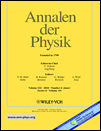
Annalen der Physik was founded in 1799 by Friedrich Nicolai, a German publisher and writer, with the goal of creating a platform for the dissemination of scientific knowledge. The journal quickly gained a reputation for publishing high-quality research in the field of physics, with contributions from notable scientists such as Johann Ritter, who discovered the ultraviolet spectrum, and Heinrich Hertz, who demonstrated the existence of electromagnetic waves. As the journal grew in popularity, it became a hub for discussions and debates among prominent physicists, including Max Planck, who introduced the concept of the quantum, and Albert Einstein, who developed the theory of relativity. Today, Annalen der Physik is published by Wiley-VCH, a leading scientific publisher, and is edited by a renowned board of physicists, including Nobel laureates such as Theodor Hänsch and Klaus von Klitzing.
⚙️ Editorial Board and Publication
The editorial board of Annalen der Physik is composed of distinguished physicists from around the world, including researchers from institutions such as the Max Planck Institute, the University of California, Berkeley, and the European Organization for Nuclear Research (CERN). The journal publishes original research articles, review articles, and letters, covering a wide range of topics in physics, from condensed matter physics to particle physics, and from theoretical physics to experimental physics. Annalen der Physik has a strong focus on interdisciplinary research, with contributions from fields such as materials science, nanotechnology, and biophysics. The journal is published monthly, both in print and online, and is available through various subscription models, including institutional subscriptions and individual subscriptions, with online access provided through platforms such as Wiley Online Library and arXiv.
🌍 Impact and Influence
Annalen der Physik has had a profound impact on the development of physics, with many groundbreaking discoveries and theories first published in its pages. The journal has been a platform for the work of numerous Nobel laureates, including Werner Heisenberg, who introduced the uncertainty principle, and Erwin Schrödinger, who developed the concept of wave mechanics. Annalen der Physik has also been a hub for discussions and debates among prominent physicists, with contributions from researchers such as Richard Feynman, who developed the path integral formulation of quantum mechanics, and Stephen Hawking, who worked on black hole physics. The journal's influence extends beyond the scientific community, with its research and discoveries often featured in popular media outlets, such as The New York Times, Nature, and Science, and its articles frequently cited in academic and policy discussions, with organizations such as the American Physical Society and the European Physical Society relying on Annalen der Physik as a key source of information.
🔮 Legacy and Future
As Annalen der Physik looks to the future, it continues to be a leading publication in the field of physics, with a strong focus on interdisciplinary research and a commitment to publishing high-quality, innovative research. The journal is exploring new formats and platforms for the dissemination of scientific knowledge, including online-only publications, such as the Annalen der Physik Focus Issues, and social media channels, such as Twitter and Facebook. Annalen der Physik is also engaging with the broader scientific community, through partnerships with organizations such as the American Physical Society and the European Physical Society, and through its participation in initiatives such as the Open Access movement, with the goal of making scientific research more accessible and widely available. As the journal celebrates its over 200-year history, it remains a vital platform for the advancement of physics and a testament to the power of scientific inquiry and discovery, with its legacy continuing to inspire new generations of physicists, including researchers such as Lisa Randall, who works on particle physics, and Neil deGrasse Tyson, who is a prominent science communicator.
Key Facts
- Year
- 1799
- Origin
- Germany
- Category
- science
- Type
- journal
Frequently Asked Questions
What is Annalen der Physik?
Annalen der Physik is a prestigious German physics journal with a rich history, founded in 1799 by Friedrich Nicolai.
Who are some notable contributors to Annalen der Physik?
Notable contributors include Max Planck, Albert Einstein, Werner Heisenberg, and Erwin Schrödinger.
What is the focus of Annalen der Physik?
The journal has a strong focus on interdisciplinary research, covering a wide range of topics in physics, from condensed matter physics to particle physics, and from theoretical physics to experimental physics.
How is Annalen der Physik published?
The journal is published monthly, both in print and online, and is available through various subscription models, including institutional subscriptions and individual subscriptions.
What is the impact of Annalen der Physik on the scientific community?
Annalen der Physik has had a profound impact on the development of physics, with many groundbreaking discoveries and theories first published in its pages, and its research and discoveries often featured in popular media outlets and cited in academic and policy discussions.