
Contents
Overview
The concept of adjoint functors emerged from the foundational work in category theory, primarily developed by mathematicians Samuel Eilenberg and Saunders Mac Lane in the mid-20th century. Their goal was to provide a unifying language for various mathematical structures and the mappings between them, moving beyond the specificities of fields like algebraic topology and universal algebra. This pursuit of abstract, unifying principles is a hallmark of advanced "Science", much like "Albert Einstein" sought to unify the laws of physics, Eilenberg and Mac Lane aimed to formalize the relationships between mathematical theories.
⚙️ How It Works
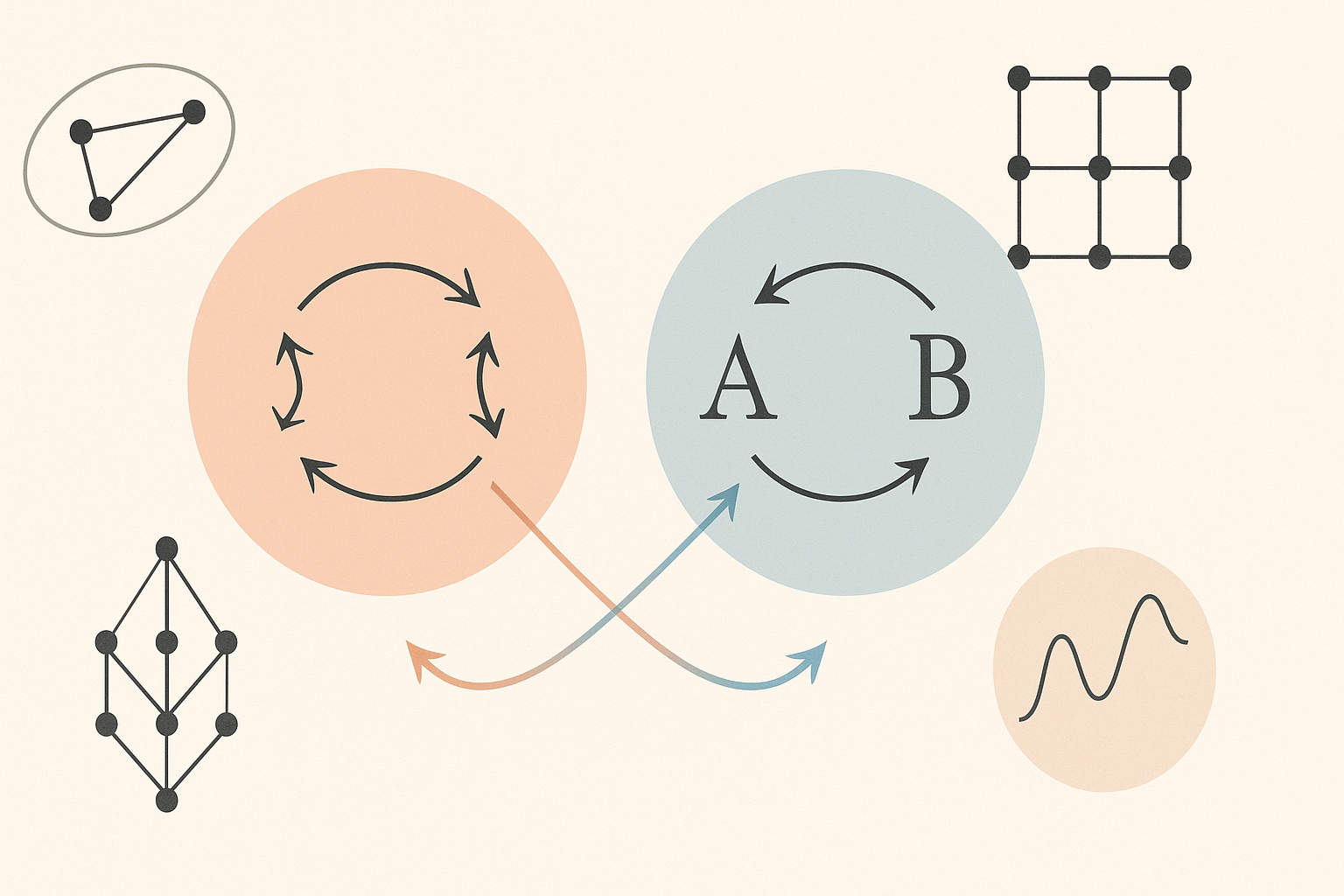
At its core, an adjoint functor relationship, or an 'adjunction', consists of a pair of functors, F (the left adjoint) and G (the right adjoint), between two categories. This relationship is characterized by a natural isomorphism between hom-sets: Hom(F(A), B) ≅ Hom(A, G(B)). This elegant formulation captures the essence of many 'universal properties' found throughout mathematics, from free groups in "Set Theory" to tensor products in linear algebra. Understanding "Category Theory" is essential to grasp the full power of this construction, as it provides a framework for comparing and relating different mathematical universes.
🌍 Cultural Impact
While deeply abstract, adjoint functors have profound implications beyond pure mathematics, influencing fields like theoretical computer science and logic. They provide a rigorous framework for understanding concepts such as data types and their operations in functional programming, and even inform the design of formal systems in areas related to "Artificial Intelligence". The principles of adjointness can be seen in the structural relationships within complex systems, offering a lens through which to analyze everything from the logic of "Blockchain" protocols to the intricate symmetries explored in "Quantum Chemistry", highlighting their broad 'cultural impact' on scientific thought.
🔮 Legacy & Future
The legacy of adjoint functors is their enduring role as a central, unifying theme in modern mathematics, providing a powerful tool for constructing new mathematical objects and understanding their properties. They continue to inspire research in areas like higher category theory and its applications to theoretical physics, where abstract structures are crucial for modeling reality. As fields like "Machine Learning" increasingly rely on abstract mathematical frameworks, the principles embodied by adjoint functors may find new relevance in formalizing learning processes, perhaps even shedding light on the underlying structure of reality itself, as pondered in "Simulation Theory".
Key Facts
- Year
- 1945-present
- Origin
- Mathematics (Category Theory)
- Category
- science
- Type
- concept
Frequently Asked Questions
What is the simplest way to understand an adjoint functor?
Think of it as a pair of operations that are 'inverse' to each other in a specific, generalized sense. For example, the free group functor (left adjoint) takes a set and creates the 'smallest' group containing it, while the underlying set functor (right adjoint) takes a group and 'forgets' its group structure, returning just its elements. They are related by a universal property.
Why are adjoint functors considered so important in mathematics?
They provide a powerful unifying concept that captures many 'universal constructions' across diverse mathematical fields. This allows mathematicians to prove general theorems that apply to many different situations, simplifying proofs and revealing deep structural similarities between seemingly unrelated areas of mathematics.
Can adjoint functors be found outside of pure mathematics?
Absolutely. While abstract, their principles are implicitly present in computer science (e.g., in the relationship between types and their constructors, or in monads in functional programming), logic, and even theoretical physics, where they help formalize relationships between different mathematical models of reality. They represent a fundamental pattern of interaction between structures.
What is the relationship between adjoint functors and universal properties?
Adjoint functors are essentially a very general way to describe universal properties. Every universal property can be expressed as an adjoint functor, and conversely, every adjoint functor relationship arises from a universal property. They are two sides of the same conceptual coin, with adjoints providing a more systematic and abstract framework.
Are there any easy-to-visualize examples of adjoint functors?
One classic example is the relationship between the 'free group' functor (which takes a set and generates the smallest group containing it) and the 'forgetful' functor (which takes a group and 'forgets' its group structure, leaving just the underlying set). Another is the relationship between the product and exponential objects in a Cartesian closed category, which is crucial in lambda calculus and type theory.