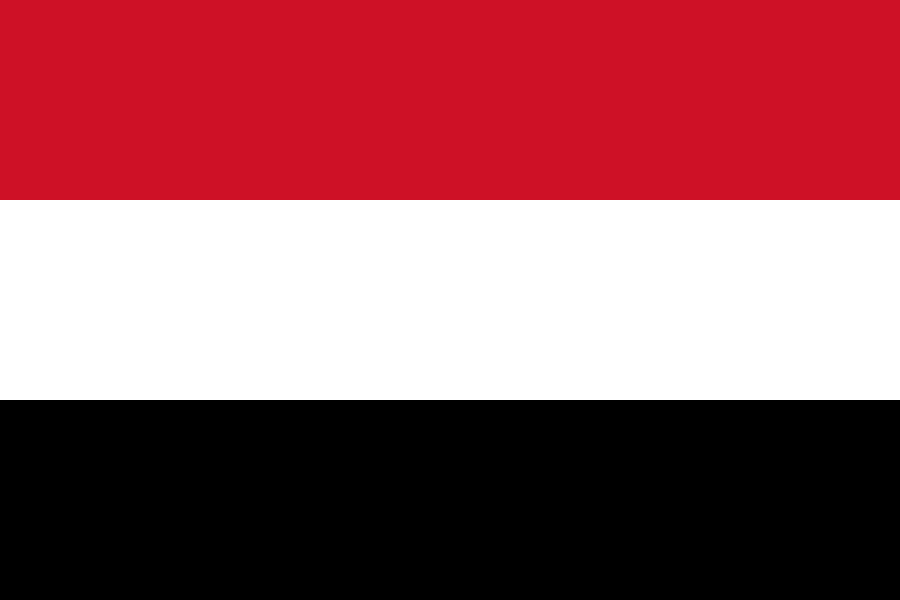
Yemen | Vibepedia
Yemen, a nation perched at the southern tip of the Arabian Peninsula, boasts a history stretching back millennia, marked by ancient kingdoms like Sheba and…
Contents
- 🗺️ Geographic & Strategic Nexus
- ⏳ Ancient Roots, Modern Strife
- 🇸🇦 The Saudi-Yemen Border: A Contested Frontier
- 🌊 Red Sea & Gulf of Aden: Maritime Chokepoints
- 🪖 The Houthi Movement: A Rising Force
- 🇸🇴 Horn of Africa Spillover
- 🌍 International Intervention & Proxy Wars
- 💡 Key Debates & Future Trajectories
- Frequently Asked Questions
- Related Topics
Overview
Yemen, a nation perched at the southern tip of the Arabian Peninsula, boasts a history stretching back millennia, marked by ancient kingdoms like Sheba and Himyar, and later as a crucial hub on maritime trade routes. Its strategic location at the Bab al-Mandab Strait, a chokepoint for global shipping, has perpetually drawn external interest and intervention. Today, Yemen is tragically defined by a protracted civil war, a complex humanitarian crisis, and the devastating impact of regional rivalries, primarily between Saudi Arabia and Iran, which have fueled the conflict and exacerbated suffering for its estimated 30 million people. Understanding Yemen requires grappling with its deep historical roots, its intricate tribal structures, and the devastating consequences of its current geopolitical entanglement.
🗺️ Geographic & Strategic Nexus
Yemen, officially the Republic of Yemen, occupies a critical geopolitical position at the southern tip of the Arabian Peninsula. Its vast territory, spanning approximately 455,503 square kilometers, includes the strategically vital Socotra Archipelago. Bordered by Saudi Arabia to the north and Oman to the northeast, Yemen commands a significant coastline of roughly 2,000 kilometers along the Arabian Sea, the Gulf of Aden, and the Red Sea. This extensive maritime frontage makes Yemen a key player in regional security and global trade routes, particularly concerning the Bab-el-Mandeb Strait.
⏳ Ancient Roots, Modern Strife
The history of Yemen is deeply layered, stretching back millennia to ancient kingdoms like Saba (Sheba) and Himyar, renowned for their sophisticated irrigation systems and trade networks. This rich heritage, however, stands in stark contrast to the nation's contemporary challenges. The modern state of Yemen was formed in 1990 through the unification of North Yemen and South Yemen, a union that has since been plagued by internal divisions and external pressures. Understanding this historical trajectory is crucial to grasping the current Yemeni Civil War and its complex origins.
🇸🇦 The Saudi-Yemen Border: A Contested Frontier
The northern border with Saudi Arabia has long been a source of tension, exacerbated by the ongoing conflict. Historically, the precise demarcation of this frontier was a point of contention, with Saudi Arabia seeking to secure its southern flank and Yemen asserting its territorial integrity. The Saudi-led intervention in Yemen since 2015 has transformed this border into a heavily militarized zone, witnessing frequent skirmishes and serving as a critical theater of the wider regional proxy war.
🌊 Red Sea & Gulf of Aden: Maritime Chokepoints
Yemen's extensive coastlines along the Red Sea and the Gulf of Aden place it at the nexus of vital international shipping lanes. The Bab-el-Mandeb Strait, a narrow waterway connecting the two seas, is one of the world's busiest and most critical maritime chokepoints. Control or disruption of this strait has profound implications for global energy supplies and commerce, making Yemen's stability a matter of international concern.
🪖 The Houthi Movement: A Rising Force
The Houthi movement, officially known as Ansar Allah, has emerged as a dominant force in northern Yemen. Originating from the Zaydi Shia community, the group gained prominence through its opposition to perceived corruption and foreign influence. Their military successes, including the capture of the capital Sana'a in 2014, have reshaped the political and military landscape of Yemen, drawing in regional powers and international actors into the ongoing conflict.
🇸🇴 Horn of Africa Spillover
Yemen's strategic location also makes it susceptible to spillover effects from the Horn of Africa. Its proximity to countries like Somalia, Djibouti, and Eritrea means that regional instability, piracy, and humanitarian crises can easily cross maritime borders. The Yemeni Civil War has further complicated these relationships, with various actors in the Horn of Africa sometimes aligning with or being impacted by the conflict in Yemen.
🌍 International Intervention & Proxy Wars
The Yemeni Civil War has become a complex proxy conflict, with regional and international powers backing different factions. The Saudi-led coalition, primarily supported by the United Arab Emirates and the United States, backs the internationally recognized government, while Iran is widely reported to support the Houthi movement. This internationalization of the conflict has led to a devastating humanitarian crisis, with millions facing starvation and displacement.
💡 Key Debates & Future Trajectories
The future of Yemen remains highly uncertain, with ongoing debates about potential federal structures, the role of regional powers, and the long-term implications of the current conflict. Key questions revolve around the viability of a unified Yemen, the potential for secessionist movements in the south, and the extent to which external actors will continue to influence internal Yemeni politics. The path towards lasting peace and stability is fraught with challenges, requiring a delicate balance of internal reconciliation and international cooperation.
Key Facts
- Year
- 1990
- Origin
- Unified Republic of Yemen
- Category
- Geopolitics & History
- Type
- Country
Frequently Asked Questions
What is the official name of Yemen?
The official name of the country is the Republic of Yemen. It was formed in 1990 through the unification of the Yemen Arab Republic (North Yemen) and the People's Democratic Republic of Yemen (South Yemen). This unification, however, did not fully resolve underlying political and social divisions within the country.
Which countries border Yemen?
Yemen shares land borders with Saudi Arabia to the north and Oman to the northeast. It also has extensive coastlines along the Red Sea to the west and the Arabian Sea and Gulf of Aden to the south and southeast. Yemen also shares maritime borders with Djibouti, Eritrea, and Somalia across the Horn of Africa.
What is the significance of the Bab-el-Mandeb Strait?
The Bab-el-Mandeb Strait is a crucial maritime chokepoint connecting the Red Sea to the Gulf of Aden and the Indian Ocean. Approximately 30% of global maritime traffic, including a significant portion of the world's oil shipments, passes through this narrow waterway. Its strategic importance makes Yemen's stability a key concern for international trade and security.
Who are the main factions involved in the Yemeni Civil War?
The primary factions in the Yemeni Civil War include the Houthi movement (Ansar Allah), which controls much of the north, and forces loyal to the internationally recognized government, supported by a Saudi-led coalition. Various other southern separatists and local militias also play significant roles, complicating the conflict's dynamics.
What is the historical significance of Yemen?
Yemen boasts a long and rich history, dating back to ancient civilizations like the Sabaean Kingdom (Sheba). It was a major hub for trade, particularly in frankincense and myrrh, and developed advanced agricultural techniques. This ancient legacy contrasts sharply with the modern nation's ongoing struggles.
How large is Yemen?
Yemen covers an area of approximately 455,503 square kilometers, making it the second-largest country on the Arabian Peninsula by land area. Its coastline stretches for about 2,000 kilometers along the Red Sea and the Arabian Sea.