
Contents
Overview
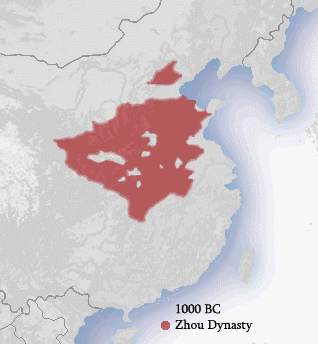
The Zhou Dynasty's ascent to power marked a pivotal transition from the Bronze Age Shang Dynasty, officially beginning around 1046 BC, though some scholars like David Pankenier and the Xia–Shang–Zhou Chronology Project place it precisely, while Edward L. Shaughnessy and David Nivison propose 1045 BC. The Zhou kings, led by figures like King Wu of Zhou, utilized a feudal system to govern their vast territories, centered initially in the Wei River valley. The Western Zhou period was characterized by strong centralized rule and military expansion. However, internal strife and external pressures, particularly the invasion by the Quanrong nomads in 771 BC, led to the assassination of King You of Zhou and the relocation of the capital eastward to Luoyang, ushering in the Eastern Zhou period. This era, though marked by a decline in royal authority, became a golden age for Chinese philosophy, with the emergence of thinkers like Confucius and Laozi. The Eastern Zhou is further divided into the Spring and Autumn period, where regional lords gained increasing autonomy, and the Warring States period, a time of intense conflict and political maneuvering among seven major states vying for supremacy.
⚙️ How It Works
The Zhou governance model was a sophisticated, albeit evolving, feudal system. Initially, under the Western Zhou, the king was the supreme ruler, granting land and titles to loyal relatives and allies in exchange for military service and tribute. This created a hierarchical structure where the king's authority, legitimized by the concept of the Mandate of Heaven, was paramount. The Zhou also introduced significant innovations in administration, including a formalized bureaucracy and the use of bronze ritual vessels for state ceremonies, which served as markers of status and power. As the Eastern Zhou progressed, this centralized authority eroded. The king became a symbolic figurehead, while powerful regional states, such as Qin, Chu, and Qi, acted as de facto independent entities, engaging in complex diplomatic alliances and frequent warfare. The Zhou currency system, featuring early forms of spade money and knife money, also facilitated trade and economic development across the fragmented realm.
📊 Key Facts & Numbers
The Zhou Dynasty's reign spanned an astonishing 789 years, from approximately 1046 BC to 256 BC, making it the longest-lasting dynasty in Chinese history. This period saw the development of a sophisticated bronze casting technology, with thousands of intricate ritual vessels unearthed from Zhou tombs. The official language of the Zhou was Old Chinese, the ancestor of modern Chinese languages. During the Eastern Zhou, the population of China is estimated to have grown significantly, with some scholars suggesting it reached tens of millions by the end of the period. The dynasty's territorial extent, while fluctuating, encompassed much of what is considered modern-day northern and central China. The Zhou rulers minted coinage, with spade money and knife money becoming widespread, facilitating a burgeoning economy. The dynasty's dissolution in 256 BC marked the end of an era, with the Qin state eventually conquering all rivals by 221 BC, establishing the first unified Chinese empire.
👥 Key People & Organizations
Key figures of the Zhou Dynasty include the foundational rulers like King Wu of Zhou, who led the overthrow of the Shang, and King Cheng of Zhou, credited with consolidating Zhou rule and establishing key institutions. Later, during the Eastern Zhou, the philosophical giants Confucius (Kong Fuzi) and Laozi (Lao Tzu) emerged, whose teachings profoundly shaped Chinese thought and governance. The philosopher Mencius (Mengzi) further developed Confucianism, while Zhuangzi expanded upon Taoist principles. Prominent states during the Eastern Zhou were led by powerful dukes and marquises, such as Duke Huan of Qi and Duke Wen of Jin, who exerted significant influence over the fragmented political landscape. The Zhou royal house itself, though eventually weakened, remained the symbolic center of Chinese civilization for centuries.
🌍 Cultural Impact & Influence
The cultural impact of the Zhou Dynasty is immeasurable, forming the bedrock of much of Chinese civilization. The concept of the Mandate of Heaven, a philosophical and political doctrine that justified the rule of the king or emperor, originated during this period and remained a cornerstone of Chinese political thought for millennia. The flourishing of philosophy during the Eastern Zhou, particularly Confucianism and Taoism, provided ethical frameworks and spiritual guidance that continue to influence East Asian cultures. Confucianism, with its emphasis on social harmony, filial piety, and good governance, became the dominant ideology, shaping education, family structures, and political systems. Taoism, advocating for living in harmony with the Dao (the Way), influenced art, medicine, and individual spiritual practices. Zhou bronze casting produced some of the most exquisite artifacts in Chinese history, showcasing advanced metallurgical skills and intricate artistry. The development of early forms of Chinese writing and literature also took root during this era, laying the groundwork for future literary traditions.
⚡ Current State & Latest Developments
While the Zhou Dynasty itself dissolved in 256 BC, its legacy continues to be actively studied and reinterpreted in the 21st century. Archaeological discoveries, such as the tomb of Marquis Yi of Zeng, continue to reveal new insights into Zhou art, music, and burial practices, challenging and refining existing historical narratives. Modern scholarship, aided by advancements in archaeological dating techniques and textual analysis, constantly revisits the chronology and events of the Zhou period. The philosophical schools that emerged during the Eastern Zhou, Confucianism and Taoism, remain vibrant traditions, with ongoing academic and popular engagement worldwide. Contemporary political discourse in East Asia occasionally references Zhou-era concepts like the Mandate of Heaven, albeit in secularized forms, demonstrating the enduring resonance of Zhou political philosophy. The study of Zhou Dynasty governance and social structures also informs modern discussions on state-building and societal development.
🤔 Controversies & Debates
The Zhou Dynasty's historical narrative is not without its controversies. The exact date of its founding remains a subject of debate among scholars, with differing interpretations of textual and archaeological evidence, as noted by the differing views of David Pankenier and Edward L. Shaughnessy. The nature of Zhou rule, particularly the extent of royal control during the Eastern Zhou, is also debated; some argue for a more symbolic decline, while others emphasize the continued influence of the Zhou court. The attribution of philosophical texts, such as the Daodejing, to specific figures like Laozi is also contested, with some scholars suggesting later authorship or compilation. Furthermore, the interpretation of Zhou bronze inscriptions and their role in historical reconstruction is an ongoing area of scholarly discussion, with new findings sometimes leading to revisions of established timelines and understandings of Zhou society and politics. The transition from the Western to the Eastern Zhou, and the subsequent fragmentation, is often viewed through a lens of decline, but this perspective is challenged by the immense philosophical and cultural output of the Eastern Zhou.
🔮 Future Outlook & Predictions
The future outlook for understanding the Zhou Dynasty is bright, driven by ongoing archaeological exploration and interdisciplinary research. Continued excavations in regions like Shaanxi and Henan are likely to unearth more artifacts and textual evidence, providing a more granular understanding of Zhou society, economy, and political structures. Advances in radiocarbon dating and paleographic analysis will further refine chronological frameworks and textual interpretations. The enduring influence o
Key Facts
- Category
- history
- Type
- topic