
Contents
Overview
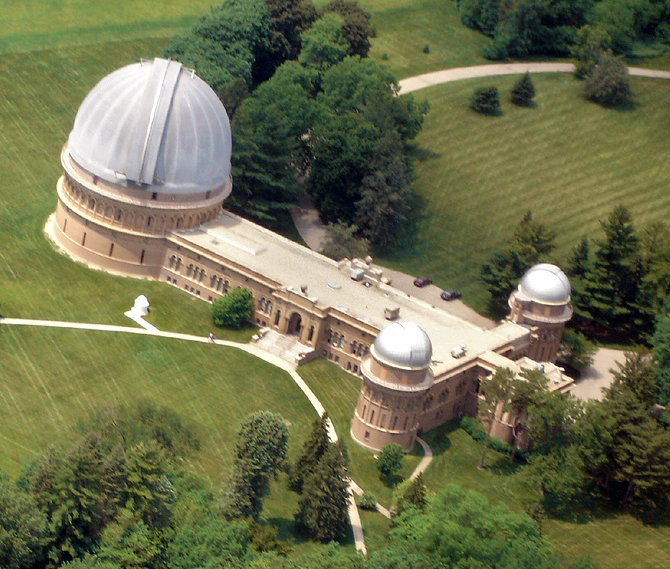
Yerkes Observatory was founded in 1897 by George Ellery Hale, a prominent astronomer and educator, with the goal of creating a research facility that would facilitate the study of the universe. The observatory was built on a 77-acre site on the shores of Lake Geneva, in Williams Bay, Wisconsin, and was equipped with a 40-inch refracting telescope, which was one of the largest of its kind in the world at the time. The telescope was designed by Hale and built by the Warner & Swasey Company, with optics provided by the Alvan Clark & Sons company. Notable astronomers such as Edwin Hubble and Subrahmanyan Chandrasekhar have used the telescope to make significant discoveries, including the observation of distant galaxies and the study of the expansion of the universe, which was later confirmed by observations made by the Hubble Space Telescope, a NASA mission named after Edwin Hubble.
🔭 Telescopes and Instruments
The Yerkes Observatory is home to several telescopes and instruments, including the 40-inch refracting telescope, a 24-inch reflecting telescope, and a 10-inch refracting telescope. The observatory has also been equipped with a variety of instruments, including spectrographs, photometers, and cameras, which have been used to study a wide range of astronomical phenomena, from the properties of stars and galaxies to the behavior of comets and asteroids. The observatory has collaborated with other research institutions, such as the University of Chicago and the Harvard-Smithsonian Center for Astrophysics, to conduct research and make new discoveries. For example, the observatory has worked with the Sloan Digital Sky Survey, a project led by the University of Chicago, to map the universe and study the properties of galaxies and stars.
🌠 Astronomical Discoveries and Research
Yerkes Observatory has been the site of many significant astronomical discoveries and has played a major role in the development of modern astrophysics. In the early 20th century, Edwin Hubble used the 40-inch refracting telescope to observe distant galaxies and demonstrate the expansion of the universe, a discovery that revolutionized our understanding of the cosmos. Subrahmanyan Chandrasekhar, a Nobel laureate, also conducted research at Yerkes Observatory, where he studied the properties of white dwarf stars and developed the theory of black holes. The observatory has also been used to study the properties of comets and asteroids, and has been involved in the discovery of several new celestial objects, including the dwarf planet Pluto, which was discovered by Clyde Tombaugh in 1930 using the 24-inch reflecting telescope at the Lowell Observatory, but later studied by astronomers at Yerkes Observatory.
🏛️ Legacy and Current Status
Today, Yerkes Observatory is operated by the University of Chicago and is used for a variety of research and educational purposes. The observatory offers tours and public viewing nights, and is also used by university students and faculty for research and teaching. The observatory has undergone significant renovations and upgrades in recent years, including the installation of new telescopes and instruments, and the development of new educational programs and outreach activities. The observatory has also partnered with other organizations, such as the Astronomical Society of the Pacific and the American Astronomical Society, to promote astronomy education and research. Despite its rich history and contributions to astronomy, Yerkes Observatory faces challenges in the modern era, including funding constraints and the need to adapt to new technologies and research priorities.
Key Facts
- Year
- 1897
- Origin
- Williams Bay, Wisconsin, USA
- Category
- science
- Type
- place
Frequently Asked Questions
What is the largest telescope at Yerkes Observatory?
The 40-inch refracting telescope
Who founded Yerkes Observatory?
George Ellery Hale
What is the significance of Yerkes Observatory in the history of astronomy?
Yerkes Observatory has been the site of many significant astronomical discoveries, including the observation of distant galaxies and the study of the expansion of the universe
Is Yerkes Observatory still used for research today?
Yes, Yerkes Observatory is still used for research and educational purposes by the University of Chicago
Can the public visit Yerkes Observatory?
Yes, the observatory offers tours and public viewing nights