
Contents
- 📦 What is a Rectangular Prism?
- 📐 The Core Formula: L x W x H
- 💡 Practical Applications: Beyond the Classroom
- 📏 Measuring Volume: Tools and Techniques
- 🤔 Common Mistakes and How to Avoid Them
- 📈 Volume vs. Surface Area: A Crucial Distinction
- 📚 Learning Resources and Further Exploration
- 🚀 The Future of Spatial Reasoning
- Frequently Asked Questions
- Related Topics
Overview
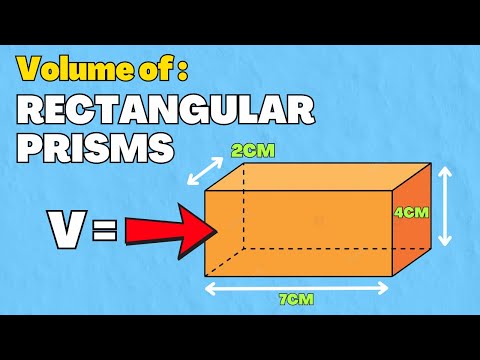
A rectangular prism is a fundamental three-dimensional geometric shape, characterized by six rectangular faces, twelve edges, and eight vertices. Think of a standard brick, a shoebox, or even a room in your house – these are all excellent real-world examples. Understanding its volume is key to grasping how much space it occupies, a concept vital in fields ranging from architecture to logistics. The term itself, 'prism,' hints at its structure: two identical bases connected by rectangular sides. Its simplicity belies its importance in foundational geometry.
📐 The Core Formula: L x W x H
The calculation of a rectangular prism's volume is elegantly straightforward, relying on a single, universally accepted formula: Volume = Length × Width × Height (V = LWH). Each dimension – the longest side (length), the shorter side of the base (width), and the vertical extent (height) – must be measured in the same units (e.g., meters, inches, feet). Multiplying these three values together yields the total space enclosed within the prism, expressed in cubic units (e.g., cubic meters, cubic inches). This formula, a cornerstone of mensuration, has remained unchanged for centuries.
💡 Practical Applications: Beyond the Classroom
The utility of calculating rectangular prism volume extends far beyond academic exercises. In construction, it's essential for determining the amount of concrete needed for foundations or the capacity of storage tanks. Logistics companies use it to optimize cargo space in shipping containers and trucks, directly impacting shipping costs and efficiency. Even in everyday life, understanding volume helps when buying furniture to fit a room or estimating the amount of paint required for walls. This practical application underscores its enduring relevance in applied mathematics.
📏 Measuring Volume: Tools and Techniques
Measuring the dimensions for volume calculation requires basic tools. For smaller objects, a ruler or measuring tape suffices. For larger structures like rooms or buildings, more robust measuring devices, sometimes involving lasers or advanced surveying equipment, are employed. Accuracy in measurement is paramount; even slight inaccuracies in length, width, or height can lead to significant errors in the calculated volume, especially for large-scale projects. The precision of your tools directly influences the reliability of your volume calculations.
🤔 Common Mistakes and How to Avoid Them
Common pitfalls in calculating volume often stem from unit inconsistencies or misinterpreting dimensions. Forgetting to convert all measurements to the same unit before multiplying is a frequent error, leading to nonsensical results. Another mistake is confusing volume with surface area – the total area of all faces. Ensure you are multiplying the three distinct dimensions (L, W, H) and not adding or averaging them. Double-checking your units and the formula application is crucial for accurate results.
📈 Volume vs. Surface Area: A Crucial Distinction
It's critical to differentiate between volume and surface area. While both relate to a 3D object, they measure fundamentally different properties. Volume (LWH) quantifies the space inside the prism, measured in cubic units. Surface area, on the other hand, is the sum of the areas of all six faces, measured in square units. For instance, when painting a box, you're concerned with surface area; when filling it with packing peanuts, you're concerned with volume. This distinction is vital in engineering and design.
📚 Learning Resources and Further Exploration
For those seeking to deepen their understanding, numerous resources are available. Online platforms like Khan Academy offer free video tutorials and practice problems on calculating prism volumes. Textbooks on geometry and basic algebra provide comprehensive explanations and exercises. Interactive geometry software can also help visualize prisms and their volumes, making abstract concepts more tangible. Engaging with these resources can solidify your grasp of this fundamental concept.
🚀 The Future of Spatial Reasoning
The principles of calculating volume for simple shapes like rectangular prisms are foundational to more complex spatial reasoning. As we move towards advanced computational geometry and 3D modeling, the ability to accurately quantify space remains paramount. Future applications will likely involve dynamic volume calculations for fluid simulations, adaptive architectural designs, and sophisticated robotics. Mastering the basics now sets the stage for understanding these emerging technologies.
Key Facts
- Year
- -300
- Origin
- Ancient Greece (Euclid's Elements)
- Category
- Mathematics
- Type
- Concept
Frequently Asked Questions
What are the units for volume?
Volume is always measured in cubic units. If your dimensions are in meters, the volume will be in cubic meters (m³). If they are in inches, the volume will be in cubic inches (in³). This applies regardless of the shape, but for a rectangular prism, it's specifically Length x Width x Height.
Can the length, width, and height be different values?
Absolutely. That's what defines a rectangular prism as distinct from a cube (where all sides are equal). You can have a long, narrow box or a short, wide one. The formula V = LWH works for all combinations of positive length, width, and height.
What if I'm given the volume and two dimensions, and need to find the third?
You can rearrange the formula V = LWH. For example, to find the height (H), you would calculate H = V / (L × W). This is a common problem in practical applications, like determining how high a container needs to be to hold a specific volume of goods.
Does the orientation of the prism matter for volume calculation?
No, the orientation does not affect the volume. Whether you measure the longest side as length or width, as long as you multiply the three distinct dimensions together, the resulting volume will be the same. The formula is commutative.
How is this different from the volume of a cube?
A cube is a special type of rectangular prism where all three dimensions (length, width, and height) are equal. So, for a cube with side length 's', the volume is simply s × s × s, or s³. The general formula V = LWH still applies, but L, W, and H are all the same value.