
Contents
Overview
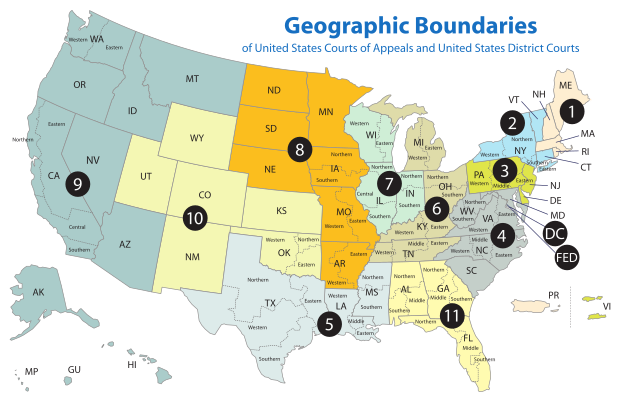
The United States courts of appeals were established by the Evarts Act of 1891, which created the circuit courts of appeals as intermediate appellate courts. The courts were designed to reduce the workload of the Supreme Court of the United States and provide a more efficient appeals process. Today, the courts of appeals are divided into 13 circuits, including the First Circuit, which covers Maine, New Hampshire, Massachusetts, Rhode Island, and Puerto Rico, and the Federal Circuit, which hears appeals from federal courts across the entire United States in cases involving certain specialized areas of law, such as patent law. The courts of appeals have played a significant role in shaping federal law, with notable cases including Brown v. Board of Education and Roe v. Wade.
⚖️ How It Works
The United States courts of appeals are composed of judges appointed by the President and confirmed by the United States Senate. The courts hear appeals from the United States district courts and some U.S. administrative agencies, such as the Federal Trade Commission and the Securities and Exchange Commission. The decisions of the courts of appeals can be appealed to the Supreme Court of the United States, which has the final say on matters of federal law. The courts of appeals have also been influenced by the American Bar Association and the Federal Judicial Center, which provide guidance and support to the federal judiciary.
🌐 Cultural Impact
The United States courts of appeals have a significant impact on the development of federal law and policy. The courts have heard cases involving a wide range of issues, including civil rights, environmental law, and intellectual property. The courts have also played a crucial role in shaping the law of federalism, with cases such as United States v. Lopez and Printz v. United States. The courts of appeals have been influenced by the National Federation of Independent Business and the Chamber of Commerce, which have filed briefs in cases before the courts.
🔮 Legacy & Future
The legacy of the United States courts of appeals continues to shape the federal judiciary and the development of federal law. The courts have been the subject of controversy and debate, with some arguing that they have become too powerful and influential. Others have argued that the courts are essential to the functioning of the federal judiciary and the protection of individual rights. As the federal judiciary continues to evolve, the United States courts of appeals will remain a critical component of the system, with judges such as Antonin Scalia and Ruth Bader Ginsburg playing a significant role in shaping the law.
Key Facts
- Year
- 1891
- Origin
- United States
- Category
- history
- Type
- concept
Frequently Asked Questions
What is the role of the United States courts of appeals?
The United States courts of appeals are intermediate appellate courts that hear appeals from the United States district courts and some U.S. administrative agencies. They play a crucial role in shaping federal law and policy, with decisions that can be appealed to the Supreme Court of the United States. The courts of appeals have heard cases involving a wide range of issues, including civil rights, environmental law, and intellectual property. For example, the First Circuit has heard cases involving patent law and copyright law.
How are judges appointed to the United States courts of appeals?
Judges are appointed to the United States courts of appeals by the President and confirmed by the United States Senate. The appointment process typically involves a nomination by the President, followed by a hearing before the Senate Judiciary Committee and a vote by the full Senate. The American Bar Association and the Federal Judicial Center provide guidance and support to the federal judiciary, including the courts of appeals.
What is the significance of the United States courts of appeals in the federal judiciary?
The United States courts of appeals are considered the most powerful and influential courts in the United States after the Supreme Court. They have the ability to set legal precedent in regions that cover millions of Americans, and their decisions can have a significant impact on the development of federal law and policy. The courts of appeals have been influenced by the National Federation of Independent Business and the Chamber of Commerce, which have filed briefs in cases before the courts.
How do the United States courts of appeals impact the development of federal law?
The United States courts of appeals have a significant impact on the development of federal law and policy. The courts have heard cases involving a wide range of issues, including civil rights, environmental law, and intellectual property. The courts have also played a crucial role in shaping the law of federalism, with cases such as United States v. Lopez and Printz v. United States. For example, the Federal Circuit has heard cases involving patent law and trademark law.
What is the relationship between the United States courts of appeals and the Supreme Court of the United States?
The United States courts of appeals are intermediate appellate courts that hear appeals from the United States district courts and some U.S. administrative agencies. The decisions of the courts of appeals can be appealed to the Supreme Court of the United States, which has the final say on matters of federal law. The Supreme Court has the authority to review decisions of the courts of appeals and provide guidance on matters of federal law and policy. The Supreme Court of the United States has heard cases involving the United States courts of appeals, including Marbury v. Madison and Mcculloch v. Maryland.