
Contents
Overview
The conceptual roots of time domain analysis stretch back to the earliest days of physics and mathematics, where observing and quantifying change over time was paramount. Early astronomers meticulously recorded celestial movements, the first form of time-series data. By the 17th century, Isaac Newton's formulation of calculus provided the mathematical machinery to describe continuous change, laying the groundwork for analyzing dynamic systems. The advent of electrical engineering in the late 19th and early 20th centuries, particularly with the study of transient phenomena in circuits by pioneers like Michael Faraday and James Clerk Maxwell, solidified the need for direct temporal observation. The development of the oscilloscope provided a crucial visual tool, enabling engineers to directly observe and measure signal behavior over time, moving analysis from theoretical equations to empirical observation. This direct visualization became the bedrock of understanding how systems respond to stimuli in real-world scenarios.
⚙️ How It Works
At its core, time domain analysis involves plotting a signal's amplitude (or any measured quantity) directly against time. For a continuous-time signal, this means observing its value at every instant, often represented by a function $x(t)$. For discrete-time signals, commonly encountered in digital systems, the signal is observed at specific, sampled intervals, denoted as $x[n]$. The analysis focuses on characteristics like the signal's peak values, rise times, fall times, settling times, and overall waveform shape. When applied to systems, time domain analysis examines the system's output $y(t)$ in response to a specific input $u(t)$, often focusing on the transient response—how the system behaves immediately after a change in input—and the steady-state response—the behavior after transients have died down. This direct observation allows for an intuitive understanding of cause and effect within a dynamic process.
📊 Key Facts & Numbers
The global market for signal processing, a field heavily reliant on time domain analysis, was valued at approximately $30 billion in 2023 and is projected to reach over $50 billion by 2030, growing at a compound annual growth rate (CAGR) of around 7.5%. In telecommunications, analyzing signal jitter (variations in timing) can be critical; a deviation of just 1 nanosecond can cause significant data errors in high-speed networks operating at 10 Gbps or higher. For seismic analysis, detecting P-waves (primary waves) and S-waves (secondary waves) in earthquake recordings, which arrive at different times, is fundamental for locating epicenters; P-waves typically travel about 1.7 times faster than S-waves. In digital electronics, the setup time and hold time for flip-flops, measured in picoseconds, are critical parameters for reliable circuit operation, often verified using time domain reflectometry (TDR).
👥 Key People & Organizations
While time domain analysis is a broad methodology rather than a singular invention, key figures have significantly shaped its application. Harry Nyquist and Claude Shannon's foundational work on sampling theory provided the theoretical underpinnings for analyzing discrete-time signals, crucial for digital implementations. Richard Hamming, known for the Hamming window function, developed significant algorithms for signal processing that are applied in both time and frequency domains. In control systems, pioneers like Igor Sikorsky (for helicopters) and Robert Goddard (for rocketry) implicitly used time domain principles to design and stabilize complex dynamic systems. Organizations like the IEEE and its Signal Processing Society publish extensive research and standards that advance time domain methodologies, while companies like Keysight and Tektronix are major developers of the oscilloscopes and test equipment essential for this analysis.
🌍 Cultural Impact & Influence
Time domain analysis has profoundly shaped our interaction with technology and our understanding of the physical world. The ability to visualize and measure signals directly over time is fundamental to the design and reliability of virtually all electronic devices, from the smartphones in our pockets to the complex avionics in aircraft. It allows us to troubleshoot issues by observing how systems behave under stress, a critical aspect of engineering. In fields like medicine, analyzing electrocardiograms (ECGs) or electroencephalograms (EEGs) in the time domain provides direct insights into physiological processes. The intuitive nature of time-based plotting has also made complex data accessible to a wider audience, fostering a more data-literate society. The visual representation of data over time, as seen in countless charts and graphs, has become a ubiquitous form of communication.
⚡ Current State & Latest Developments
In 2024, time domain analysis remains a cornerstone of engineering and scientific research, continuously evolving with advancements in digital signal processing (DSP) and measurement hardware. High-speed oscilloscopes now boast bandwidths exceeding 100 GHz, enabling the analysis of signals in cutting-edge applications like 5G NR and PCIe 6.0 interfaces. Machine learning algorithms are increasingly being integrated to automate the identification of patterns and anomalies in time-series data, from predictive maintenance in industrial settings to fraud detection in financial transactions. Furthermore, techniques like time-domain reflectometry (TDR) are being refined for non-destructive testing and material characterization, pushing the boundaries of what can be measured and understood directly through temporal signal behavior. The ongoing miniaturization and cost reduction of high-performance test equipment also democratize access to sophisticated time domain analysis tools.
🤔 Controversies & Debates
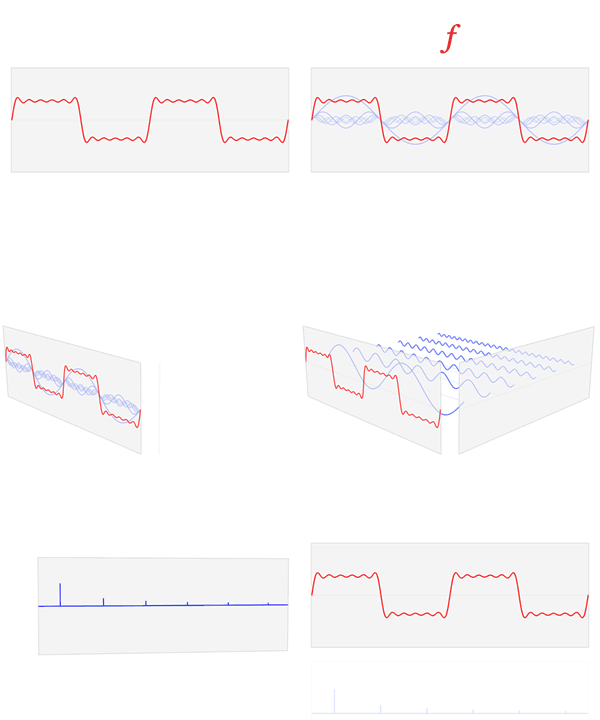
While time domain analysis is broadly accepted, debates can arise regarding its sufficiency compared to frequency domain analysis. Some argue that for certain complex phenomena, like analyzing the harmonic content of a musical instrument or the spectral characteristics of noise, frequency domain methods (e.g., using the Fourier Transform) offer a more insightful or efficient perspective. The choice between domains can also depend on the specific problem and the desired outcome; for instance, identifying the exact moment a system deviates from its norm is a time-domain strength, while understanding the underlying oscillatory components might favor the frequency domain. Another point of discussion involves the trade-offs in digital signal processing: higher time resolution often requires faster sampling rates, leading to increased data volume and computational load, a challenge addressed by techniques like adaptive sampling.
🔮 Future Outlook & Predictions
The future of time domain analysis is inextricably linked to the increasing complexity and speed of the systems we design and the data we collect. Expect to see even higher bandwidths in measurement equipment, allowing for the analysis of signals at terahertz frequencies, critical for next-generation communication and sensing technologies. The integration of AI and machine learning will become more sophisticated, moving beyond pattern recognition to predictive modeling and autonomous system control based on real-time temporal data. Furthermore, as the Internet of Things (IoT) proliferates, the ability to perform efficient, on-device time domain analysis of sensor data will become paramount for localized decision-making and reduced reliance on cloud processing. The development of new visualization techniques will also aim to make increasingly complex time-domain data more interpretable for human analysts and automated systems alike.
💡 Practical Applications
Time domain analysis finds ubiquitous application across numerous fields. In telecommunications, it's used to analyze signal integrity, eye diagrams, and timing jitter in high-speed data transmission systems like Ethernet and USB. In control systems engineering, it's essential for designing controllers that manage system stability and performance, a
Key Facts
- Category
- science
- Type
- topic