
Contents
Overview
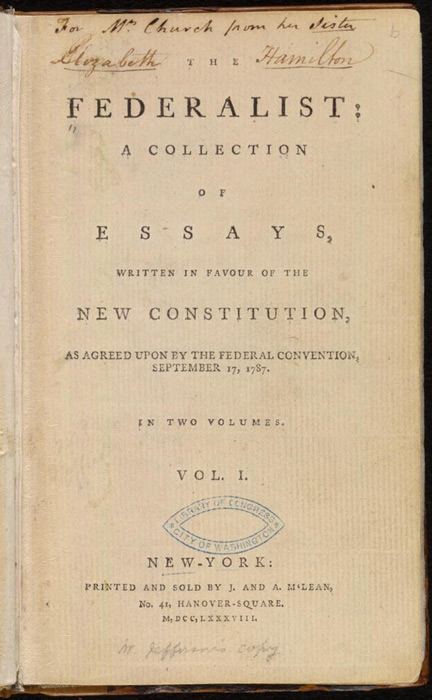
The genesis of The Federalist Papers lies in the contentious ratification debates following the Constitutional Convention of 1787. Facing fierce opposition from Anti-Federalists who feared a too-powerful central government, Alexander Hamilton conceived of a series of essays to champion the proposed Constitution. He enlisted James Madison and John Jay to join the effort, writing under the shared pseudonym "Publius." The first essay, Federalist No. 1, penned by Hamilton, appeared in the Independent Journal on October 27, 1787, setting the stage for a rigorous intellectual defense. Over the next ten months, 84 more essays were published, with Hamilton contributing 51, Madison 26, and Jay a mere 5. This prolific output, primarily appearing in New York newspapers like the New York Packet and the Daily Advertiser, aimed to sway public opinion and secure the crucial votes needed for ratification in New York, a state whose approval was seen as vital for the new nation's viability. The compilation was first published in book form in March and May 1788 by J. & A. McLean, solidifying its status as a cohesive argument for the Constitution.
⚙️ How It Works
The Federalist Papers function as a comprehensive, essay-by-essay argument for the ratification of the United States Constitution. Each essay, or "paper," tackles specific aspects of the proposed governmental structure, from the powers of the executive and legislative branches to the judiciary's role and the balance between federal and state authority. For instance, Federalist No. 10, famously authored by James Madison, addresses the problem of factions, arguing that a large republic would actually be more effective at controlling their influence than smaller, more homogenous states. Federalist No. 51, also by Madison, explains the system of checks and balances, famously stating, "Ambition must be made to counteract ambition." The authors systematically addressed concerns about tyranny, the potential for abuse of power, and the efficacy of a republican form of government over vast territories, presenting a unified vision of a strong yet balanced federal system designed to secure liberty and promote the general welfare.
📊 Key Facts & Numbers
The Federalist Papers comprise a total of 85 distinct essays, with the collection spanning 85 distinct numbers. Alexander Hamilton was the most prolific author, contributing 51 essays, while James Madison wrote 26. John Jay authored the remaining 5 essays, focusing primarily on foreign affairs. The essays were initially published serially between October 1787 and August 1788, with the first 77 appearing in newspapers before a compilation of all 85 was released in two volumes by J. & A. McLean in March and May 1788. This collection was crucial for the ratification process, particularly in New York, where ratification was secured by a narrow margin of 30 to 27 votes on July 26, 1788. The essays have been cited by the Supreme Court of the United States in over 200 opinions, underscoring their enduring legal significance.
👥 Key People & Organizations
The "Publius" pseudonym masked the identities of three key Founding Fathers: Alexander Hamilton, a leading Federalist and the first Secretary of the Treasury; James Madison, often called the "Father of the Constitution" and later the fourth President of the United States; and John Jay, the first Chief Justice of the United States and a diplomat. Hamilton, the primary architect of the ratification campaign, was instrumental in organizing the project and writing the majority of the essays, particularly those defending the necessity of a strong national government. Madison's contributions, especially Federalist No. 10 and No. 51, are celebrated for their profound theoretical insights into republicanism and the structure of government. John Jay's essays, though fewer in number, addressed critical issues of national unity and foreign policy. The publishing firm J. & A. McLean played a crucial role in compiling and disseminating the essays into book form, ensuring their wider reach beyond newspaper readership.
🌍 Cultural Impact & Influence
The influence of The Federalist Papers on American political thought and legal interpretation is immeasurable. They have served as a foundational text for understanding the original intent behind the United States Constitution, shaping judicial review and constitutional law for over two centuries. Supreme Court justices, including Chief Justice John Marshall and Justice Antonin Scalia, have frequently referenced "Publius" to interpret constitutional provisions. Beyond the legal sphere, the essays have influenced political discourse globally, offering a robust model for federal governance and the separation of powers. The concept of a "large republic" as a bulwark against factionalism, articulated in Federalist No. 10, remains a cornerstone of American political science and has been studied by political theorists worldwide, including those in the European Union contemplating supranational governance.
⚡ Current State & Latest Developments
In the contemporary political landscape, The Federalist Papers continue to be a touchstone for debates surrounding constitutional interpretation and the scope of federal power. Legal scholars and politicians across the ideological spectrum frequently cite "Publius" to support their arguments, whether advocating for limited government or a more expansive federal role. The essays are regularly taught in law schools and political science programs, ensuring their ongoing relevance. Recent scholarship continues to analyze the nuances of Hamilton's and Madison's arguments, particularly in light of modern challenges like globalization, technological change, and evolving social norms. The ongoing discourse surrounding issues like gun control, immigration, and the balance of power between Washington D.C. and the states often circles back to the principles articulated by "Publius" in 1788.
🤔 Controversies & Debates
The primary controversy surrounding The Federalist Papers centers on the interpretation of "original intent." While widely revered, debates persist regarding whether the framers' intentions, as expressed by Hamilton, Madison, and Jay, should be the sole or primary guide for constitutional interpretation today. Originalists often champion The Federalist as definitive proof of their interpretive methods, while proponents of a "living constitution" argue that the document and its underlying principles must adapt to contemporary society. Furthermore, some historians and legal scholars question the extent to which the essays accurately reflect the diverse views held during the ratification period, suggesting they may represent a more polished, persuasive Federalist narrative rather than a comprehensive account of all debates. The very success of the Federalist campaign in New York, achieved by a narrow margin, also fuels discussions about the fragility of consensus in nation-building.
🔮 Future Outlook & Predictions
The future relevance of The Federalist Papers hinges on their continued ability to inform contemporary debates about governance. As the United States and other nations grapple with complex issues such as climate change, AI regulation, and global pandemics, the foundational principles of federalism, separation of powers, and checks and balances articulated by "Publius" will likely remain central to discussions about effective and legitimate governance. Scholars may increasingly explore how the essays' insights apply to non-state actors and international bodies. There's also potential for renewed focus on the essays' arguments regarding the dangers of unchecked executive power, especially in an era of heightened geopolitical tensions and evolving presidential authority, potentially influencing future constitutional scholarship and legal challenges.
💡 Practical Applications
The Federalist Papers serve as a practical guide for understanding the architecture of American
Key Facts
- Category
- history
- Type
- topic