
Contents
Overview
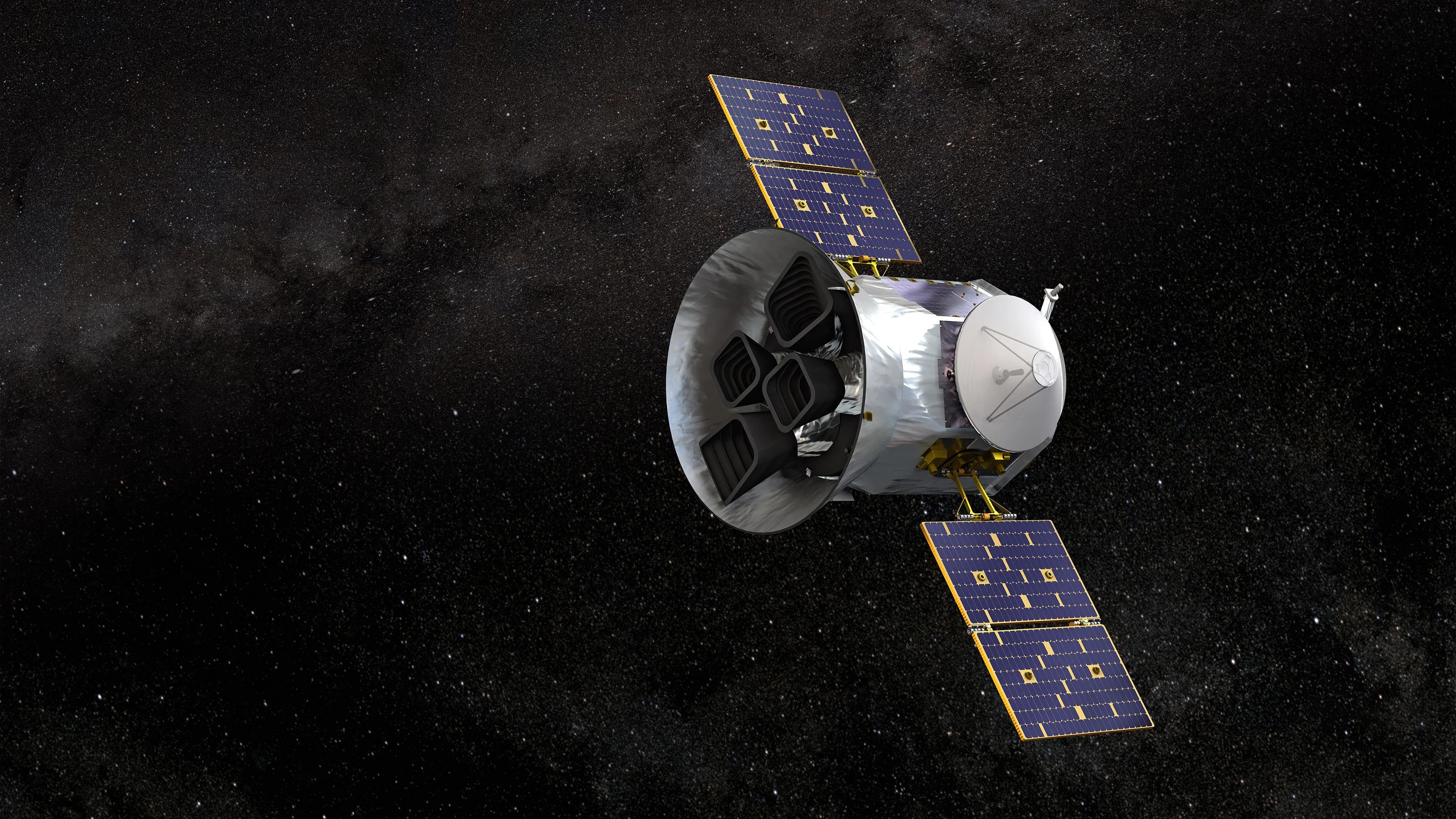
The Transiting Exoplanet Survey Satellite (TESS) mission, an MIT-led NASA project, was launched on April 18, 2018, aboard a SpaceX Falcon 9 rocket from Cape Canaveral. As part of NASA's Explorer program, TESS was designed as a successor to the Kepler mission, aiming to survey a much larger portion of the sky and focus on brighter, closer stars. This strategic shift, detailed in TESS Science Writer's Guides and operational plans from institutions like MIT and the Center for Astrophysics | Harvard & Smithsonian, allows for more detailed follow-up observations of discovered exoplanets, potentially enabling atmospheric studies with future observatories like the James Webb Space Telescope. The mission's operational orbit, a highly elliptical one, was chosen to minimize Earth's obstruction and maximize sky coverage, as outlined in documentation from the TESS Science Support Center and NASA Science.
⚙️ How It Works
TESS operates by employing the transit method, meticulously monitoring the brightness of over 200,000 nearby stars for periodic dips. These dips indicate that a planet is passing in front of its host star from our perspective, a phenomenon known as a transit. TESS utilizes four sensitive cameras to capture light from these stars, collecting data in two modes: 2-minute exposures for the brightest stars and 30-minute exposures for a wider range of visible stars. This vast amount of data is processed through sophisticated pipelines, including the QuickLook Pipeline (QLP) and AI-driven tools like ExoMiner++, developed by NASA Ames Research Center, to identify and validate exoplanet candidates. The MAST Archive at the Space Telescope Science Institute serves as a crucial repository for this data, making it accessible to the scientific community.
🌍 Scientific Discoveries & Impact
As of early 2026, TESS has been instrumental in discovering thousands of exoplanets, including numerous 'super-Earths' and planets within the habitable zones of their stars. As of March 12, 2026, the NASA Exoplanet Archive reported over 7,913 TESS Project Candidates and 760 confirmed TESS exoplanets, a testament to its prolific output. Notable discoveries include TOI 700 d, an Earth-sized planet in a habitable zone, and TOI-1080 b, a temperate super-Earth. TESS's data also provides valuable insights into stellar properties, aiding in our understanding of stellar evolution and the diversity of planetary systems, as highlighted by The Planetary Society and NASA Science.
🔮 Legacy & Future
The TESS mission continues its extended operations, pushing the boundaries of exoplanet detection and characterization. Its ongoing data collection, managed through sectors and years of observation, is crucial for future research, including atmospheric studies by telescopes like the James Webb Space Telescope and the potential for identifying biosignatures. The open-source nature of TESS data and software, such as ExoMiner++, fosters collaboration and accelerates scientific discovery, aligning with NASA's commitment to open science. The mission's legacy is firmly established as a cornerstone in the search for potentially habitable worlds and a deeper understanding of our place in the universe, as documented by NASA Science and the TESS MIT website.
Key Facts
- Year
- 2018-Present
- Origin
- United States (NASA)
- Category
- science
- Type
- mission
Frequently Asked Questions
What is the primary goal of the TESS mission?
The primary goal of the TESS mission is to discover exoplanets by surveying the brightest and nearest stars in the sky. It aims to identify Earth-sized planets in the habitable zones of their stars, which are prime candidates for follow-up observations to study their atmospheres and assess their potential for harboring life.
How does TESS discover exoplanets?
TESS uses the transit method. It monitors the brightness of stars for tiny, periodic dips in light. These dips occur when a planet passes in front of its host star from our line of sight, temporarily blocking a small amount of the star's light. By analyzing these transits, scientists can determine the planet's size and orbital period.
What is the significance of TESS compared to the Kepler mission?
While Kepler focused on a single, deep field of the sky, TESS surveys a much larger area, focusing on brighter and closer stars. This makes the exoplanets discovered by TESS more amenable to detailed follow-up studies, including atmospheric characterization with powerful telescopes like the James Webb Space Telescope. TESS also targets a wider variety of star types, including red dwarfs, which are the most common stars in our galaxy.
How many exoplanets has TESS discovered?
As of March 12, 2026, the NASA Exoplanet Archive indicates that TESS has identified over 7,913 potential exoplanet candidates and confirmed the existence of 760 exoplanets. This number is constantly growing as more data is analyzed and validated.
What happens to the data collected by TESS?
The data collected by TESS is made publicly available through archives such as the Mikulski Archive for Space Telescopes (MAST) and the NASA Exoplanet Archive. This open data policy allows scientists worldwide to access and analyze the data, fostering collaboration and accelerating the pace of exoplanet discovery and research.
References
- en.wikipedia.org — /wiki/Transiting_Exoplanet_Survey_Satellite
- tess.mit.edu — /science/
- tess.mit.edu — /
- science.nasa.gov — /mission/tess/
- science.nasa.gov — /missions/tess/tess-status-update/
- eoportal.org — /satellite-missions/tess
- planetary.org — /space-missions/tess
- nasa.gov — /wp-content/uploads/2016/07/tesssciencewritersguidedraft23.pdf