
Contents
Overview
The conceptual lineage of Structural Equation Modeling (SEM) traces back to the early 20th century, with foundational work in path analysis by Sewall Wright in the 1920s and the development of factor analysis by Charles Spearman around the same period. These techniques, while powerful, were often applied in isolation. The true synthesis into what we now recognize as SEM began to coalesce in the 1960s and 1970s, significantly propelled by the work of Karl Jöreskog and Dag Sörbom. Their development of the Linear Structural Relations (LISREL) program in 1970 provided a unified framework and computational tool, allowing researchers to simultaneously estimate multiple equations and latent variables. This marked a pivotal moment, moving SEM from a theoretical construct to a practical, widely applicable methodology, particularly within psychology and sociology, enabling the formal testing of complex theoretical frameworks.
⚙️ How It Works
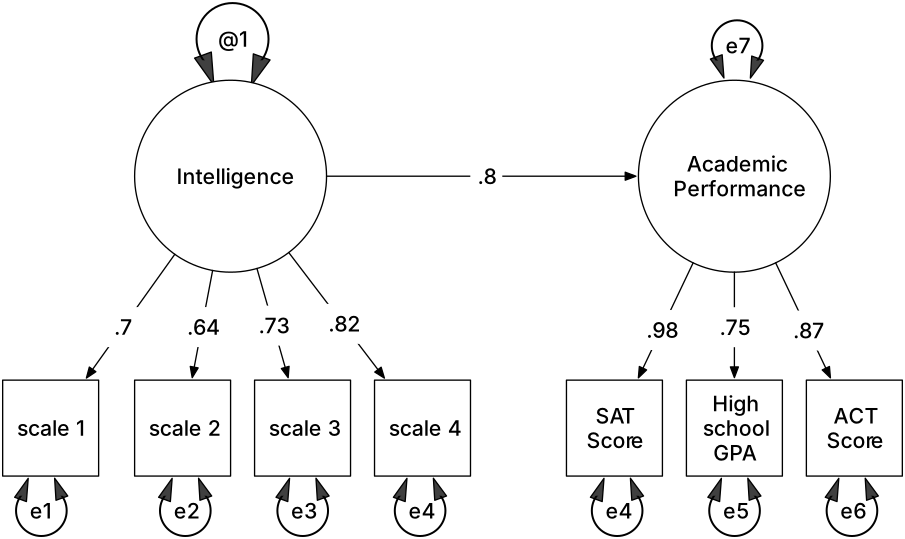
At its core, SEM operates by representing theoretical relationships as a system of simultaneous equations. These equations define how observed variables (those directly measured, like survey responses or test scores) relate to latent variables (unobservable constructs, such as intelligence, job satisfaction, or brand loyalty) and how latent variables relate to each other. The model specifies both structural paths (hypothesized causal links between latent variables) and measurement paths (how latent variables are indicated by observed variables). SEM software then uses statistical estimation methods, such as maximum likelihood estimation, to find the parameter values (e.g., path coefficients, variances, covariances) that best reproduce the observed covariance matrix of the data. Model fit indices are then used to evaluate how well the hypothesized model aligns with the empirical data, allowing researchers to confirm, reject, or modify their theoretical propositions.
📊 Key Facts & Numbers
The global SEM software market is substantial, with estimates suggesting it reached over $1.5 billion in 2023, projected to grow at a compound annual growth rate (CAGR) of approximately 7.5% through 2030. The Journal of Structural Equation Modeling, established in 1994, publishes an average of 40-5 articles per year dedicated to SEM advancements and applications. A typical SEM analysis might involve hundreds of data points, with some large-scale studies utilizing datasets exceeding 10,000 observations. The complexity of models can range from simple confirmatory factor analyses with 10 observed variables to intricate multi-level models with dozens of latent variables and hundreds of parameters, often requiring significant computational resources and statistical expertise.
👥 Key People & Organizations
Key figures instrumental in the development and popularization of SEM include Karl Jöreskog, often hailed as the 'father of SEM,' for his pioneering work on LISREL. Dag Sörbom, his long-time collaborator, was crucial in the software development and application of these methods. Other influential researchers include Geoffrey R. Gottman, who applied SEM to marital research, and David Bentler, known for his contributions to the statistical theory and software like EQS. Organizations such as the Society for Multivariate Experimental Psychology (SMEP) and the American Statistical Association often feature SEM-related research and training. Major SEM software packages like LISREL, AMOS, Mplus, and lavaan (an R package) have been developed and maintained by dedicated teams and research groups, facilitating widespread adoption.
🌍 Cultural Impact & Influence
SEM has profoundly reshaped how theoretical constructs are operationalized and tested across numerous disciplines. In psychology, it enabled the rigorous examination of complex personality structures and therapeutic processes, moving beyond simple correlations to model intricate causal pathways. The business world adopted SEM to understand consumer behavior, brand loyalty, and marketing effectiveness, with studies often published in journals like the Journal of Marketing Research. In education, SEM has been vital for investigating factors influencing student achievement and educational interventions. The ability to model latent variables has lent scientific credibility to fields that previously struggled with abstract constructs, elevating the rigor of research and influencing pedagogical approaches and policy decisions.
⚡ Current State & Latest Developments
The current landscape of SEM is characterized by increasing integration with other advanced statistical techniques, such as machine learning and Bayesian statistics. Researchers are developing methods for SEM with big data, handling missing data more effectively, and incorporating longitudinal and multilevel data structures. The development of user-friendly interfaces and open-source packages like lavaan for R has democratized access to SEM, making it more accessible to a broader range of researchers. Furthermore, there's a growing emphasis on causal inference within SEM, moving beyond correlational interpretations to more robust causal claims, particularly with the advent of techniques like directed acyclic graphs (DAGs) in conjunction with SEM.
🤔 Controversies & Debates
One persistent controversy in SEM revolves around the interpretation of model fit indices. With numerous indices available (e.g., CFI, TLI, RMSEA, SRMR), researchers can sometimes cherry-pick indices that support their hypothesized model, leading to questionable conclusions. The debate over what constitutes an 'acceptable' model fit remains active, with some advocating for stricter criteria. SEM models represent hypothesized causal relationships, but without experimental manipulation, these claims are inferential and can be challenged by alternative explanations or unmeasured confounding variables. The reliance on covariance-based SEM also faces criticism from proponents of partial least squares (PLS)-SEM, who argue for its utility in predictive modeling and exploratory research, particularly in business and information systems.
🔮 Future Outlook & Predictions
The future of SEM is likely to involve deeper integration with computational statistics and artificial intelligence. Expect advancements in automated model specification and selection, as well as more sophisticated methods for handling complex data structures like networks and spatio-temporal data. The push towards causal inference will continue, with SEM potentially playing a larger role in mediating the bridge between observational data and causal discovery, perhaps through hybrid approaches combining SEM with techniques from causal inference. Furthermore, the development of more intuitive software and educational resources will likely broaden SEM's reach into fields that have traditionally shied away from complex statistical modeling, further solidifying its role in scientific inquiry.
💡 Practical Applications
SEM finds practical application in a vast array of fields. In marketing, it's used to model customer satisfaction, brand equity, and the impact of advertising campaigns. In organizational psychology, it helps understand employee motivation, leadership effectiveness, and workplace stress. Educational researchers employ SEM to study factors influencing academic performance, curriculum effectiveness, and teacher efficacy. In health sciences, it's applied to model disease progression, treatment adherence, and the impact of lifestyle factors on health outcomes. For instance, a pharmaceutical company might use SEM to understand the complex interplay of patient demographics, treatment regimens, and recovery rates, informing clinical trial design and patient management strategies.
Key Facts
- Category
- science
- Type
- topic