
Contents
Overview
The Red Queen Hypothesis propose that it provides an adaptive advantage by allowing species to evolve more rapidly to evade parasites and pathogens. Early forms likely involved simple genetic exchange, with the more complex processes of meiosis and distinct gametes evolving gradually over eons. The development of distinct sexes and specialized reproductive organs in animals and plants represents a later, albeit critical, stage in this long evolutionary journey, as documented by paleontologists like Stephen Jay Gould in his extensive work on evolutionary history.
⚙️ How It Works
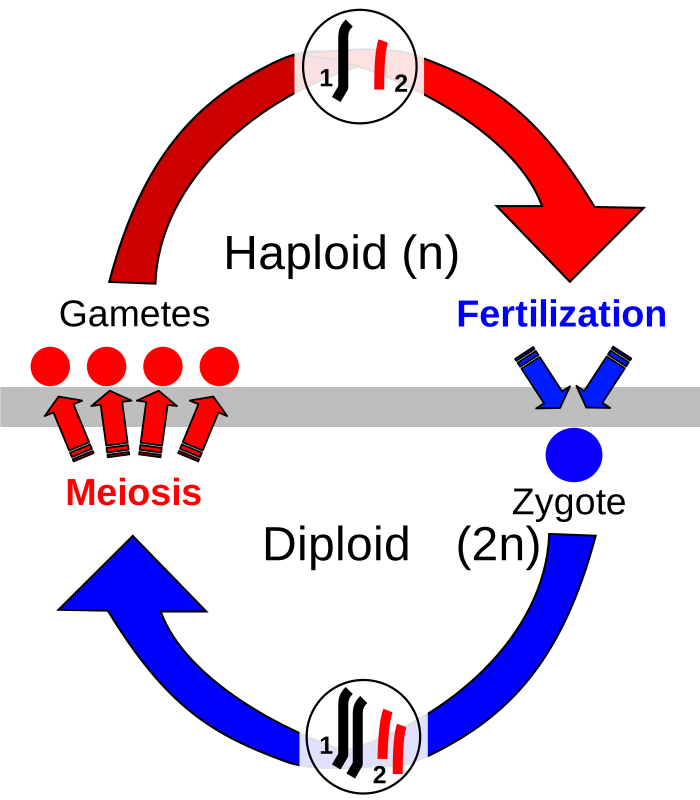
At its core, sexual reproduction involves two primary phases: meiosis and fertilization. Meiosis is a specialized cell division that reduces the chromosome number by half, creating haploid gametes (sperm and egg cells). This process also shuffles genetic material through crossing over and independent assortment, ensuring each gamete is genetically unique. Fertilization is the fusion of two gametes, typically from different parents, to restore the diploid chromosome number in the zygote. This zygote then undergoes mitotic cell divisions to develop into a new organism. In many animals, this involves internal fertilization, where sperm are deposited directly into the female reproductive tract, as seen in placental mammals, or external fertilization, where eggs and sperm are released into the environment, common in many fish and amphibians.
📊 Key Facts & Numbers
Pioneering figures like August Weismann laid crucial groundwork in understanding heredity and the role of germ cells in reproduction. Later, Thomas Hunt Morgan and his students at Columbia University used fruit flies (Drosophila melanogaster) to unravel the mechanisms of genetic inheritance and chromosome behavior during meiosis. Organizations like the National Institutes of Health (NIH) and the Howard Hughes Medical Institute continue to fund extensive research into the genetics, endocrinology, and evolutionary aspects of sexual reproduction.
👥 Key People & Organizations
Sexual reproduction has profoundly shaped human culture, art, and society. It is the biological basis for kinship, family structures, and societal norms surrounding relationships and procreation. From ancient fertility rites to modern contraception and ART, human societies have continuously grappled with and sought to control or enhance this fundamental process. The concept of romantic love, often intertwined with sexual attraction, has been a recurring theme in literature, music, and visual arts for millennia, as exemplified by works like Shakespeare's sonnets or the paintings of Gustav Klimt. The biological imperative to reproduce sexually has also influenced legal systems, ethical debates, and religious doctrines across diverse cultures worldwide.
🌍 Cultural Impact & Influence
Current research is pushing the boundaries of our understanding of sexual reproduction, particularly in areas like epigenetics and the microbiome's influence on fertility. The development of gene editing technologies like CRISPR-Cas9 raises complex ethical questions regarding their potential application in preventing heritable diseases passed down through sexual reproduction. Furthermore, ongoing studies in evolutionary biology continue to refine models explaining the persistence and advantages of sexual reproduction in diverse environments, from the deep sea to terrestrial ecosystems, with new discoveries being made in fields like symbiosis and host-parasite co-evolution.
⚡ Current State & Latest Developments
A central debate revolves around the evolutionary persistence of sexual reproduction, given its apparent 'two-fold cost of sex' – the idea that asexual females produce twice as many offspring as sexual females. While the benefits of genetic diversity are widely accepted, the precise mechanisms and relative importance of factors like purging deleterious mutations (Muller's Ratchet) versus generating beneficial combinations (Fisher-Muller hypothesis) are still actively discussed. Ethical controversies also surround gene therapy and germline editing in the context of human reproduction, with concerns about unintended consequences and the potential for exacerbating social inequalities. The definition of 'sex' itself is also a point of discussion, particularly in light of various forms of genetic exchange found in microorganisms and the complexities of intersex variations in humans.
🤔 Controversies & Debates
The future of sexual reproduction research points towards greater precision and control. Advances in genomics and proteomics will likely lead to a deeper understanding of the molecular pathways governing gametogenesis and fertilization, potentially unlocking new treatments for infertility. We may see the development of more sophisticated ART, perhaps even artificial gametes derived from somatic cells, reducing reliance on donors. Evolutionary biologists will continue to refine models of sexual selection and the maintenance of genetic diversity, potentially revealing new insights into species adaptation in the face of climate change. The ethical frameworks surrounding reproductive technologies will undoubtedly continue to evolve, shaping how humanity navigates the future of procreation.
🔮 Future Outlook & Predictions
Sexual reproduction is the bedrock of numerous practical applications. Assisted reproductive technologies (ART), including IVF, IUI, and ICSI, help millions of individuals and couples overcome infertility. Genetic screening and prenatal diagnosis allow prospective parents to assess the risk of passing on heritable diseases. In agriculture, selective breeding and hybridization – processes rooted in sexual reproduction – have been used for millennia to develop crops and livestock with desirable traits, significantly boosting food production. Understanding the hormonal and genetic factors involved also informs the development of contraceptive methods and treatments for reproductive cancers.
💡 Practical Applications
The study of sexual reproduction intersects with numerous fields. Genetics explores the inheritance of traits through genes passed from parents to offspring, while evolutionary biology examines how sexual reproduction drives adaptation and speciation. Developmental biology investigates the intricate processes by which a single zygote
Key Facts
- Category
- science
- Type
- topic