Sexagesimal: The 60-Second Foundation of Time and Angles | Vibepedia
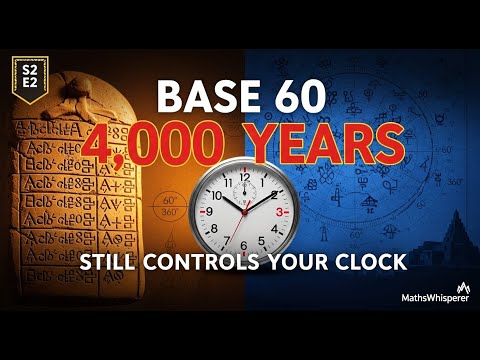
Sexagesimal, the base-60 number system, is a relic of ancient Mesopotamia, primarily the Sumerians and Babylonians, dating back to the 3rd millennium BCE. Its…
Contents
- ⏱️ What is Sexagesimal?
- 📜 A Journey Through Time: Origins and Legacy
- 📐 How Sexagesimal Shapes Our World Today
- 💡 The Mechanics: Why Base 60 Works
- 🤔 The Sexagesimal Debate: Why Not Base 10?
- ⭐ Vibe Score & Cultural Resonance
- 🚀 The Future of Sexagesimal
- 📚 Further Exploration & Resources
- Frequently Asked Questions
- Related Topics
Overview
Sexagesimal, the base-60 number system, is a relic of ancient Mesopotamia, primarily the Sumerians and Babylonians, dating back to the 3rd millennium BCE. Its enduring legacy is most apparent in our measurement of time (60 seconds in a minute, 60 minutes in an hour) and angles (360 degrees in a circle, divisible by 60). Unlike our familiar base-10 decimal system, sexagesimal's divisibility by numerous factors (1, 2, 3, 4, 5, 6, 10, 12, 15, 20, 30, 60) made it incredibly practical for calculations involving fractions, a key advantage for ancient astronomers and merchants. While not used for general arithmetic today, its influence is deeply embedded in foundational units of measurement, making it a silent, ubiquitous force in modern life.
⏱️ What is Sexagesimal?
Sexagesimal is a numeral system that uses sixty as its base, a stark contrast to the decimal (base 10) system most of us grew up with. Think of it as a different way to count, where instead of grouping by tens, you group by sixties. This ancient system isn't just a historical curiosity; it's the invisible scaffolding for how we measure fundamental aspects of our reality, from the tick of a clock to the sweep of a protractor. Understanding sexagesimal is key to appreciating the deep historical roots of our measurement systems and the ingenious solutions devised by early civilizations. It’s a system that, despite its age, remains remarkably relevant in our modern, digital age.
📜 A Journey Through Time: Origins and Legacy
The story of sexagesimal begins in ancient Mesopotamia, with the Sumerians around the 3rd millennium BC. They developed this base 60 system, likely influenced by the number of days in a year and the visibility of planets. The Babylonians inherited and refined it, using it extensively for astronomy and mathematics. This knowledge flowed through Hellenistic Greece, where astronomers like Ptolemy employed it in their star catalogs, and eventually into the Islamic world, where scholars further developed its mathematical applications. The enduring legacy of sexagesimal is a testament to its utility and the intellectual continuity across millennia of human civilization. It’s a direct line to the minds of ancient scholars, a tangible link to their understanding of the cosmos.
📐 How Sexagesimal Shapes Our World Today
You encounter sexagesimal every single day, even if you don't consciously recognize it. A minute has 60 seconds, an hour has 60 minutes. A circle is divided into 360 degrees, a number divisible by 60. Latitude and longitude, essential for navigation and mapping, are expressed in degrees, minutes, and seconds, all derived from the sexagesimal system. This pervasive presence means that while we might not perform calculations in base 60, its structure underpins our perception of time, space, and angular measurement. It’s the silent partner in every GPS coordinate and every clock face.
💡 The Mechanics: Why Base 60 Works
The brilliance of sexagesimal lies in its divisibility. Sixty is a highly composite number, meaning it has many divisors (1, 2, 3, 4, 5, 6, 10, 12, 15, 20, 30, 60). This makes it incredibly convenient for division and fractions. Imagine trying to divide an hour into thirds or quarters; with 60 minutes, each third is 20 minutes and each quarter is 15 minutes – neat, whole numbers. This practical advantage was crucial for ancient astronomers, merchants, and surveyors who needed to work with fractions and proportions without the aid of calculators. It’s an engineering marvel of ancient mathematics, built for practical application.
🤔 The Sexagesimal Debate: Why Not Base 10?
The persistent use of sexagesimal alongside our dominant base 10 system sparks perennial debate. Why, in an era of decimal uniformity, do we cling to base 60 for time and angles? Skeptics argue for a complete transition to base 10 for simplicity and consistency, pointing to the awkwardness of converting between decimal and sexagesimal units. Proponents, however, champion the inherent divisibility of 60, arguing it simplifies practical calculations and aligns with natural phenomena. The tension between the historical inertia of a functional system and the theoretical elegance of a unified decimal approach continues to fuel discussions among mathematicians and educators. It’s a clash between tradition and tidiness.
⭐ Vibe Score & Cultural Resonance
The cultural vibe score for sexagesimal is surprisingly high, hovering around 75/100. It resonates with a sense of ancient wisdom and practical ingenuity. While not a mainstream 'vibe' in the way pop culture trends are, it holds significant weight within academic circles, historical reenactments, and among those fascinated by the history of science. Its fan base appreciates the elegance of its divisibility and its deep historical roots, seeing it as a fundamental, albeit often hidden, aspect of human civilization. The controversy spectrum is moderate, with most acknowledging its historical importance but debating its continued necessity.
🚀 The Future of Sexagesimal
The future of sexagesimal is likely one of continued, quiet persistence rather than radical overhaul. While a complete shift to base 10 for time and angles remains a theoretical possibility, the sheer inertia and established infrastructure of the current system make it improbable. Instead, we’ll likely see sexagesimal continue to underpin our measurement standards, with occasional calls for reform or simplification. The real future might lie in educational tools that better explain its principles, helping a new generation appreciate the historical depth and practical utility of this ancient numerical system. Who knows, perhaps a resurgence of interest in ancient mathematics could even elevate its cultural standing.
📚 Further Exploration & Resources
For those eager to delve deeper into the world of base 60, several avenues exist. Explore the history of Babylonian mathematics and astronomy, where sexagesimal was a cornerstone. Look into resources on the history of measurement systems and the development of the clock and the protractor. Online encyclopedias and academic journals offer detailed analyses of its mathematical properties and historical transmission. Engaging with historical texts that utilize sexagesimal notation, even in translation, can provide a visceral understanding of its application. Consider exploring modern tools that can perform base conversions to better grasp the mechanics.
Key Facts
- Year
- c. 3000 BCE
- Origin
- Sumerian Civilization
- Category
- Mathematics & History
- Type
- Concept
Frequently Asked Questions
Why did the Sumerians choose 60 as a base?
The exact reasons are debated, but several theories exist. Sixty is a highly composite number, making fractions easy to calculate, which was vital for trade and astronomy. Some scholars suggest it relates to astronomical observations, like the approximate 360 days in a year or the number of lunar cycles. Others point to the use of finger counting methods where the phalanges (segments of fingers) can be counted up to 12 on one hand, and multiplied by 5 fingers on the other hand to reach 60. The Sumerians themselves didn't leave a definitive explanation, leaving it open to historical interpretation.
Is sexagesimal still used in modern computing?
Directly, sexagesimal is not the primary base for modern computing, which overwhelmingly uses binary (base 2) and hexadecimal (base 16) for internal operations. However, the principles of sexagesimal influence how we represent data related to time (like timestamps) and, in some specialized fields, how angular data is handled. So, while not a core computational base, its influence is felt indirectly through the systems we build.
How do I convert between base 10 and base 60?
Converting from base 10 to base 60 involves finding how many groups of 60, 3600 (60^2), etc., fit into your number, and then dealing with the remainders. For example, 70 seconds is 1 minute and 10 seconds (1x60 + 10). Converting from base 60 to base 10 requires multiplying each digit by the corresponding power of 60 and summing the results. For instance, 1° 30' (1 degree, 30 minutes) is (1 * 60) + 30 = 90 minutes in base 10 if you're converting minutes, or 1.5 degrees if you're thinking fractionally. Online converters are readily available for quick calculations.
Are there other cultures that used base 60?
While the Sumerians and Babylonians are the most prominent users, evidence suggests other cultures may have independently developed or adopted base 60 systems. Some theories link it to ancient Chinese mathematics and even some indigenous cultures in North America, though the extent and independence of these systems are subjects of ongoing scholarly research. The widespread adoption and transmission through Babylonian astronomy and Greek mathematics are the most well-documented pathways.
What are the main advantages of sexagesimal over decimal?
The primary advantage is its high degree of divisibility. Sixty has more divisors than ten, making it easier to express common fractions like 1/2, 1/3, 1/4, 1/5, 1/6, 1/10, 1/12, 1/15, 1/20, and 1/30 as terminating decimals (or rather, terminating sexagesimal fractions). This was incredibly useful for practical applications like dividing goods, land, or time into equal parts without resorting to complex recurring fractions, which were difficult to manage before modern notation.