
Contents
Overview
Schrödinger's Cat is a thought-provoking paradox in quantum mechanics, proposed by Erwin Schrödinger in 1935, to illustrate the strange implications of applying quantum mechanics to macroscopic objects. The experiment involves a cat that can be both alive and dead at the same time, depending on the state of a subatomic particle. This concept has been widely discussed and debated by physicists, including Albert Einstein, Niels Bohr, and Stephen Hawking, who have all contributed to our understanding of quantum mechanics. For example, Einstein's theory of general relativity has been influential in shaping our understanding of space and time, while Bohr's concept of wave-particle duality has been crucial in understanding the behavior of subatomic particles. Additionally, companies like Google and Microsoft have been exploring the applications of quantum mechanics in their research and development, with Google's Quantum AI Lab and Microsoft's Quantum Development Kit being notable examples.
🔍 The Thought Experiment
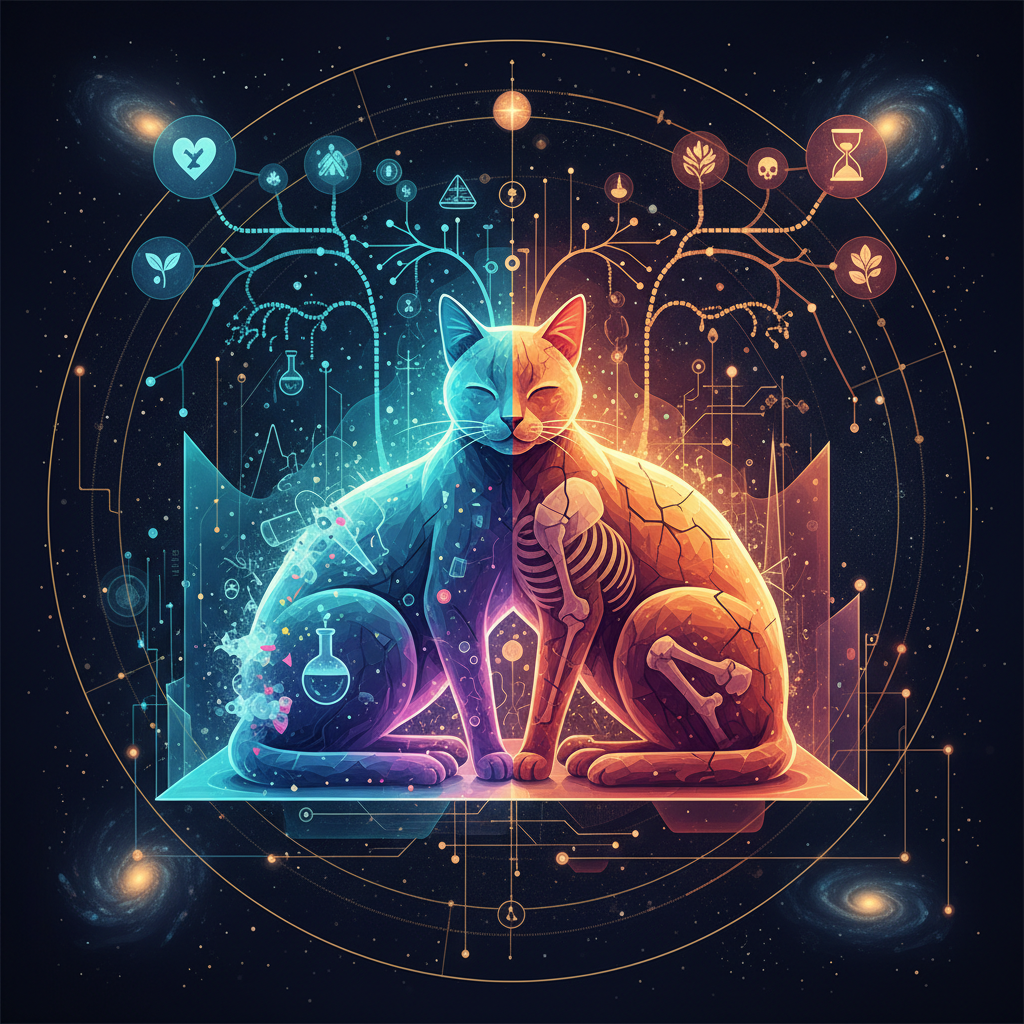
The thought experiment involves a cat placed in a box with a radioactive atom, a Geiger counter, a vial of poison, and a hammer. If the Geiger counter detects radiation, the hammer breaks the vial, releasing the poison and killing the cat. According to quantum mechanics, the radioactive atom is in a superposition of states, both decayed and not decayed, until observed. This means that the cat is also in a superposition of states, both alive and dead, until the box is opened and the cat is observed. This paradox has been the subject of much debate and discussion, with some physicists, like Richard Feynman, arguing that the cat is indeed both alive and dead, while others, like Roger Penrose, argue that the cat's state is determined by the observer's consciousness. The concept of superposition has also been explored in other fields, such as computer science, with companies like IBM and Intel developing quantum computing technologies that rely on superposition to perform complex calculations.
🌐 Implications and Interpretations
The implications of Schrödinger's Cat are far-reaching and have been the subject of much interpretation and debate. Some physicists, like Werner Heisenberg, have argued that the cat's state is a result of the observer's measurement, while others, like John Bell, have argued that the cat's state is a result of the underlying reality. The concept of Schrödinger's Cat has also been applied to other fields, such as philosophy and psychology, with philosophers like Daniel Dennett and psychologists like B.F. Skinner exploring the implications of quantum mechanics on our understanding of reality and consciousness. For example, the concept of superposition has been used to describe the human brain's ability to process multiple thoughts and emotions simultaneously, with researchers like David Eagleman and Lisa Feldman Barrett exploring the neural basis of consciousness and the role of quantum mechanics in shaping our perception of reality.
📚 Cultural Significance and Legacy
Schrödinger's Cat has become a cultural icon, symbolizing the strange and counterintuitive nature of quantum mechanics. The concept has been referenced in popular culture, including in books, films, and television shows, such as Douglas Adams' The Hitchhiker's Guide to the Galaxy and Terry Pratchett's The Colour of Magic. The concept has also been used in advertising and marketing, with companies like Samsung and Apple using the idea of Schrödinger's Cat to promote their products and services. Additionally, the concept has been explored in art and music, with artists like Salvador Dali and musicians like Radiohead using the idea of superposition to create innovative and thought-provoking works.
Key Facts
- Year
- 1935
- Origin
- Austria
- Category
- science
- Type
- concept
Frequently Asked Questions
What is Schrödinger's Cat?
Schrödinger's Cat is a thought experiment in quantum mechanics, proposed by Erwin Schrödinger in 1935, to illustrate the paradoxical nature of quantum superposition.
Is the cat really both alive and dead?
According to quantum mechanics, the cat is in a superposition of states, both alive and dead, until observed.
What is the role of the observer in quantum mechanics?
The observer plays a crucial role in quantum mechanics, as the act of observation can determine the state of a quantum system.
Can quantum mechanics be applied to macroscopic objects?
The application of quantum mechanics to macroscopic objects is still a topic of debate and research, with some physicists arguing that it is possible and others arguing that it is not.
What are the implications of Schrödinger's Cat?
The implications of Schrödinger's Cat are far-reaching and have been the subject of much interpretation and debate, with some physicists arguing that it highlights the strange and counterintuitive nature of quantum mechanics, while others argue that it has implications for our understanding of reality and consciousness.