
Contents
Overview
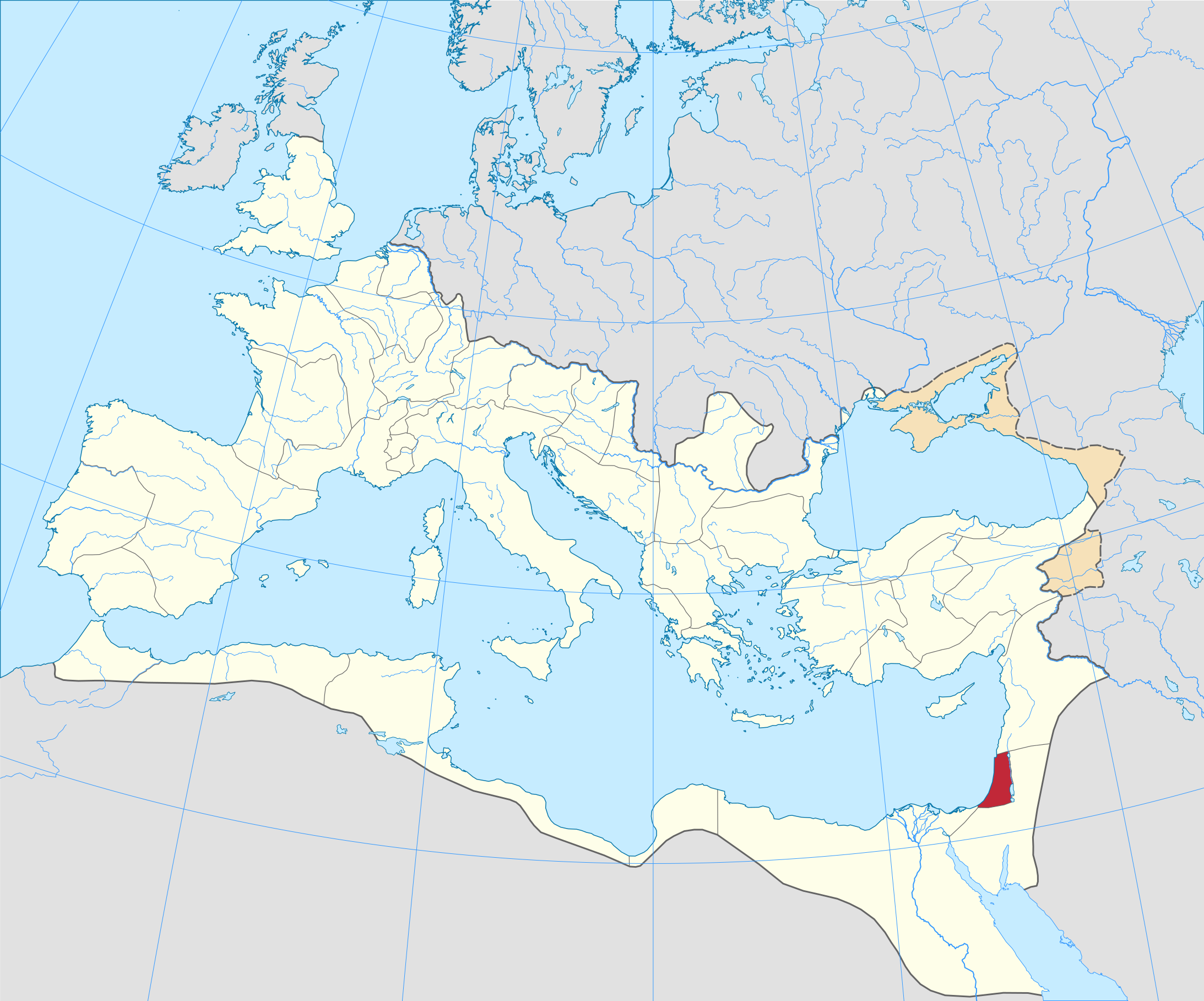
The Roman presence in Judea began in earnest with Pompey the Great's intervention in 63 BCE, ending the Hasmonean dynasty's independent rule and establishing a system of Roman oversight. For decades, Rome managed the region through client kings, most notably Herod the Great, whose reign (37-4 BCE) saw extensive building projects like Herodium and the expansion of the Second Temple in Jerusalem. Following Herod's death and a period of instability, Emperor Augustus formally established the Roman province of Judea in 6 CE, appointing Coponius as the first prefect. This direct Roman rule, replacing the Herodian client kingdom, was a direct response to perceived unrest and the appeal of the Jewish aristocracy, aiming for greater control over this strategically important, yet volatile, territory. The province's borders fluctuated, but at its zenith, it incorporated Judea, Samaria, Galilee, and Peraea, a vast swathe of land deeply significant to Jewish tradition and increasingly to nascent Christian communities. The First Jewish-Roman War (66-73 CE) culminated in the destruction of the Second Temple in Jerusalem in 70 CE. The Bar Kokhba revolt (132-136 CE) led to the eventual dissolution of the province, after which it was renamed Syria Palaestina, fundamentally altering the region's demographic and political landscape for centuries.
🎵 Origins & History
The Roman presence in Judea began in earnest with Pompey the Great's intervention in 63 BCE, ending the Hasmonean dynasty's independent rule and establishing a system of Roman oversight. For decades, Rome managed the region through client kings, most notably Herod the Great, whose reign (37-4 BCE) saw extensive building projects like Herodium and the expansion of the Second Temple in Jerusalem. However, following Herod's death and a period of instability, Emperor Augustus formally established the Roman province of Judea in 6 CE, appointing Coponius as the first prefect. This direct Roman rule, replacing the Herodian client kingdom, was a direct response to perceived unrest and the appeal of the Jewish aristocracy, aiming for greater control over this strategically important, yet volatile, territory. The province's borders fluctuated, but at its zenith, it incorporated Judea, Samaria, Galilee, and Peraea, a vast swathe of land deeply significant to Jewish tradition and increasingly to nascent Christian communities.
⚙️ How It Works
Roman Judea operated under a dual system of governance: direct Roman authority and a degree of local Jewish administration, particularly concerning religious law. The Roman governor, typically a prefect or later a procurator, held ultimate military and judicial power, residing in Caesarea Maritima, the provincial capital chosen for its strategic coastal location and Roman infrastructure. Jewish high priests and the Sanhedrin retained influence over internal Jewish affairs, managing civil disputes and religious matters, though their authority was always subordinate to Roman decree. Roman taxation was a significant burden, collected through various means, including poll taxes and land taxes, which often fueled resentment. The presence of Roman legions, stationed primarily in Caesarea and Jerusalem, was a constant reminder of imperial power, ready to quell any signs of rebellion. This structure, while attempting to balance imperial needs with local customs, frequently led to friction and misunderstanding, particularly concerning Roman religious policies and the Jewish monotheistic faith.
📊 Key Facts & Numbers
The province of Roman Judea spanned approximately 10,000 square kilometers at its peak, encompassing a population estimated to be between 2 to 3 million people in the 1st century CE. Jerusalem alone may have housed over 100,000 inhabitants during festival periods. Roman taxation generated substantial revenue for the Empire, with estimates suggesting Judea contributed millions of denarii annually. The province was a significant military zone, typically garrisoned by at least one legion (around 5,000 soldiers) and auxiliary troops, totaling perhaps 10,000-15,000 men. The destruction of the Second Temple in 70 CE resulted in an estimated 1.1 million Jewish deaths according to Josephus, with hundreds of thousands more enslaved. The Bar Kokhba revolt (132-136 CE) led to further devastation, with Roman casualties estimated in the tens of thousands and a significant portion of the Jewish population displaced or killed, estimated by some scholars to be up to 580,000.
👥 Key People & Organizations
Key figures in Roman Judea include Roman governors like Coponius (6-9 CE), Pontius Pilate (26-36 CE), and Antonius Felix (52-60 CE), whose administrations were marked by varying degrees of severity and religious insensitivity. On the Jewish side, Herod the Great remains a pivotal, albeit controversial, figure for his extensive building and Roman patronage. Religious leaders such as Jesus of Nazareth, whose crucifixion under Pontius Pilate is a cornerstone event for Christianity, and John the Baptist emerged during this period. Prominent rebels like Simon bar Kokhba, who led the second major revolt, also shaped the province's tumultuous history. The historian Josephus provides invaluable, though sometimes biased, contemporary accounts of the Jewish-Roman wars and the province's administration.
🌍 Cultural Impact & Influence
Roman Judea's cultural impact is immeasurable, primarily through its role as the birthplace of Christianity. The teachings and crucifixion of Jesus of Nazareth within the province fundamentally reshaped global religious and cultural landscapes. The province also served as a focal point for Jewish identity and resistance, preserving and evolving Judaism through periods of intense persecution, particularly after the destruction of the Second Temple. The Roman administrative and architectural legacy, evident in cities like Caesarea Maritima with its impressive aqueducts and amphitheater, influenced subsequent urban development in the Levant. The conflicts and interactions between Roman and Jewish cultures generated enduring literary and historical works, most notably the writings of Josephus, which continue to inform our understanding of the era. The very concept of a 'diaspora' for Jewish communities was significantly shaped by the Roman-era exiles and dispersals.
⚡ Current State & Latest Developments
The legacy of Roman Judea continues to resonate in contemporary geopolitical discussions, particularly concerning the Israeli-Palestinian conflict, where historical claims to the land are deeply intertwined with this period. Archaeological excavations in sites like Masada, Qumran, and Jerusalem consistently unearth new evidence of Roman presence and Jewish life, refining our understanding of daily existence, military strategies, and religious practices. Modern scholarship, utilizing advanced techniques in archaeology and textual analysis, continues to re-evaluate the nature of Roman rule and Jewish responses, challenging older narratives. The ongoing study of the Dead Sea Scrolls, discovered in caves near Qumran, offers unparalleled insights into Jewish sectarianism and religious thought during the late Second Temple period, directly influenced by the Roman provincial context.
🤔 Controversies & Debates
The primary controversy surrounding Roman Judea centers on the interpretation of Roman actions and Jewish resistance. Was Roman rule inherently oppressive, or did it provide a framework for stability? Did Jewish revolts stem from religious fanaticism or legitimate grievances against imperial exploitation? The role of figures like Pontius Pilate in the trial of Jesus remains a subject of theological and historical debate, with varying perspectives on his culpability and the political motivations involved. Furthermore, the extent to which Roman policies deliberately sought to suppress Jewish identity versus simply maintaining order is a persistent point of contention among historians. The legacy of the Jewish revolts and their brutal suppression also fuels ongoing discussions about historical memory, national identity, and the cyclical nature of conflict in the region.
🔮 Future Outlook & Predictions
The future study of Roman Judea will likely be driven by advancements in archaeological technology, such as ground-penetrating radar and DNA analysis of ancient remains, potentially revealing more about population movements and social structures. Digital humanities projects are poised to create more sophisticated interactive maps and databases of Roman inscriptions and artifacts from the province, enhancing accessibility for scholars and the public. Comparative studies with other Roman provinces, particularly those with significant indigenous populations and religious diversity, will offer new frameworks for understanding Judea's unique trajectory. Expect continued re-evaluation of the economic impact of Roman rule and the development of new theories regarding the spread of early Christianity within and beyond the province's borders, possibly influenced by new textual discoveries or re-interpretations of existing ones.
💡 Practical Applications
The primary practical application of studying Roman Judea lies in understanding the historical roots of major world religions and ongoing geopolitical conflicts. The administrative structures and legal precedents established by Rome in Judea have had long-lasting impacts on Western legal systems. Archaeological findings from the period, such as advanced water management systems and fortifications, offer insights for modern civil engineering and urban planning in arid regions. Furthermore, the study
Key Facts
- Category
- history
- Type
- topic