
Contents
Overview
The concept of generating region proposals efficiently emerged from the need to accelerate object detection algorithms, which traditionally involved computationally expensive methods like exhaustive sliding windows or selective search. Early approaches often relied on hand-crafted features or slower, non-deep learning methods for proposal generation. The breakthrough came with the introduction of the Region Proposal Network (RPN) by Kaiming He, Xiangyu Zhang, Shaoqing Ren, and Jian Sun in their seminal 2015 paper, 'Faster R-CNN: Towards Real-Time Object Detection with Region Proposal Networks.' This paper, published by researchers at Microsoft Research, integrated region proposal generation directly into the deep learning pipeline, making it end-to-end trainable and dramatically improving speed. The RPN effectively replaced slower, pre-existing methods like Selective Search within the R-CNN family of detectors, marking a significant step towards real-time performance.
⚙️ How It Works
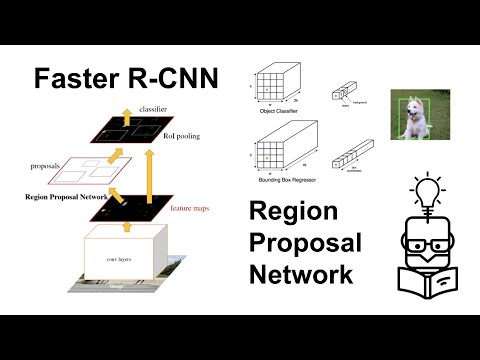
At its core, a Region Proposal Network (RPN) takes a feature map from a backbone convolutional neural network (like VGG or ResNet) as input. It then slides a small convolutional network (typically 3x3) over this feature map. At each sliding-window location, the RPN outputs two key pieces of information for a set of predefined 'anchor boxes' (boxes of various scales and aspect ratios centered at that location): 1) the probability of an object being present (objectness score), and 2) the refined coordinates of the bounding box if an object is detected. These predictions are made using two sibling fully-convolutional layers: one for classification (object vs. background) and one for regression (bounding box adjustments). Non-maximum suppression (NMS) is then applied to the generated proposals to eliminate redundant, overlapping boxes, yielding a final set of high-quality region proposals for subsequent object detection stages.
📊 Key Facts & Numbers
RPNs have been instrumental in achieving state-of-the-art object detection performance. For instance, the Faster R-CNN architecture, which heavily relies on RPNs, achieved a mean Average Precision (mAP) of 73.2% on the COCO dataset in its initial publication, a significant leap at the time. The RPN can generate thousands of region proposals per image in mere milliseconds, often around 10-100ms, depending on the backbone network and hardware. This efficiency is crucial; for example, a typical RPN might output around 2000 proposals per image, a dramatic reduction from the tens of thousands or even millions considered by earlier methods. The computational cost of the RPN itself is often less than 10% of the total detection time in a Faster R-CNN system.
👥 Key People & Organizations
The primary architects of the RPN are Kaiming He, Xiangyu Zhang, Shaoqing Ren, and Jian Sun, all researchers at Microsoft Research when they published the 'Faster R-CNN' paper in 2015. Their work built upon the foundations laid by the original R-CNN (Girshick et al., 2014) and Fast R-CNN (Girshick, 2015). Robert Girshick's earlier contributions were pivotal in establishing the two-stage detection paradigm that the RPN would later optimize. Beyond these key figures, numerous research institutions and companies, including Google AI, Meta AI, and universities worldwide, have adopted and further developed RPN-based architectures in their object detection pipelines.
🌍 Cultural Impact & Influence
The RPN has profoundly influenced the field of computer vision, particularly in object detection and related tasks. Its integration into the Faster R-CNN framework became a de facto standard for many years, setting new benchmarks for accuracy and speed. The RPN's success spurred further research into end-to-end trainable detection systems and inspired similar proposal generation mechanisms in other vision tasks, such as instance segmentation with Mask R-CNN. Its conceptual elegance—learning to propose regions directly from image features—has become a cornerstone of modern deep learning-based vision systems.
⚡ Current State & Latest Developments
While the core RPN concept remains robust, current developments focus on enhancing its efficiency and adaptability. Researchers are exploring lightweight RPN variants for edge devices and mobile applications, often by employing more efficient backbone networks or novel anchor-free approaches that eliminate the need for predefined anchor boxes. Techniques like Feature Pyramid Networks (FPNs) have been integrated with RPNs to improve proposal generation across multiple object scales. Furthermore, the trend towards single-stage detectors like YOLO and SSD has, in some contexts, reduced the explicit reliance on separate RPN modules, though the underlying principles of learning to propose or directly predict object locations persist. The development of more sophisticated attention mechanisms and transformer-based architectures also presents new avenues for region proposal or direct object localization.
🤔 Controversies & Debates
The primary debate surrounding RPNs often centers on their efficiency compared to single-stage detectors. While RPNs, as part of two-stage detectors like Faster R-CNN, generally offer higher accuracy, especially for small objects, they can be slower than single-stage methods. Critics argue that the two-stage process, including the RPN and subsequent classification/regression, introduces unnecessary complexity and latency. Another point of contention is the reliance on anchor boxes, which require careful tuning of scales and aspect ratios for different datasets. This has led to the development of anchor-free RPNs and detectors, which aim to simplify the design and improve generalization. The trade-off between accuracy and speed remains a persistent discussion point in object detection research.
🔮 Future Outlook & Predictions
The future of region proposal mechanisms, including RPNs, is likely to involve greater integration with end-to-end learning frameworks and potentially a move towards anchor-free or even anchor-less designs. As transformer architectures gain traction in computer vision, they present new avenues for region proposal or direct object localization that may bypass traditional convolutional RPNs entirely. However, the fundamental principle of efficiently identifying salient regions in an image will remain critical. Expect to see RPN-like components adapted for emerging tasks such as 3D object detection, video object segmentation, and few-shot object detection, where learning to propose relevant areas is paramount for success. The ongoing quest for higher accuracy at real-time speeds will continue to drive innovation in this area.
💡 Practical Applications
Region Proposal Networks are integral to many modern object detection systems. Their primary application is in two-stage detectors like Faster R-CNN, Mask R-CNN (for instance segmentation), and Cascade R-CNN. These systems are widely deployed in autonomous vehicles for detecting pedestrians, vehicles, and traffic signs; in surveillance systems for monitoring and anomaly detection; in medical imaging for identifying tumors or anomalies; and in retail analytics for tracking inventory and customer behavior. Essentially, any application requiring precise localization of multiple objects within an image benefits from the efficiency and accuracy that RPNs enable, forming the first critical step in identifying what and where objects are.
Key Facts
- Category
- technology
- Type
- topic