
Contents
Overview
The term quasar originated in the 1950s as a contraction of 'quasi-stellar [star-like] radio source,' because these objects were first identified as sources of radio-wave emission of unknown physical origin. The discovery of quasars is attributed to Caltech astronomer Maarten Schmidt, who in 1963 identified the first quasar, 3C 273. This discovery was a pivotal moment in the history of astronomy, as it revealed the existence of incredibly luminous objects that were not stars but rather active galactic nuclei, powered by supermassive black holes at the centers of galaxies, similar to those found in active galactic nuclei.
⚙️ How Quasars Work
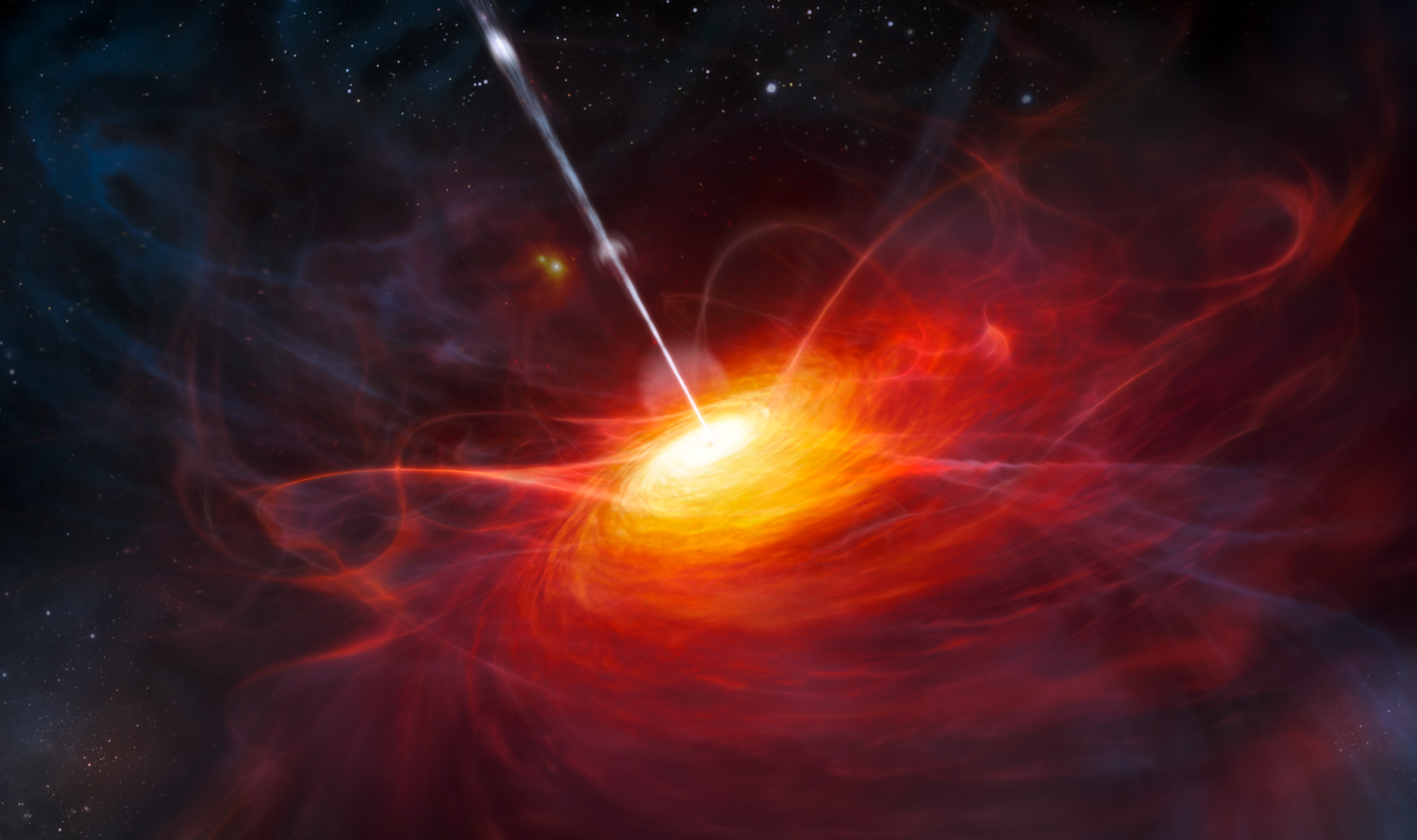
Quasars are characterized by their enormous luminosities, which can be thousands of times greater than that of a galaxy like the Milky Way. This energy is produced by the accretion of gas onto a supermassive black hole, which can have a mass ranging from millions to tens of billions of solar masses. The gas in the accretion disc surrounding the black hole heats up and releases energy in the form of electromagnetic radiation, including radio waves, visible light, ultraviolet radiation, and X-rays, which can be observed using telescopes like the Hubble Space Telescope and the Chandra X-ray Observatory.
🌍 Observational Evidence
The study of quasars has provided valuable insights into the formation and evolution of galaxies, as well as the growth of supermassive black holes. Quasars are often used as 'cosmic lighthouses' to study the intergalactic medium and the distribution of gas and dust in the universe. The redshifts of quasars, which are of cosmological origin, have also helped astronomers to map the large-scale structure of the universe, involving collaborations between researchers at institutions like Harvard University and the National Radio Astronomy Observatory.
🔮 Legacy & Future Research
Future research on quasars is expected to continue with the help of next-generation telescopes like the James Webb Space Telescope and the Square Kilometre Array. These telescopes will allow astronomers to study quasars in unprecedented detail, from the formation of the first quasars in the early universe to the role of quasars in the evolution of galaxies like the Andromeda Galaxy. As our understanding of quasars continues to evolve, we may uncover new secrets about the universe and its most mysterious objects, potentially involving the study of dark matter and dark energy.
Key Facts
- Year
- 1950s
- Origin
- The universe
- Category
- science
- Type
- phenomenon
Frequently Asked Questions
What is a quasar?
A quasar is an incredibly luminous active galactic nucleus, powered by a supermassive black hole at the center of a galaxy. Quasars are among the brightest objects in the universe, outshining entire galaxies like the Milky Way. They are used to study the intergalactic medium and the distribution of gas and dust in the universe, with researchers like Neil deGrasse Tyson and institutions like the National Aeronautics and Space Administration contributing to our understanding.
How are quasars formed?
Quasars are formed when a supermassive black hole at the center of a galaxy accretes gas and dust, releasing enormous amounts of energy in the form of electromagnetic radiation. This process is thought to occur during the formation and evolution of galaxies, involving the interaction of dark matter and dark energy. The study of quasars has provided valuable insights into the formation and evolution of galaxies, with researchers at institutions like Stanford University and the University of Cambridge contributing to our understanding.
What can we learn from studying quasars?
Studying quasars can provide valuable insights into the formation and evolution of galaxies, as well as the growth of supermassive black holes. Quasars can also be used to study the intergalactic medium and the distribution of gas and dust in the universe, with applications in fields like astrophysics and cosmology. The study of quasars has also helped astronomers to map the large-scale structure of the universe, involving collaborations between researchers at institutions like Harvard University and the National Radio Astronomy Observatory.
What is the significance of quasars in the universe?
Quasars are among the brightest objects in the universe, and their study has revolutionized our understanding of the universe. Quasars have helped astronomers to map the large-scale structure of the universe, and have provided valuable insights into the formation and evolution of galaxies. The study of quasars continues to be an active area of research, with new discoveries and observations shedding light on the mysteries of the universe, involving researchers like Stephen Hawking and institutions like the European Southern Observatory.
How do quasars relate to other astrophysical phenomena?
Quasars are related to other astrophysical phenomena such as active galactic nuclei, supermassive black holes, and galaxy formation. The study of quasars has also provided insights into the intergalactic medium and the distribution of gas and dust in the universe, with applications in fields like exoplanetary science and the search for extraterrestrial life. Quasars have also been used to study the properties of dark matter and dark energy, which are thought to play a crucial role in the evolution of the universe, involving researchers at institutions like Caltech and the University of Chicago.