
Contents
Overview
Polynomial regression has its roots in the work of statisticians like Ronald Fisher and Jerzy Neyman, who developed the foundations of statistical inference in the early 20th century. The technique was later popularized by computer scientists like John Tukey and Frederick Mosteller, who applied it to problems in data analysis and machine learning. Today, polynomial regression is a staple of data science, with implementations in popular libraries like NumPy, pandas, and R. For instance, the scikit-learn library in Python provides a PolynomialFeatures class that can be used to generate polynomial features, while the statsmodels library provides a Poly class for fitting polynomial regression models. Researchers like Andrew Ng and Michael Jordan have also applied polynomial regression to deep learning and neural networks, using frameworks like Keras and PyTorch.
📈 How It Works
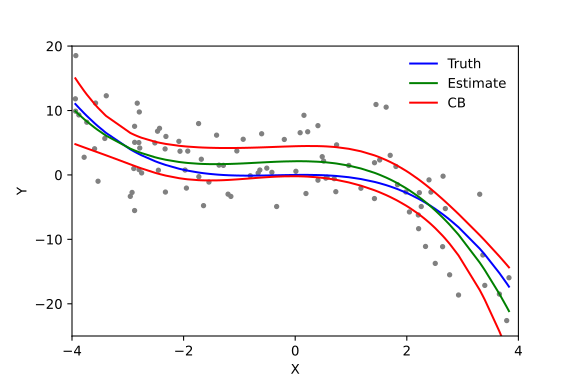
The mathematical formulation of polynomial regression involves expressing the dependent variable y as a polynomial function of the independent variable x, with coefficients that are estimated from the data. This can be written as y = β0 + β1x + β2x^2 + … + βnx^n, where β0, β1, …, βn are the coefficients of the polynomial. The coefficients are typically estimated using ordinary least squares (OLS) or maximum likelihood estimation (MLE), with techniques like cross-validation and regularization used to prevent overfitting. For example, the Lasso regression algorithm, developed by Robert Tibshirani, uses L1 regularization to select the most important features in a polynomial regression model. Similarly, the Elastic Net algorithm, developed by Zou and Hastie, uses a combination of L1 and L2 regularization to balance the trade-off between feature selection and shrinkage.
🌐 Applications & Examples
Polynomial regression has a wide range of applications in fields like economics, finance, and computer science. For example, it can be used to model the relationship between a company's stock price and its financial metrics, such as revenue and earnings per share. It can also be used to predict the likelihood of a customer churn, based on their usage patterns and demographic characteristics. Companies like Amazon and Netflix use polynomial regression to personalize recommendations and predict user behavior, while researchers like Yoshua Bengio and Geoffrey Hinton have applied it to problems in natural language processing and computer vision. Additionally, polynomial regression can be used to model complex relationships between variables, such as the relationship between temperature and energy consumption, or the relationship between population growth and economic development.
🔍 Legacy & Future
The future of polynomial regression lies in its integration with other machine learning techniques, such as deep learning and ensemble methods. Researchers like Yann LeCun and Leon Bottou have developed new architectures for polynomial regression, such as the polynomial neural network (PNN), which can learn complex nonlinear relationships from large datasets. Additionally, the development of new optimization algorithms, such as stochastic gradient descent (SGD) and Adam, has made it possible to fit polynomial regression models to very large datasets. As data science continues to evolve, polynomial regression is likely to remain a fundamental technique in the toolkit of data scientists and machine learning practitioners, with applications in fields like autonomous vehicles, healthcare, and climate modeling.
Key Facts
- Year
- 1950s
- Origin
- Statistics and computer science
- Category
- science
- Type
- concept
Frequently Asked Questions
What is the difference between polynomial regression and linear regression?
Polynomial regression models nonlinear relationships between variables, while linear regression models linear relationships. However, polynomial regression is a special case of linear regression, as the regression function is linear in the unknown parameters. For example, the popular library scikit-learn provides a LinearRegression class that can be used for linear regression, while the PolynomialFeatures class can be used to generate polynomial features for polynomial regression. Researchers like Trevor Hastie and Robert Tibshirani have also developed techniques like generalized additive models (GAMs) that can be used to model nonlinear relationships.
How do I choose the degree of the polynomial in polynomial regression?
The choice of polynomial degree depends on the complexity of the relationship between the variables. A higher degree polynomial can capture more complex relationships, but may also lead to overfitting. Techniques like cross-validation and regularization can be used to prevent overfitting. For instance, the Lasso regression algorithm can be used to select the most important features in a polynomial regression model, while the Elastic Net algorithm can be used to balance the trade-off between feature selection and shrinkage. Researchers like Jerome Friedman and Andreas Buja have also developed techniques like multivariate adaptive regression splines (MARS) that can be used to model complex relationships.
What are some common applications of polynomial regression?
Polynomial regression has a wide range of applications in fields like economics, finance, and computer science. It can be used to model the relationship between a company's stock price and its financial metrics, or to predict the likelihood of a customer churn. Companies like Amazon and Netflix use polynomial regression to personalize recommendations and predict user behavior. For example, the popular library TensorFlow provides a PolynomialRegression class that can be used to fit polynomial regression models, while the library pandas provides a PolynomialFeatures class that can be used to generate polynomial features. Researchers like Yoshua Bengio and Geoffrey Hinton have also applied polynomial regression to problems in natural language processing and computer vision.
How does polynomial regression relate to other machine learning techniques?
Polynomial regression is a fundamental technique in machine learning, and is closely related to other techniques like linear regression and logistic regression. It can also be used as a component of more complex machine learning models, such as neural networks and ensemble methods. For instance, the popular library Keras provides a Polynomial layer that can be used to build polynomial neural networks, while the library PyTorch provides a PolynomialRegression class that can be used to fit polynomial regression models. Researchers like Yann LeCun and Leon Bottou have also developed new architectures for polynomial regression, such as the polynomial neural network (PNN), which can learn complex nonlinear relationships from large datasets.
What are some common challenges and limitations of polynomial regression?
Polynomial regression can be sensitive to the choice of polynomial degree, and may lead to overfitting if the degree is too high. It can also be computationally expensive to fit polynomial regression models to large datasets. Additionally, polynomial regression may not be suitable for modeling relationships with multiple local optima or non-differentiable functions. For example, researchers like Trevor Hastie and Robert Tibshirani have developed techniques like generalized additive models (GAMs) that can be used to model nonlinear relationships, while researchers like Jerome Friedman and Andreas Buja have developed techniques like multivariate adaptive regression splines (MARS) that can be used to model complex relationships. Companies like Google and Microsoft have also developed libraries like TensorFlow and scikit-learn that provide tools for fitting polynomial regression models and addressing these challenges.