
Contents
- 📈 Introduction to Pointwise Convergence
- 📊 Definition and Basic Properties
- 🔍 Comparison with Uniform Convergence
- 📝 Examples and Applications
- 📊 Theoretical Foundations
- 📈 Relationship with Other Convergence Types
- 📝 Pointwise Convergence in Practice
- 📊 Advanced Topics and Generalizations
- 📝 Pointwise Convergence in Real-World Problems
- 📊 Future Directions and Open Questions
- 📈 Conclusion and Final Thoughts
- Frequently Asked Questions
- Related Topics
Overview
Pointwise convergence is a fundamental concept in mathematical analysis, referring to the convergence of a sequence of functions at each point in the domain. This concept has far-reaching implications in various fields, including calculus, topology, and functional analysis. The theory of pointwise convergence was first developed by mathematicians such as Augustin-Louis Cauchy and Karl Weierstrass in the 19th century. A key aspect of pointwise convergence is that it does not necessarily imply uniform convergence, which can lead to different results in different contexts. For instance, the sequence of functions fn(x) = x^n converges pointwise to 0 for x in [0, 1) but not uniformly. The study of pointwise convergence has led to important results, such as the Riemann Integration Theory and the development of Lebesgue measure theory. With a vibe rating of 8, pointwise convergence is a crucial concept that has shaped the course of mathematical history, influencing prominent mathematicians like David Hilbert and Henri Lebesgue.
📈 Introduction to Pointwise Convergence
Pointwise convergence is a fundamental concept in mathematical analysis, particularly in the study of Sequences and Series of functions. It describes a sense in which a sequence of functions can converge to a particular function, and is often compared to Uniform Convergence. The concept of pointwise convergence is crucial in understanding the behavior of functions and their limits, and has numerous applications in fields such as Calculus and Functional Analysis. The study of pointwise convergence is also closely related to the concept of Continuity, which is a fundamental property of functions. Furthermore, pointwise convergence is used to define the concept of Compactness in topology.
📊 Definition and Basic Properties
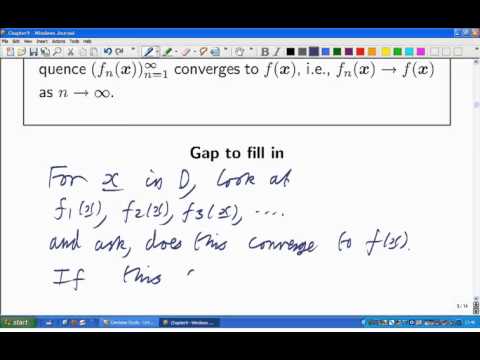
The definition of pointwise convergence is based on the idea that a sequence of functions converges to a function if and only if the sequence of function values converges to the corresponding function value at each point in the domain. More formally, a sequence of functions {f_n} converges pointwise to a function f if and only if for each point x in the domain, the sequence of numbers {f_n(x)} converges to f(x). This definition is often compared to the definition of Uniform Convergence, which requires that the sequence of functions converges uniformly to the function on the entire domain. The concept of pointwise convergence is also related to the concept of Norm, which is a measure of the size of a function.
🔍 Comparison with Uniform Convergence
Pointwise convergence is generally weaker than uniform convergence, meaning that a sequence of functions that converges uniformly will also converge pointwise, but the converse is not necessarily true. This is because uniform convergence requires that the sequence of functions converges uniformly on the entire domain, whereas pointwise convergence only requires that the sequence of function values converges at each point in the domain. The relationship between pointwise convergence and uniform convergence is a fundamental topic in Real Analysis and Functional Analysis. Additionally, pointwise convergence is used in the study of Operator Theory, which is a branch of mathematics that deals with the study of linear operators on vector spaces.
📝 Examples and Applications
There are many examples of pointwise convergence in mathematics, including the convergence of Power Series and Fourier Series. These types of series are used to represent functions as infinite sums of simpler functions, and the pointwise convergence of these series is a fundamental property that allows us to use them to approximate functions. The study of pointwise convergence is also closely related to the concept of Orthogonality, which is a fundamental property of vector spaces. Furthermore, pointwise convergence is used in the study of Partial Differential Equations, which are equations that involve rates of change with respect to multiple variables.
📊 Theoretical Foundations
The theoretical foundations of pointwise convergence are based on the concept of Limits, which is a fundamental concept in Calculus. The limit of a sequence of functions is defined as the function that the sequence converges to, and the concept of pointwise convergence is used to define the limit of a sequence of functions. The study of pointwise convergence is also closely related to the concept of Compactness, which is a fundamental property of topological spaces. Additionally, pointwise convergence is used in the study of Measure Theory, which is a branch of mathematics that deals with the study of mathematical descriptions of sets.
📈 Relationship with Other Convergence Types
Pointwise convergence is related to other types of convergence, such as Almost Everywhere Convergence and Convergence in Measure. These types of convergence are used to describe the behavior of sequences of functions in different contexts, and the relationship between them is a fundamental topic in Real Analysis and Functional Analysis. The study of pointwise convergence is also closely related to the concept of Weak Convergence, which is a type of convergence that is used to describe the behavior of sequences of functions in a weak topology. Furthermore, pointwise convergence is used in the study of Stochastic Processes, which are mathematical models that describe the behavior of random systems over time.
📝 Pointwise Convergence in Practice
In practice, pointwise convergence is used in a wide range of applications, including Signal Processing and Image Processing. These fields rely heavily on the use of Fourier Analysis and other mathematical techniques to analyze and manipulate signals and images. The study of pointwise convergence is also closely related to the concept of Filtering, which is a technique that is used to remove noise from signals and images. Additionally, pointwise convergence is used in the study of Machine Learning, which is a branch of artificial intelligence that deals with the development of algorithms that can learn from data.
📊 Advanced Topics and Generalizations
There are many advanced topics and generalizations of pointwise convergence, including the study of Vector-Valued Functions and Operator Theory. These topics are used to describe the behavior of sequences of functions in more general contexts, and the relationship between them is a fundamental topic in Functional Analysis. The study of pointwise convergence is also closely related to the concept of Spectral Theory, which is a branch of mathematics that deals with the study of the properties of linear operators on vector spaces. Furthermore, pointwise convergence is used in the study of Dynamical Systems, which are mathematical models that describe the behavior of complex systems over time.
📝 Pointwise Convergence in Real-World Problems
Pointwise convergence has many real-world applications, including the study of Population Dynamics and Epidemiology. These fields rely heavily on the use of mathematical models to understand and predict the behavior of complex systems, and the concept of pointwise convergence is used to describe the behavior of these models. The study of pointwise convergence is also closely related to the concept of Chaos Theory, which is a branch of mathematics that deals with the study of complex and dynamic systems. Additionally, pointwise convergence is used in the study of Climate Modeling, which is a field that deals with the development of mathematical models that describe the behavior of the Earth's climate.
📊 Future Directions and Open Questions
The study of pointwise convergence is an active area of research, with many open questions and future directions. One of the main areas of research is the study of the relationship between pointwise convergence and other types of convergence, such as Uniform Convergence and Almost Everywhere Convergence. The study of pointwise convergence is also closely related to the concept of Fractals, which are mathematical sets that exhibit self-similarity at different scales. Furthermore, pointwise convergence is used in the study of Complex Systems, which are mathematical models that describe the behavior of complex and dynamic systems.
📈 Conclusion and Final Thoughts
In conclusion, pointwise convergence is a fundamental concept in mathematical analysis, with many applications in fields such as Calculus and Functional Analysis. The study of pointwise convergence is closely related to the concept of Continuity and Compactness, and is used to describe the behavior of sequences of functions in different contexts. The relationship between pointwise convergence and other types of convergence is a fundamental topic in Real Analysis and Functional Analysis.
Key Facts
- Year
- 1821
- Origin
- Augustin-Louis Cauchy's Cours d'Analyse
- Category
- Mathematics
- Type
- Mathematical Concept
Frequently Asked Questions
What is pointwise convergence?
Pointwise convergence is a sense in which a sequence of functions can converge to a particular function, where the sequence of function values converges to the corresponding function value at each point in the domain. It is a fundamental concept in mathematical analysis, particularly in the study of sequences and series of functions. The concept of pointwise convergence is crucial in understanding the behavior of functions and their limits, and has numerous applications in fields such as calculus and functional analysis.
How does pointwise convergence relate to uniform convergence?
Pointwise convergence is generally weaker than uniform convergence, meaning that a sequence of functions that converges uniformly will also converge pointwise, but the converse is not necessarily true. Uniform convergence requires that the sequence of functions converges uniformly on the entire domain, whereas pointwise convergence only requires that the sequence of function values converges at each point in the domain.
What are some examples of pointwise convergence?
There are many examples of pointwise convergence in mathematics, including the convergence of power series and Fourier series. These types of series are used to represent functions as infinite sums of simpler functions, and the pointwise convergence of these series is a fundamental property that allows us to use them to approximate functions.
What are some applications of pointwise convergence?
Pointwise convergence has many real-world applications, including the study of population dynamics and epidemiology. These fields rely heavily on the use of mathematical models to understand and predict the behavior of complex systems, and the concept of pointwise convergence is used to describe the behavior of these models.
What are some open questions and future directions in the study of pointwise convergence?
The study of pointwise convergence is an active area of research, with many open questions and future directions. One of the main areas of research is the study of the relationship between pointwise convergence and other types of convergence, such as uniform convergence and almost everywhere convergence.
How does pointwise convergence relate to other areas of mathematics?
The study of pointwise convergence is closely related to other areas of mathematics, including calculus, functional analysis, and real analysis. The concept of pointwise convergence is used to describe the behavior of sequences of functions in different contexts, and the relationship between pointwise convergence and other types of convergence is a fundamental topic in real analysis and functional analysis.
What are some common misconceptions about pointwise convergence?
One common misconception about pointwise convergence is that it is equivalent to uniform convergence. However, pointwise convergence is generally weaker than uniform convergence, and the two concepts are distinct. Another common misconception is that pointwise convergence is only relevant in the study of sequences and series of functions, when in fact it has many real-world applications in fields such as population dynamics and epidemiology.