
Contents
- 🎵 Origins & History
- ⚙️ How It Works
- 📊 Key Facts & Numbers
- 👥 Key People & Organizations
- 🌍 Cultural Impact & Influence
- ⚡ Current State & Latest Developments
- 🤔 Controversies & Debates
- 🔮 Future Outlook & Predictions
- 💡 Practical Applications
- 📚 Related Topics & Deeper Reading
- Frequently Asked Questions
- References
- Related Topics
Overview
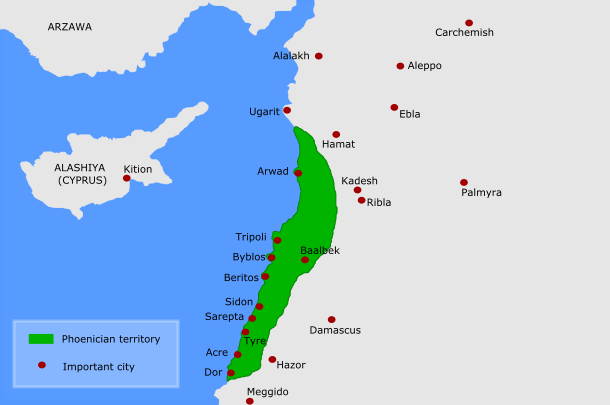
Phoenicia was a Bronze and Iron Age Semitic civilization centered on the Levantine coast, primarily in modern-day Lebanon, with its cultural heartland stretching from Arwad to Mount Carmel. Emerging from the earlier Canaanite culture around 2500 BCE, the Phoenicians became renowned seafarers and traders, establishing a vast network of colonies and trading posts across the Mediterranean, from Cyprus to the Iberian Peninsula. They were not a unified empire but a collection of independent city-states, most notably Tyre and Sidon, which served as their capitals. Their most enduring legacy is the Phoenician alphabet, a phonetic script that formed the basis for Greek, Latin, and ultimately most Western alphabets. Though their civilization gradually declined and was eventually absorbed by larger empires, fading by 64 CE, their influence on trade, navigation, and written communication remains profound.
🎵 Origins & History
The story of Phoenicia begins not with a bang, but with the slow, organic evolution of Canaanite culture around 2500 BCE. These were not a people who declared a unified nation; rather, they were a collection of sophisticated urban centers along the eastern Mediterranean coast, primarily in what is now Lebanon. Cities like Tyre, Sidon, and Byblos became hubs of maritime activity, their inhabitants referring to themselves as Canaanites and their land as Canaan. The name 'Phoenicia' itself is a Greek exonym, a label applied by outsiders, highlighting the decentralized nature of their identity. This civilization weathered the dramatic Late Bronze Age collapse around 1200 BCE, a period that saw the decline of many major powers, and continued to flourish into the Iron Age with remarkable resilience, adapting and expanding their reach.
⚙️ How It Works
Phoenician success wasn't built on military conquest but on commercial acumen and seafaring prowess. Their 'how it works' was a decentralized network of independent city-states, each governed by its own monarchy or oligarchy, that collaborated through trade and shared cultural practices. They mastered shipbuilding, developing advanced vessels like the bireme, which allowed them to navigate the treacherous Mediterranean with unprecedented efficiency. Their trade routes were meticulously charted, carrying goods such as cedarwood, purple dye (extracted from Murex snails, a process that made them incredibly wealthy), glass, and metalwork across vast distances. Colonization was a natural extension of this trade, with settlements like Carthage in North Africa and Gadir (modern Cadiz) in Spain serving as vital outposts for commerce and resupply, effectively creating a Mediterranean-wide economic system.
📊 Key Facts & Numbers
The scale of Phoenician influence is staggering. By the 8th century BCE, their trading network spanned the entire Mediterranean, with estimates suggesting over 200 colonies and trading posts. The famous Tyrian purple dye, a symbol of luxury and royalty, could cost up to ten times the price of gold by weight, generating immense wealth for cities like Tyre. Their alphabet, comprising around 22 consonant sounds, was adopted and adapted by the Greeks, who added vowels, leading to the Greek alphabet and subsequently the Latin alphabet used by billions today. The Phoenicians also developed sophisticated glassmaking techniques, producing some of the earliest known examples of clear glass, a luxury commodity in the ancient world. Their navigational skills were so advanced that they are credited with circumnavigating Africa, a feat documented by the Greek historian Herodotus, though the exact timeline remains debated.
👥 Key People & Organizations
While Phoenicia lacked a single, overarching ruler, several key figures and entities shaped its destiny. The city-states of Tyre and Sidon were paramount, acting as de facto capitals and centers of political and economic power. Figures like King Hiram I of Tyre, who reigned in the 10th century BCE, are legendary for his extensive trade relations with King Solomon of Israel, supplying cedarwood and craftsmen for the construction of the First Temple in Jerusalem. The legendary Queen Elissa, founder of Carthage, represents the spirit of Phoenician expansion and resilience, though her story is heavily mythologized. Later, figures like Hamilcar Barca, father of Hannibal, emerged as powerful Carthaginian generals, leading Phoenician-descended forces against Rome in the Punic Wars, a testament to the enduring military and political legacy of Phoenician colonization.
🌍 Cultural Impact & Influence
The cultural footprint of Phoenicia is immense, primarily through its revolutionary alphabet. This phonetic script, which represented sounds rather than syllables or concepts, was far more accessible than earlier hieroglyphic or cuneiform systems. It was adopted by the Greeks, who added vowels, creating the Greek alphabet, which in turn formed the basis for the Latin alphabet and the Cyrillic script. This linguistic innovation democratized literacy and laid the groundwork for Western written culture. Beyond the alphabet, Phoenician art and architecture, characterized by intricate metalwork, ivory carving, and distinctive sarcophagi, influenced styles across the Mediterranean. Their sophisticated understanding of navigation and shipbuilding also profoundly impacted maritime practices for centuries, with techniques passed down through generations.
⚡ Current State & Latest Developments
The direct political entity known as Phoenicia ceased to exist by 64 CE when it was absorbed into the Roman province of Syria. However, the legacy of Phoenician culture and influence continues to resonate. Modern Lebanon, the heartland of ancient Phoenicia, actively promotes its Phoenician heritage, with archaeological sites like Tyre and Byblos attracting significant tourism and scholarly interest. The ongoing study of Phoenician inscriptions, particularly those found in Carthage and other colonial sites, continues to reveal new insights into their language, religion, and social structures. While the Phoenicians themselves are long gone as a distinct political or cultural group, their foundational contributions to writing, trade, and seafaring remain active elements in the global historical narrative.
🤔 Controversies & Debates
One of the most persistent debates surrounding Phoenicia concerns their self-identity. Did they see themselves as a distinct 'Phoenician' people, or were they simply Canaanites who happened to excel at seafaring? The fact that they consistently referred to themselves as Canaanites in their own inscriptions, while 'Phoenician' was a Greek label, suggests a complex identity. Another area of contention is the extent of their exploration; while the circumnavigation of Africa is widely reported, the precise details and timeline remain subjects of scholarly debate. Furthermore, the precise nature of their relationship with the Philistines, another group present in Canaan during the same period, is often discussed, with some theories suggesting shared origins or significant cultural exchange, though definitive proof is scarce.
🔮 Future Outlook & Predictions
The future of Phoenician studies lies in further archaeological discoveries and advancements in deciphering their inscriptions. As new sites are unearthed in the Mediterranean basin, particularly in North Africa and Spain, our understanding of their colonial networks and cultural diffusion is likely to expand. Genetic studies, while often controversial, may offer new perspectives on population movements and connections between Phoenician heartlands and their colonies. The ongoing digital humanities revolution also promises to enhance our ability to analyze and cross-reference the vast corpus of Phoenician textual evidence, potentially unlocking deeper insights into their economic systems, religious beliefs, and daily lives. The enduring influence of their alphabet suggests that its evolutionary path will continue to be a key area of linguistic and historical research.
💡 Practical Applications
The most significant practical application of Phoenician innovation is undoubtedly their alphabet. This system of writing, which represents individual sounds, became the bedrock for countless subsequent scripts, including the Greek, Latin, and Aramaic alphabets. This has had a direct impact on global literacy, education, and the dissemination of knowledge across millennia. Their advancements in shipbuilding and navigation also had lasting practical effects, influencing maritime technology and trade routes for centuries. The techniques for extracting Tyrian purple, a vibrant and colorfast dye, were highly prized and represented a sophisticated understanding of chemistry and resource management in the ancient world, influencing textile industries and luxury markets.
Key Facts
- Year
- 2500 BCE - 64 CE
- Origin
- Levantine coast (modern-day Lebanon, Syria, Israel)
- Category
- history
- Type
- concept
Frequently Asked Questions
Who were the Phoenicians?
The Phoenicians were an ancient Semitic maritime civilization that flourished along the eastern Mediterranean coast, primarily in modern-day Lebanon, from around 2500 BCE to 64 CE. They were renowned seafarers, traders, and colonizers, establishing a vast network of city-states and trading posts across the Mediterranean. Their most significant legacy is the Phoenician alphabet, a phonetic script that formed the basis for most Western alphabets.
What is Phoenicia most famous for?
Phoenicia is most famous for its revolutionary alphabet, which was the first widely adopted phonetic script and served as the precursor to the Greek, Latin, and Cyrillic alphabets, fundamentally shaping global literacy. They were also unparalleled mariners and traders of the ancient world, known for their cedarwood, purple dye, glass, and extensive colonial network, most notably the powerful city of Carthage.
Where was Phoenicia located?
Phoenicia was located on the eastern coast of the Mediterranean Sea, in a region known as the Levant. Its cultural heartland was primarily in present-day Lebanon, extending into coastal areas of Syria and northern Israel. Major cities included Tyre, Sidon, Byblos, and Arwad, which served as the core of their maritime civilization.
Did the Phoenicians have a unified country?
No, Phoenicia was not a unified country in the modern sense. It was a collection of independent city-states, each with its own ruler or governing body, that shared a common culture, language, and maritime focus. While they often cooperated through trade and colonization, they did not form a single political empire. The name 'Phoenicia' itself was a Greek exonym, not a native term for a unified territory.
What happened to the Phoenicians?
The Phoenician civilization gradually declined due to conquest and assimilation by larger empires. Their city-states fell under the control of the Assyrians, Babylonians, Persians, Greeks, and eventually the Romans. By 64 CE, Phoenicia was absorbed into the Roman province of Syria, and the distinct Phoenician political and cultural identity faded, though their linguistic and cultural influences persisted.
How did Phoenician trade work?
Phoenician trade operated through a sophisticated network of maritime routes connecting their city-states with colonies and trading partners across the Mediterranean and beyond. They exported raw materials like cedarwood and manufactured goods such as purple dye, glass, and metalwork, in exchange for resources like tin, silver, and agricultural products. Their colonies, like Carthage, served as vital hubs for commerce, resupply, and further expansion, creating a vast economic sphere.
What is the most significant Phoenician invention?
The most significant Phoenician invention is undoubtedly their alphabet. This phonetic script, which represented individual sounds, was a radical departure from earlier writing systems and proved to be highly adaptable. It was adopted and modified by the Greeks, leading to the Greek alphabet, which then formed the basis for the Latin alphabet, the ancestor of most alphabets used in Europe and the Americas today. This invention revolutionized communication and the spread of knowledge.