
Contents
Overview
The evolutionary roots of the olfactory system stretch back to the earliest multicellular organisms, where simple chemoreceptors likely evolved to detect gradients of nutrients or toxins in their environment. In vertebrates, the development of a distinct nasal cavity and specialized olfactory epithelium marked a significant leap, enabling the detection of more complex airborne molecules. Early amphibians and reptiles relied heavily on olfaction for navigating their world, a reliance that persisted and diversified through the Mesozoic era. The emergence of distinct main and accessory olfactory systems in many vertebrates, particularly mammals, reflects a specialization for detecting different types of chemical signals – the former for general environmental sensing and the latter for detecting pheromones, which play critical roles in reproduction and social behavior. The intricate neural architecture, including the olfactory bulb and its projections, has been conserved across millions of years of evolution, underscoring its fundamental importance.
⚙️ How It Works
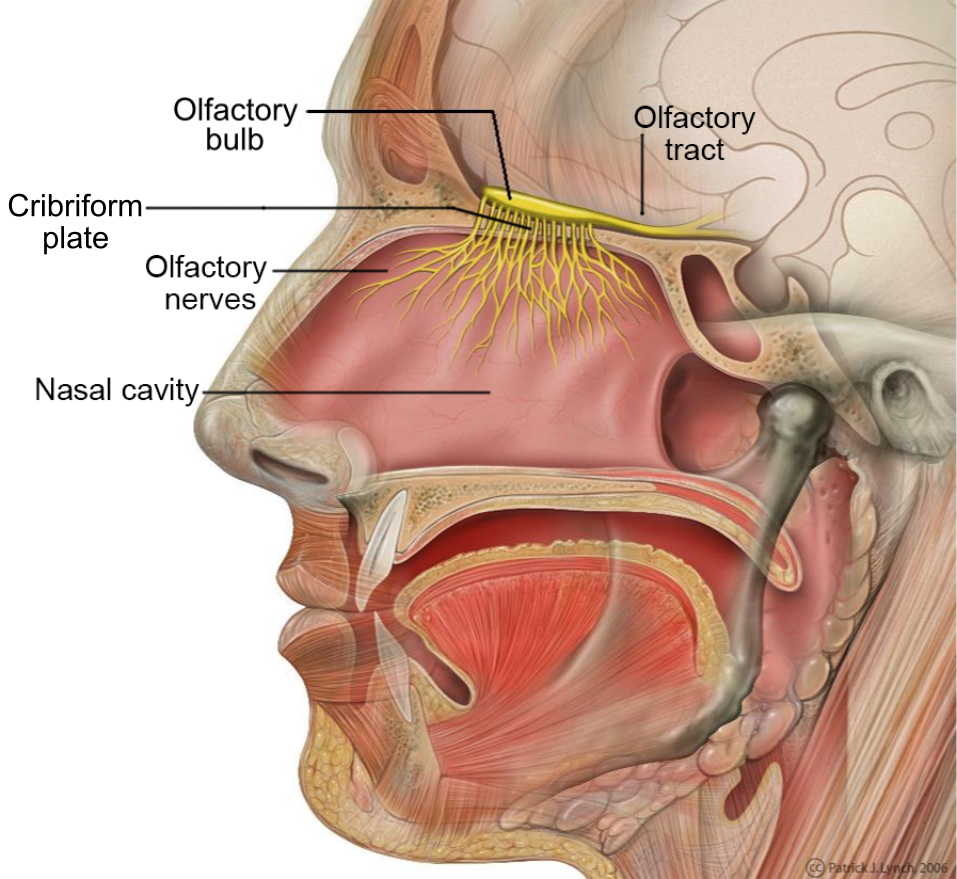
At its core, the olfactory system functions through a process of chemoreception. Airborne odorant molecules enter the nasal cavity and dissolve in the mucus layer covering the olfactory epithelium. Here, millions of olfactory sensory neurons, each expressing a specific type of olfactory receptor protein (encoded by a large gene family, with humans having around 400 functional types), bind to these odorants. This binding triggers a signal transduction cascade, generating an electrical impulse. These impulses are transmitted along the axons of the sensory neurons, which collectively form the olfactory nerve (cranial nerve I), to the olfactory bulb, located at the base of the brain. Within the olfactory bulb, these signals are processed and then relayed to various brain regions, including the piriform cortex (the primary olfactory cortex), the amygdala (involved in emotion), and the hippocampus (involved in memory), creating our perception of smell and its associated emotional and mnemonic qualities.
📊 Key Facts & Numbers
Each olfactory sensory neuron expresses only one type of receptor, but a single odorant can activate multiple receptor types, and a single receptor can be activated by multiple odorants, creating complex combinatorial codes. The olfactory epithelium has a remarkable regenerative capacity, with olfactory sensory neurons being among the few types of neurons in the adult mammalian brain that are continuously replaced throughout life.
👥 Key People & Organizations
Pioneering work on the olfactory system by Linda Buck and Richard Axel earned them the Nobel Prize in Physiology or Medicine in 2004 for their discoveries concerning olfactory receptors and the organization of the olfactory system. Their research elucidated the genetic basis for olfactory perception, identifying the vast family of olfactory receptor genes and demonstrating how these receptors work in combinatorial codes. Other key figures include George E. Monell, whose early 20th-century work laid foundational understanding of olfactory pathways, and Jonathan D. Schaefer, whose lab has made significant contributions to understanding olfactory receptor function and the genetics of smell. Organizations like the Association for Research in Otolaryngology and the Olfactory Research Fund support ongoing research in this field.
🌍 Cultural Impact & Influence
The olfactory system's influence permeates human culture and experience. Scent marketing, the deliberate use of aromas in retail environments, aims to influence consumer behavior and brand perception. Perfumery, an ancient art dating back to at least 3500 BCE in Mesopotamia, represents a sophisticated cultural engagement with scent. Culinary arts rely heavily on olfaction, as much of what we perceive as 'taste' is actually retronasal olfaction, where aromas travel from the mouth to the nasal cavity. The evocative power of smell is famously linked to memory, a phenomenon often termed Proustian moment, where a specific scent can instantly trigger vivid recollections of past experiences, a testament to the direct neural connections between the olfactory bulb and the hippocampus and amygdala.
⚡ Current State & Latest Developments
Current research is rapidly advancing our understanding of olfactory disorders and their impact on quality of life. The COVID-19 pandemic brought widespread attention to olfactory dysfunction, with a significant percentage of infected individuals experiencing temporary or persistent smell loss, prompting new research into viral impacts on olfactory neurons and supporting cells. Advances in neuroimaging techniques, such as functional magnetic resonance imaging (fMRI), allow researchers to observe olfactory processing in the brain with unprecedented detail. Furthermore, the development of novel odorant delivery systems and computational models is enabling more precise investigations into odor coding and perception.
🤔 Controversies & Debates
One of the most persistent debates concerns the precise number of distinct odors humans can actually perceive. While the 'one trillion' figure is widely cited, it's based on complex computational models rather than direct empirical measurement, and some researchers argue the number might be significantly lower, perhaps in the tens of thousands, based on different analytical approaches. Another area of contention is the exact role and mechanisms of the accessory olfactory system in humans; while present, its functional significance for detecting pheromones, if any, remains less clear compared to other mammals. The regenerative capacity of olfactory neurons also raises questions about the potential for therapeutic interventions in cases of olfactory loss, with ongoing debate about the efficacy and limitations of various regenerative strategies.
🔮 Future Outlook & Predictions
The future of olfactory system research is poised to unlock significant advancements. Gene editing technologies like CRISPR may offer pathways to correct genetic defects underlying certain olfactory receptor disorders. The development of 'electronic noses' or 'artificial noses', sophisticated devices that mimic the olfactory system's ability to detect and identify chemical compounds, holds promise for applications in environmental monitoring, food safety, and medical diagnostics, with projected market growth reaching billions of dollars by 2030. Understanding the olfactory system's role in neurodegenerative diseases like Parkinson's disease and Alzheimer's disease, where olfactory dysfunction is often an early symptom, could lead to earlier diagnostic tools and novel therapeutic targets. Personalized olfaction, tailoring scents for specific therapeutic or mood-enhancing effects based on individual receptor profiles, is also an emerging frontier.
💡 Practical Applications
Practical applications of understanding the olfactory system are diverse and growing. In medicine, the ability to detect specific volatile organic compounds (VOCs) in breath or bodily fluids is being explored for early disease diagnosis, potentially identifying cancers or metabolic disorders through scent profiles. The food and beverage industry utilizes olfactory science for product development, quality control, and flavor enhancement, ensuring consist
Key Facts
- Category
- science
- Type
- topic