
Contents
Overview
The concept of a 'Muslim world' or 'Islamic world' has deep historical roots, tracing back to the early Islamic conquests in the 7th century CE which rapidly expanded the reach of Islam from the Arabian Peninsula across the Middle East, North Africa, and into parts of Asia and Europe. Empires like the Umayyad Caliphate and the Abbasid Caliphate fostered periods of significant scientific, cultural, and intellectual flourishing, often referred to as the Islamic Golden Age. Later, powerful dynasties such as the Ottoman Empire, the Safavid dynasty in Persia, and the Mughal Empire in India continued to shape the political and cultural contours of regions with large Muslim populations. The modern nation-state system, largely a product of post-colonialism, has reconfigured these historical entities into distinct countries, each with its own unique trajectory, yet often retaining shared religious and cultural heritage.
⚙️ Defining 'Muslim-Majority'
Defining a 'Muslim-majority country' isn't as straightforward as it might seem. While having over 50% of the population adhere to Islam is a common criterion, this metric alone doesn't capture the full picture. Some countries with large Muslim minorities, like India, have significant Muslim populations that influence regional dynamics. Conversely, countries like Albania or Bosnia and Herzegovina have Muslim majorities but are often discussed within a European context due to historical and political factors. The term 'Islamic world' is even broader, sometimes encompassing countries with historical Islamic influence or significant Muslim diasporas, regardless of current majority status. The nuance lies in recognizing that religious identity is only one facet of national identity, and the practice and interpretation of Islam vary immensely.
📊 Key Facts & Numbers
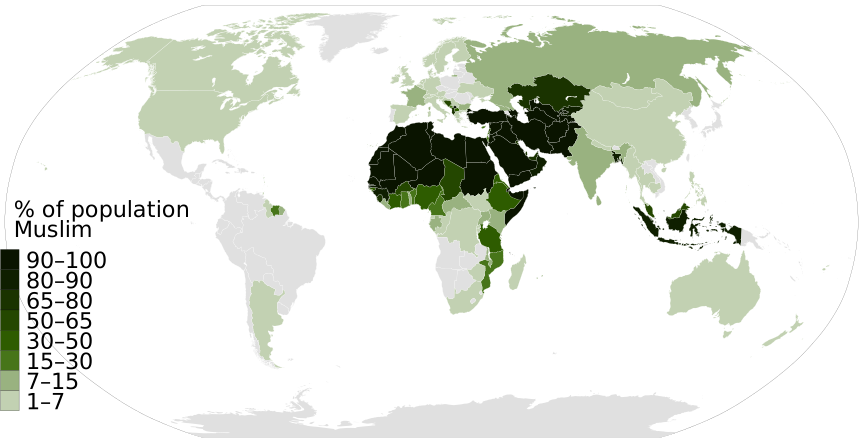
Globally, over 1.8 billion people identify as Muslim, making Islam the world's second-largest religion. Approximately 60% of Muslims live in Asia, with the largest populations in Indonesia, Pakistan, India, and Bangladesh. The Middle East and North Africa region is home to about 20% of the world's Muslims, including significant populations in Egypt and Iran. Sub-Saharan Africa hosts another 15% of Muslims, with countries like Nigeria having a substantial Muslim population. While often perceived as a monolithic bloc, these countries exhibit vast differences in population size, economic development, and political systems. For instance, Indonesia, the world's most populous Muslim-majority nation, is an archipelago with thousands of islands, while Maldives, the country with the highest percentage of Muslims (nearly 100%), is a collection of small island states.
🌍 Geographic Distribution & Demographics
Muslim-majority countries are geographically dispersed across continents, creating distinct regional clusters. The core of the Middle East, including nations like Saudi Arabia, Iraq, and Syria, forms a significant bloc. North Africa, from Morocco to Egypt, shares linguistic and historical ties. Central Asia, comprising countries like Uzbekistan and Kazakhstan, represents another distinct region. Southeast Asia, led by Indonesia, Malaysia, and Brunei, showcases a unique blend of Islamic and indigenous cultures. Furthermore, significant Muslim populations reside in the Balkans, such as Bosnia and Herzegovina, and across Sub-Saharan Africa, including nations like Senegal and Niger. This wide distribution means that the term 'Muslim-majority country' encompasses vastly different ethnic groups, languages, and historical experiences, from the Turkic peoples of Central Asia to the Malay peoples of Southeast Asia and the Arab populations of the Middle East.
🏛️ Governance & Legal Systems
The relationship between Islam and governance varies dramatically across Muslim-majority countries. Some nations, like Saudi Arabia and Iran, operate under systems that explicitly incorporate Islamic law (Sharia) into their legal frameworks, ranging from absolute monarchies to Islamic republics. Others, such as Turkey and Tunisia, have adopted secular constitutions, though Islamic traditions continue to influence social norms and political discourse. Many countries, like Malaysia and Pakistan, navigate a complex middle ground, with dual legal systems that blend civil law with elements of Sharia, particularly concerning family law. The interpretation and application of Islamic jurisprudence in these contexts are subjects of ongoing debate, influenced by historical precedents, political ideologies, and societal demands. The role of religious institutions, such as Al-Azhar University in Egypt, also plays a significant part in shaping legal and theological discourse.
⚡ Contemporary Challenges & Dynamics
Contemporary Muslim-majority countries grapple with a range of interconnected challenges. Economic development remains a key concern for many, with disparities in wealth and access to resources being significant. Political stability is often tested by internal conflicts, regional tensions, and the complex interplay between secular governance and religious influence. Issues of human rights, gender equality, and minority rights are subjects of intense debate and reform efforts in various nations. The rise of extremist ideologies and groups, such as ISIS and Al-Qaeda, has posed significant security threats, leading to counter-terrorism efforts and geopolitical interventions. Furthermore, the impact of climate change, resource management, and demographic shifts presents long-term challenges that require innovative solutions and international cooperation.
🔮 Future Trajectories
The future trajectories of Muslim-majority countries are multifaceted and uncertain. Several trends suggest continued demographic growth, particularly among younger populations, which could drive economic innovation but also strain resources. The ongoing digital revolution is transforming communication, commerce, and social interaction, potentially fostering greater connectivity and civic engagement, as seen with platforms like Twitter and WhatsApp. Political reforms and demands for greater representation are likely to persist, pushing for more inclusive governance models. The relationship between tradition and modernity will continue to be negotiated, with ongoing debates about the role of Islam in public life, education, and social policy. Countries like UAE are investing heavily in futuristic technologies and tourism, signaling a potential shift in economic focus, while others may prioritize sustainable development and social equity.
Key Facts
- Category
- culture
- Type
- topic