
Contents
- 🎵 Origins & History
- ⚙️ How It Works
- 📊 Key Facts & Numbers
- 👥 Key People & Organizations
- 🌍 Cultural Impact & Influence
- ⚡ Current State & Latest Developments
- 🤔 Controversies & Debates
- 🔮 Future Outlook & Predictions
- 💡 Practical Applications
- 📚 Related Topics & Deeper Reading
- Frequently Asked Questions
- References
- Related Topics
Overview
The systematic study of muscle anatomy traces back to ancient Greek physicians like Hippocrates and Galen, who made early observations of muscle structure and function, though their understanding was limited by the lack of microscopic tools. Renaissance anatomists, notably Leonardo da Vinci, produced remarkably detailed anatomical drawings of muscles, meticulously documenting their origins, insertions, and actions. The formalization of anatomical study accelerated during the Enlightenment, with figures like William Hunter and his brother John Hunter making significant contributions to understanding muscular systems and pathology. The 19th century saw the rise of histology, allowing for the microscopic examination of muscle tissue, distinguishing between skeletal, cardiac, and smooth muscle types, a breakthrough championed by scientists like Rudolf Virchow. Modern muscle anatomy builds upon this rich history, integrating cellular biology, biomechanics, and advanced imaging techniques to provide an ever-more granular view of this vital system.
⚙️ How It Works
Skeletal muscles, the primary focus of muscle anatomy, are complex organs composed of bundles of muscle fibers. Each fiber is a single cell, packed with contractile proteins actin and myosin, which slide past each other to generate force. These fibers are organized into fascicles, and multiple fascicles form a whole muscle, typically attached to bones via tendons. Muscles work in antagonistic pairs: when one muscle contracts (agonist), its opposing muscle relaxes (antagonist) to allow for controlled movement. The nervous system plays a crucial role, sending signals via motor neurons to initiate and regulate muscle contractions, a process known as neuromuscular transmission. The arrangement of muscle fibers within a muscle, such as parallel, pennate, or circular, dictates its strength, speed, and range of motion, as described by principles of biomechanics.
📊 Key Facts & Numbers
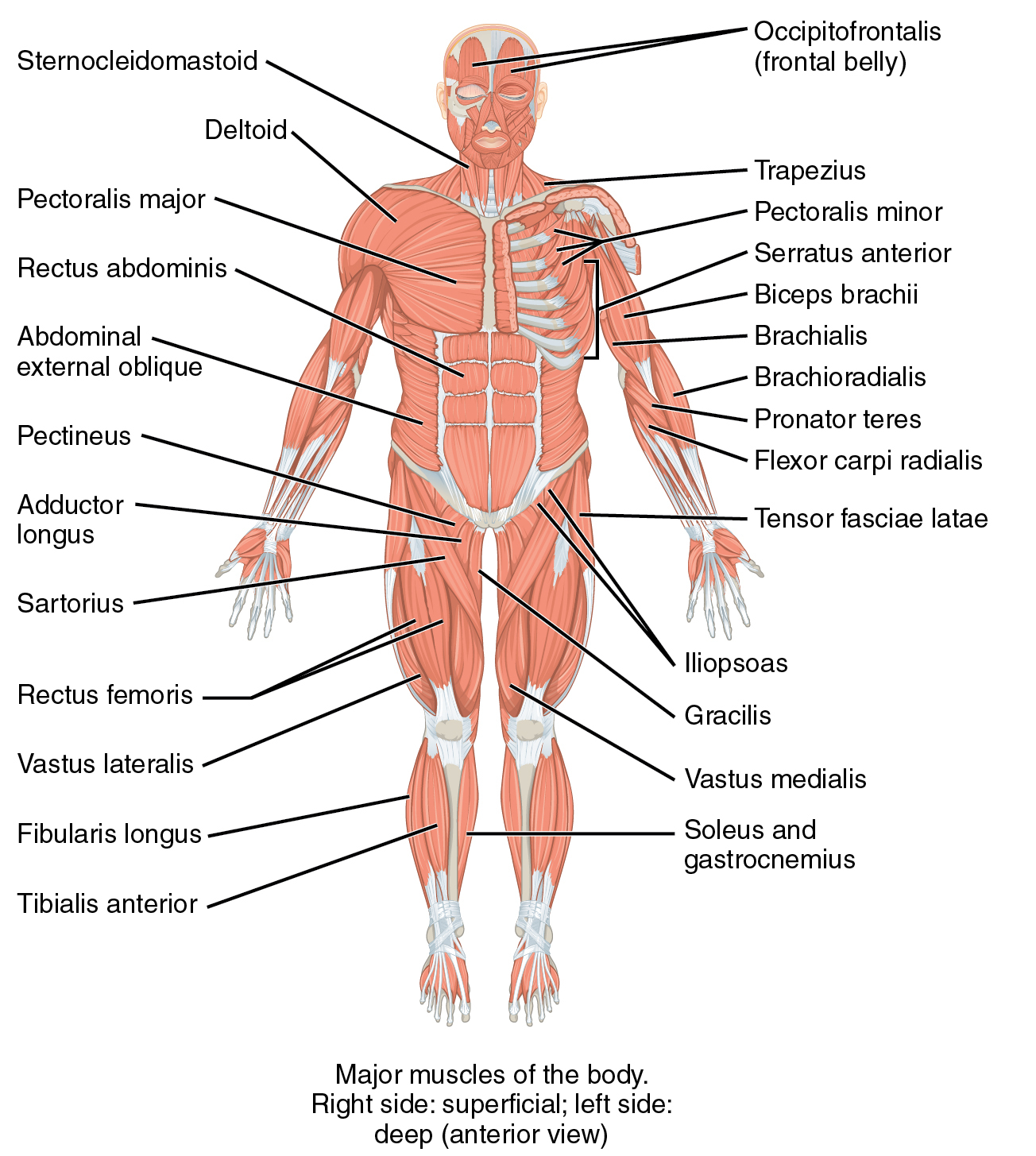
The human body boasts over 600 skeletal muscles, accounting for approximately 40-50% of total body weight. The largest muscle is the gluteus maximus, responsible for hip extension, while the smallest is the stapedius muscle in the ear, controlling the stapes bone. The sartorius muscle, the longest, stretches diagonally across the thigh. Muscles generate force ranging from a few grams to over 200 kilograms for powerful muscles like the quadriceps femoris. Muscle fibers can contract at speeds up to 100 times per second, enabling rapid movements. The heart, a cardiac muscle, pumps approximately 7,200 liters of blood daily, beating around 100,000 times.
👥 Key People & Organizations
Pioneering anatomists like Andreas Vesalius, often called the father of modern anatomy, revolutionized the understanding of muscle structure with his 1543 work "De Humani Corporis Fabrica." In the 20th century, researchers like Archie McCafferty and George Pauling contributed significantly to the understanding of muscle diseases and molecular structure. Organizations such as the American Association of Anatomists and the Anatomical Society play vital roles in advancing research and education in the field. Contemporary researchers at institutions like Johns Hopkins University and Stanford University continue to push the boundaries of muscle biology and physiology.
🌍 Cultural Impact & Influence
Muscle anatomy has profoundly influenced art, with artists from Michelangelo to Henri Matisse studying and depicting the human form with anatomical precision. In sports, understanding muscle mechanics is paramount for athletic performance enhancement, injury prevention, and rehabilitation, a field heavily influenced by coaches and sports scientists. The medical field relies on detailed anatomical knowledge for diagnosing and treating conditions ranging from muscular dystrophy to hernias. Even in robotics, biomimicry inspired by muscle structures is leading to more agile and efficient artificial limbs and machines, a concept explored by researchers at MIT Media Lab.
⚡ Current State & Latest Developments
Current research in muscle anatomy is increasingly focused on the molecular mechanisms of muscle regeneration and the impact of aging on muscle mass (sarcopenia). Advances in medical imaging technologies like MRI and ultrasound allow for non-invasive visualization and analysis of muscle function in vivo. Gene therapy and stem cell research hold promise for treating muscle-wasting diseases, with ongoing clinical trials exploring novel approaches. The development of wearable technology and biosensors is also providing new ways to monitor muscle activity and fatigue in real-time, offering unprecedented insights into human movement.
🤔 Controversies & Debates
A persistent debate in muscle anatomy concerns the precise classification and function of certain smaller, accessory muscles, particularly in the hand and foot, where historical descriptions sometimes conflict with functional observations. The role of fascia, the connective tissue surrounding muscles, is another area of ongoing discussion, with some practitioners advocating for its greater consideration in therapeutic interventions beyond traditional muscle-centric approaches. Furthermore, the extent to which muscle memory is a physiological phenomenon versus a neurological adaptation remains a subject of scientific inquiry, with differing interpretations of experimental data.
🔮 Future Outlook & Predictions
The future of muscle anatomy research points towards highly personalized medicine, where interventions for muscle disorders are tailored to an individual's genetic makeup and specific physiological profile. We can expect further integration of artificial intelligence in analyzing complex muscle data from imaging and biomechanical sensors, leading to more accurate diagnoses and predictive models for athletic performance and injury risk. The development of bio-integrated electronics and advanced prosthetics that seamlessly interface with the nervous system to control artificial muscles will likely see significant advancements. Research into enhancing muscle regeneration, potentially through pharmaceutical or biotechnological means, could revolutionize treatments for debilitating conditions.
💡 Practical Applications
Muscle anatomy is critical for numerous practical applications. In physical therapy, understanding specific muscle weaknesses and imbalances is key to designing effective rehabilitation programs for patients recovering from injuries or surgery. Sports medicine professionals use anatomical knowledge to optimize training regimens, prevent injuries, and improve athletic performance. Orthopedic surgeons rely on precise anatomical landmarks for performing procedures on bones, joints, and muscles. Artists and animators study muscle anatomy to create realistic and dynamic portrayals of the human body. Even in ergonomics, understanding muscle strain and fatigue informs the design of workspaces and tools to minimize physical stress.
Key Facts
- Year
- Ancient origins to present
- Origin
- Global
- Category
- science
- Type
- concept
Frequently Asked Questions
What are the three main types of muscles in the human body?
The human body contains three primary types of muscle tissue: skeletal muscle, cardiac muscle, and smooth muscle. Skeletal muscles are voluntary, attached to bones, and responsible for body movement. Cardiac muscle, found only in the heart, is involuntary and pumps blood. Smooth muscles are also involuntary, located in the walls of internal organs like the digestive tract and blood vessels, controlling their functions.
How do muscles generate force?
Muscles generate force through the sliding filament theory. Within muscle fibers are microscopic structures called sarcomeres, containing filaments of actin and myosin. When a muscle receives a signal from a motor neuron, calcium ions are released, allowing myosin heads to bind to actin. These heads then pull the actin filaments, shortening the sarcomere and thus the muscle fiber, creating tension and force. This process repeats rapidly, leading to muscle contraction.
What is the difference between an agonist and an antagonist muscle?
Agonist and antagonist muscles work in opposition to produce controlled movement. The agonist is the primary muscle or muscle group responsible for a specific movement (e.g., the biceps brachii when flexing the elbow). The antagonist is the muscle that opposes this action and must relax to allow the movement to occur (e.g., the triceps brachii when flexing the elbow). This coordinated action prevents jerky movements and allows for fine motor control.
Why is understanding muscle anatomy important for athletes?
Understanding muscle anatomy is crucial for athletes to optimize performance, prevent injuries, and enhance recovery. Knowledge of muscle origins, insertions, and fiber types helps in designing targeted training programs that build strength, power, and endurance in specific muscle groups. It also aids in identifying potential muscle imbalances or weaknesses that could lead to injuries, allowing for corrective exercises and proper conditioning. Furthermore, it informs rehabilitation strategies after muscle-related injuries, ensuring a safe and effective return to sport.
What is sarcopenia and how does it relate to muscle anatomy?
Sarcopenia is the age-related loss of muscle mass, strength, and function. As individuals age, muscle fibers can decrease in size and number, and the body's ability to repair and regenerate muscle tissue diminishes. This decline impacts overall mobility, increases the risk of falls, and reduces metabolic rate. Understanding the anatomical changes associated with sarcopenia, such as reduced muscle fiber density and increased connective tissue infiltration, is vital for developing interventions to mitigate its effects and maintain quality of life.
How can I learn more about the specific muscles in my body?
To learn more about specific muscles, start with anatomical atlases and textbooks that provide detailed diagrams and descriptions. Online resources like Kenhub or Visible Body offer interactive 3D models and detailed information on muscle names, locations, origins, insertions, and actions. Practicing palpation (feeling your own muscles) can also enhance understanding. Consider taking introductory anatomy courses offered by universities or online platforms like Coursera or edX.
What are the latest advancements in studying muscle regeneration?
Recent advancements in muscle regeneration research involve exploring the roles of satellite cells, the muscle stem cells responsible for repair, and identifying signaling pathways that promote their activation and proliferation. Scientists are investigating gene editing techniques like CRISPR-Cas9 to correct genetic defects causing muscle diseases and exploring stem cell therapies using various cell sources. Biomaterials and engineered tissues are also being developed to create scaffolds that support muscle regrowth, with promising results in preclinical studies aiming to treat conditions like muscular dystrophy and injuries.