
Contents
Overview
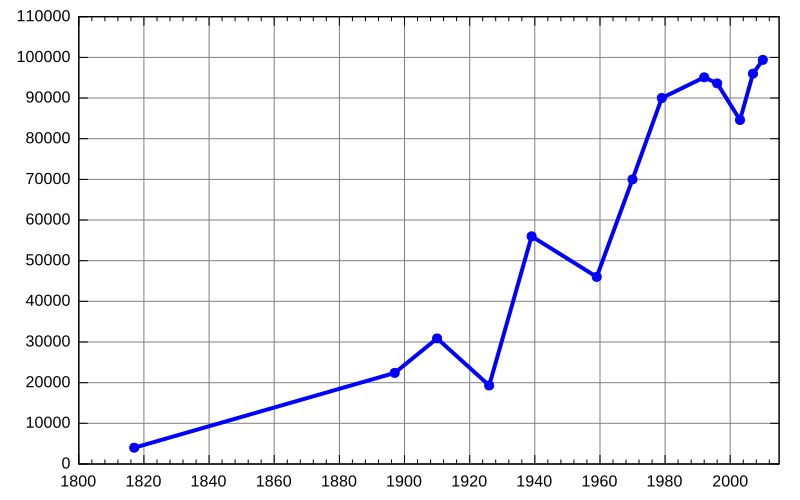
A line chart, also known as a line graph or curve chart, is a fundamental visualization tool that displays data points connected by straight line segments. Its primary function is to illustrate trends and changes over a continuous interval, most commonly time. By ordering data points chronologically and joining them, line charts transform raw numbers into easily digestible narratives of progress, decline, or fluctuation. They are ubiquitous across scientific research, financial analysis, business reporting, and everyday data interpretation, serving as a visual language for understanding complex patterns. The simplicity and clarity of line charts make them indispensable for identifying correlations, forecasting future movements, and communicating insights effectively to diverse audiences.
🎵 Origins & History
William Playfair, often hailed as the father of modern statistical graphics, demonstrated the power of visual data to convey complex economic trends through his charts. Over the subsequent centuries, the line chart evolved alongside statistical methodologies and advancements in printing and graphing technologies, becoming a standard tool in fields ranging from meteorology to economics.
⚙️ How It Works
At its core, a line chart operates by plotting data points on a two-dimensional Cartesian coordinate system. The horizontal axis (x-axis) typically represents an independent variable, most frequently time or a sequential category, while the vertical axis (y-axis) represents a dependent variable, such as temperature, stock price, or sales figures. Each data point, or marker, signifies a specific measurement at a given point on the x-axis. These markers are then connected by straight line segments, creating a visual path that highlights the rate and direction of change between consecutive points. The slope of these lines directly communicates the magnitude of change, making it easy to spot increases, decreases, and periods of stability.
📊 Key Facts & Numbers
Website analytics platforms like Google Analytics use line charts to track user traffic, page views, and conversion rates.
👥 Key People & Organizations
While the concept of graphical data representation predates specific individuals, William Playfair stands as a monumental figure for his systematic application and popularization of line charts in the late 18th century. Later, statisticians like Florence Nightingale utilized graphical methods, including early forms of line charts, to advocate for public health reforms, famously using her coxcomb diagrams to illustrate mortality rates during the Crimean War. In the digital age, developers at companies like Microsoft and Google have integrated line charting capabilities into spreadsheet software and data visualization tools, making them accessible to millions. The development of libraries such as Matplotlib in Python and D3.js in JavaScript has empowered countless data scientists and analysts, including figures like Hadley Wickham, to create sophisticated and interactive line-based visualizations.
🌍 Cultural Impact & Influence
The cultural footprint of the line chart is profound, embedding itself as a universal symbol for progress and data-driven insight. From news broadcasts illustrating economic indicators to scientific journals detailing experimental results, line charts have become the visual lingua franca of quantitative information. Their adoption in educational materials, starting from elementary school, instills an early understanding of data trends. The ubiquity of line charts in financial reporting, particularly for stock market performance, has shaped public perception of investment volatility and economic health. Even in popular culture, the visual representation of a rising or falling line is instantly understood as a metaphor for success or failure, demonstrating its deep integration into our collective consciousness.
⚡ Current State & Latest Developments
In the current digital landscape, line charts are more dynamic and interactive than ever. Platforms like Tableau and Microsoft Power BI allow users to create sophisticated, real-time line charts that update automatically with incoming data streams. The integration of line charts into web dashboards and business intelligence tools means that millions of professionals now monitor key performance indicators (KPIs) via live line graphs. Furthermore, advancements in machine learning are increasingly being used to forecast future data points on line charts, offering predictive insights for everything from sales forecasts to disease outbreaks. The development of libraries like Plotly enables the creation of interactive, web-based line charts that can be embedded in virtually any digital platform.
🤔 Controversies & Debates
Debates surrounding line charts often center on their potential for misinterpretation or oversimplification. A key controversy involves the manipulation of the y-axis scale; by stretching or compressing the vertical axis, a chart creator can exaggerate or minimize the apparent magnitude of change, leading to misleading conclusions. Critics also point to the risk of drawing causal inferences solely from correlation, a common pitfall when observing trends in time-series data. For instance, a spurious correlation might show a line chart of ice cream sales rising in tandem with drowning incidents, implying a connection where none exists, with both being driven by a third variable: hot weather. The choice of connecting points with straight lines, rather than smoothing them, can also be debated, particularly when dealing with noisy data where a smoothed trend might be more informative.
🔮 Future Outlook & Predictions
The future of line charts is inextricably linked to the evolution of data visualization and artificial intelligence. We can expect to see increasingly sophisticated interactive features, allowing users to drill down into specific data points, compare multiple series with greater ease, and even manipulate variables to see hypothetical outcomes. The integration of AI will likely lead to more intelligent forecasting capabilities embedded directly into line chart visualizations, providing automated insights and anomaly detection. Furthermore, as data becomes more complex and multidimensional, line charts may evolve to incorporate additional visual encodings, such as color, size, or animation, to represent more variables simultaneously without sacrificing clarity. The ongoing quest for more intuitive and impactful data communication will continue to drive innovation in how we draw and interpret these fundamental graphs.
💡 Practical Applications
Line charts are indispensable tools across a vast array of practical applications. In finance, they are used to track stock prices, currency exchange rates, and market indices, helping investors make informed decisions. Scientists employ them to visualize experimental results, track environmental changes like global temperatures or CO2 levels, and model complex phenomena. Businesses rely on line charts to monitor sales performance, website traffic, customer acquisition costs, and operational efficiency. Healthcare professionals use them to track patient vital signs, disease progression, and the effectiveness of treatments. Even in everyday life, people might use line charts to track personal fitness goals, budget expenditures, or project timelines, demonstrating their broad utility.
Key Facts
- Category
- technology
- Type
- topic